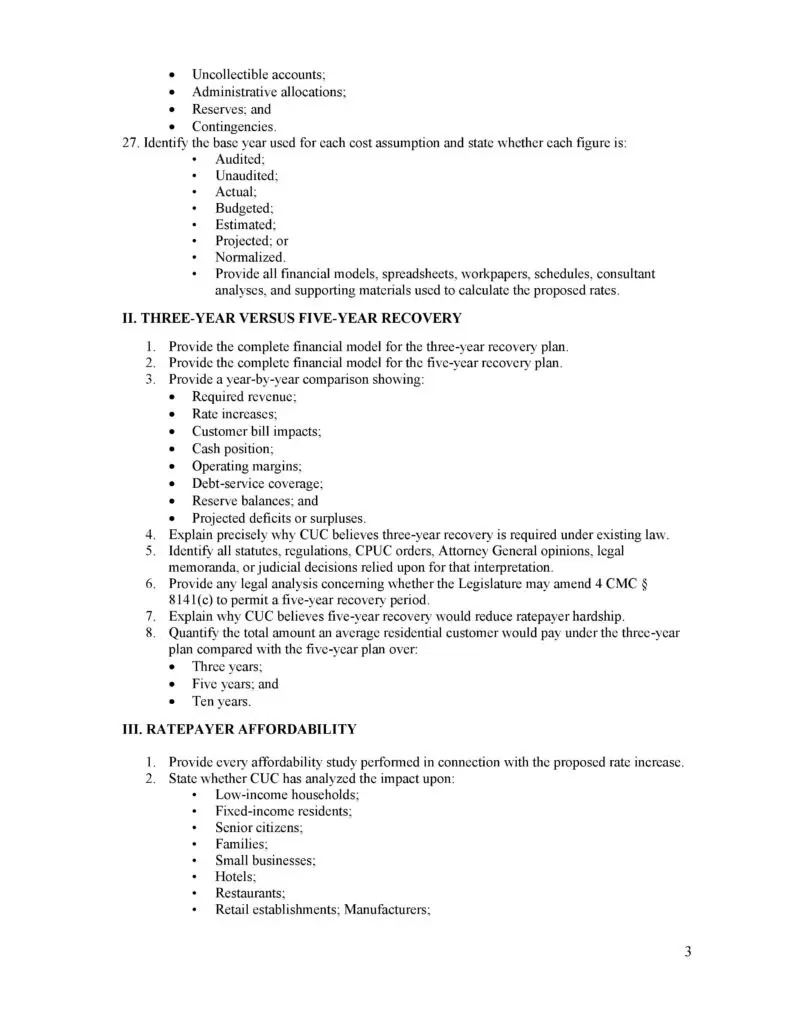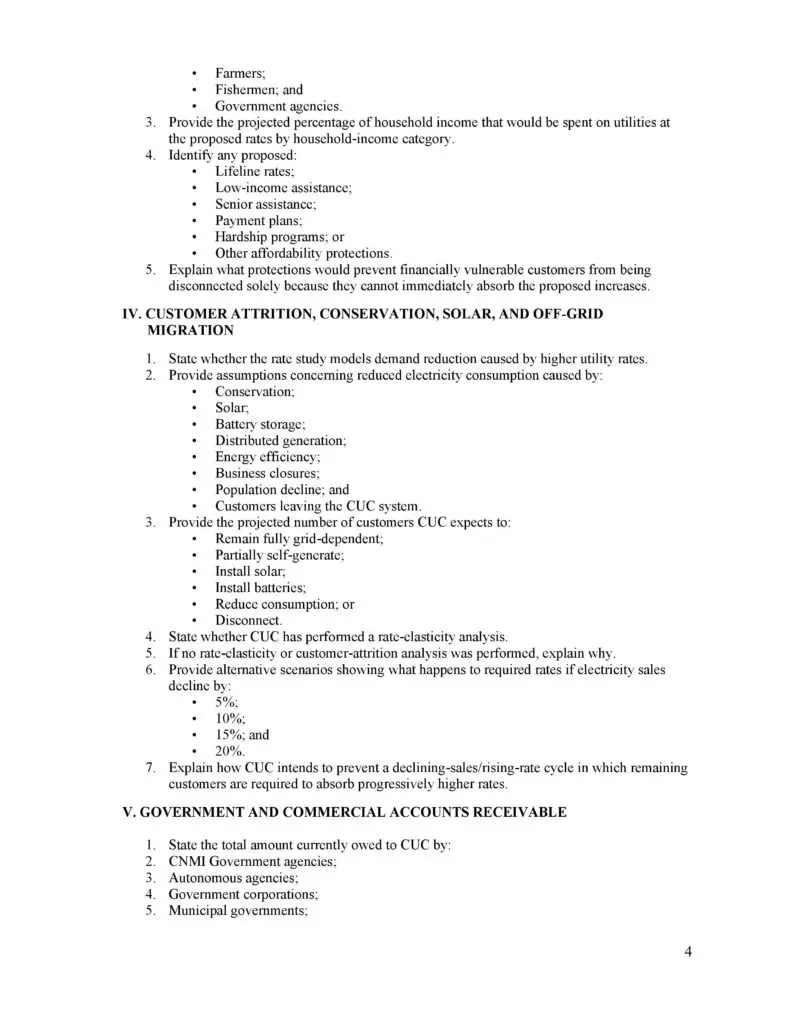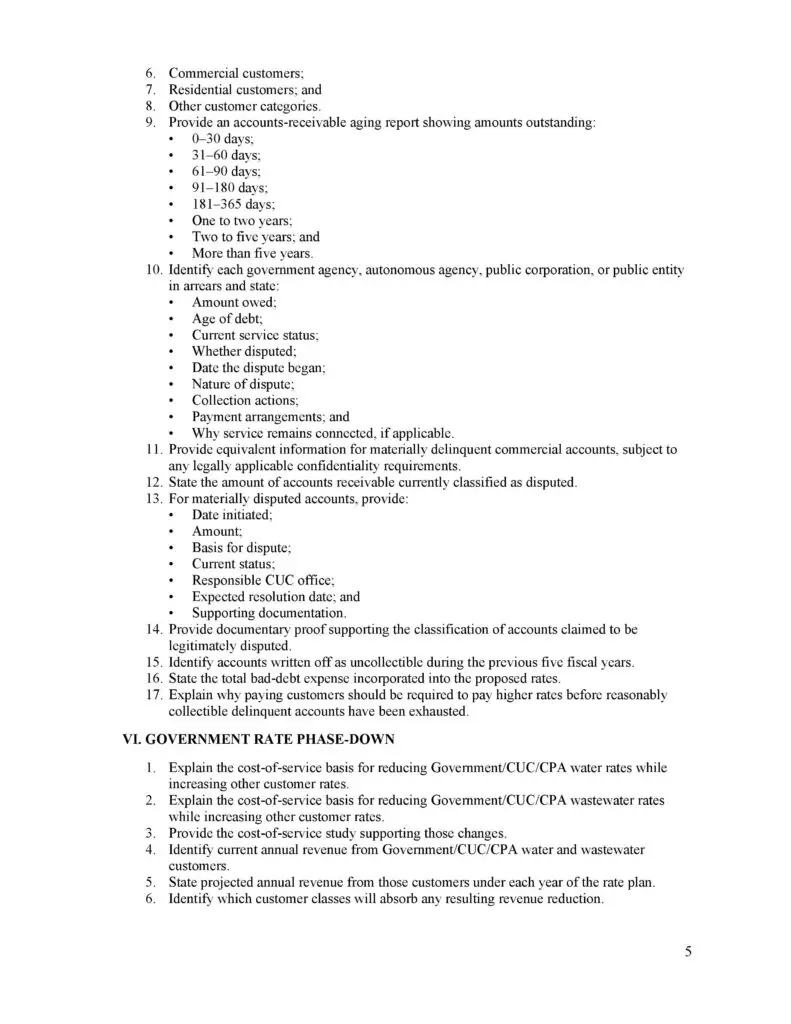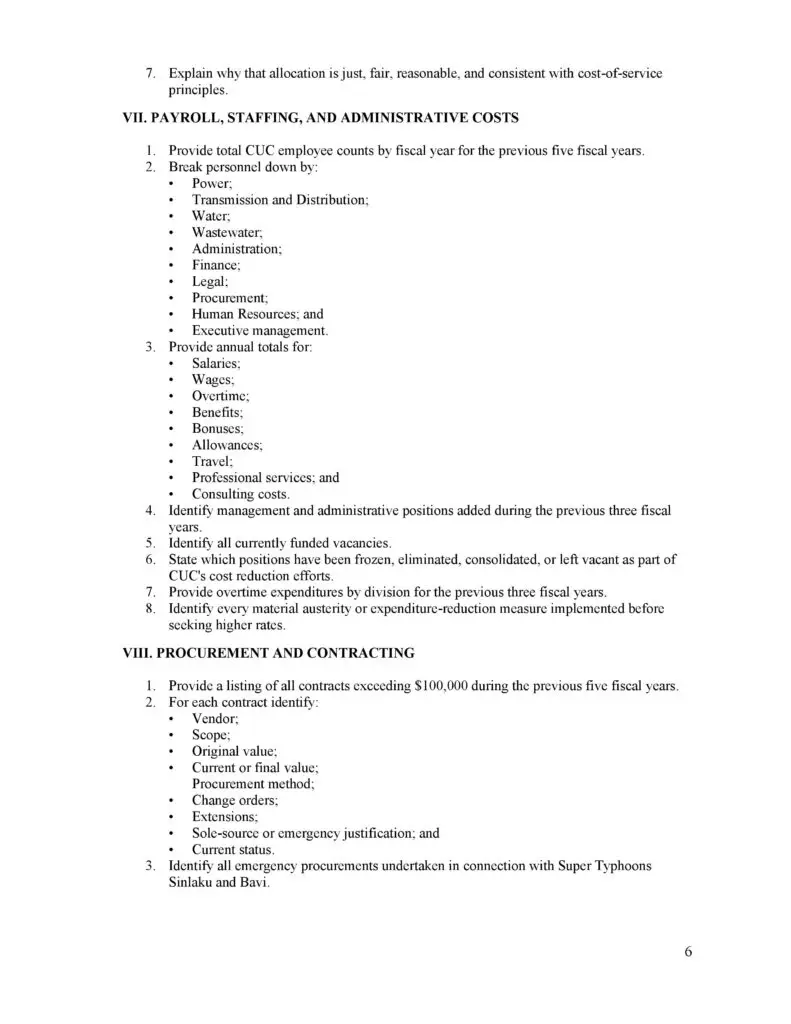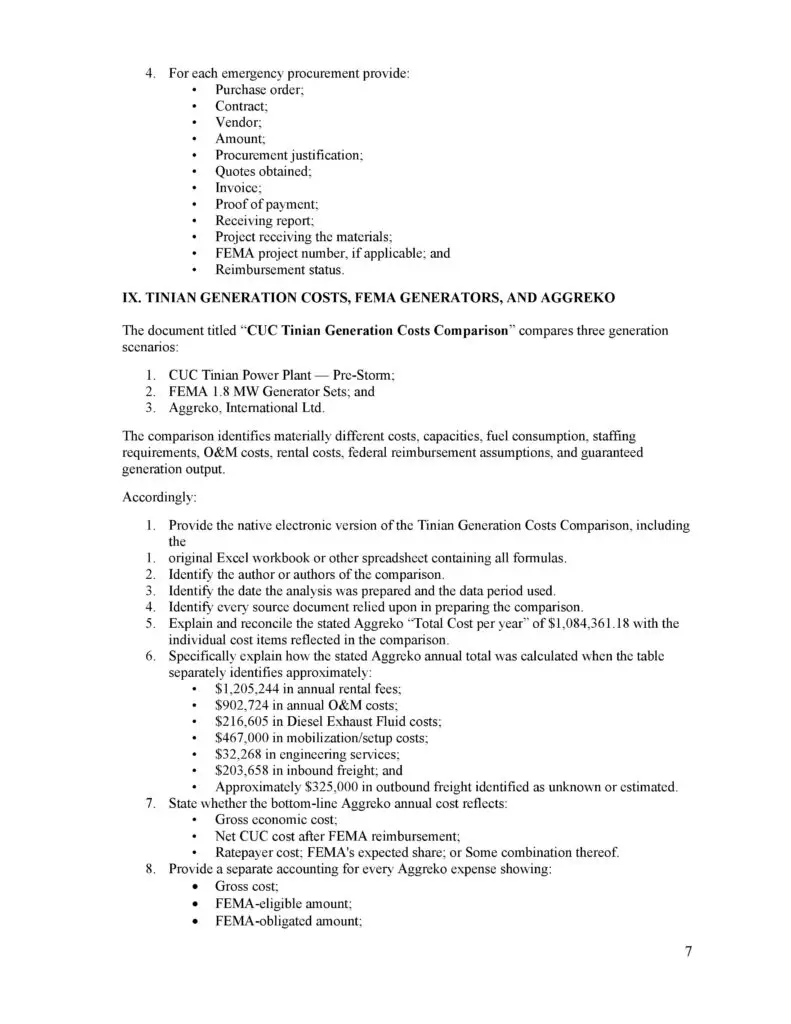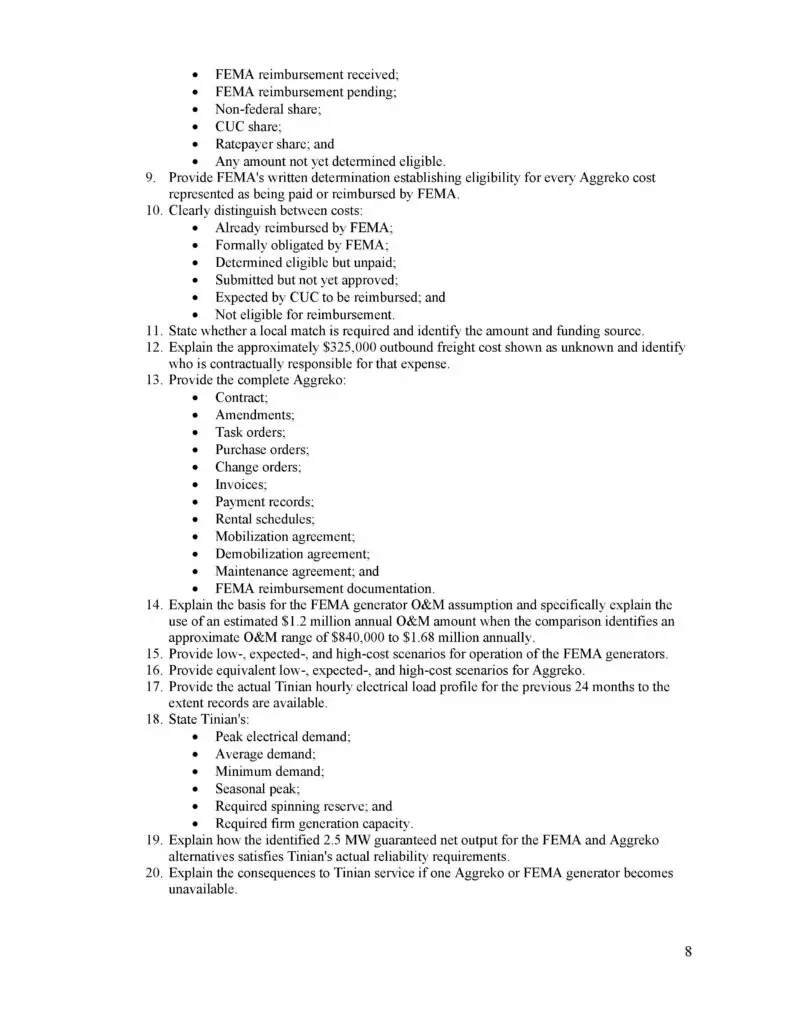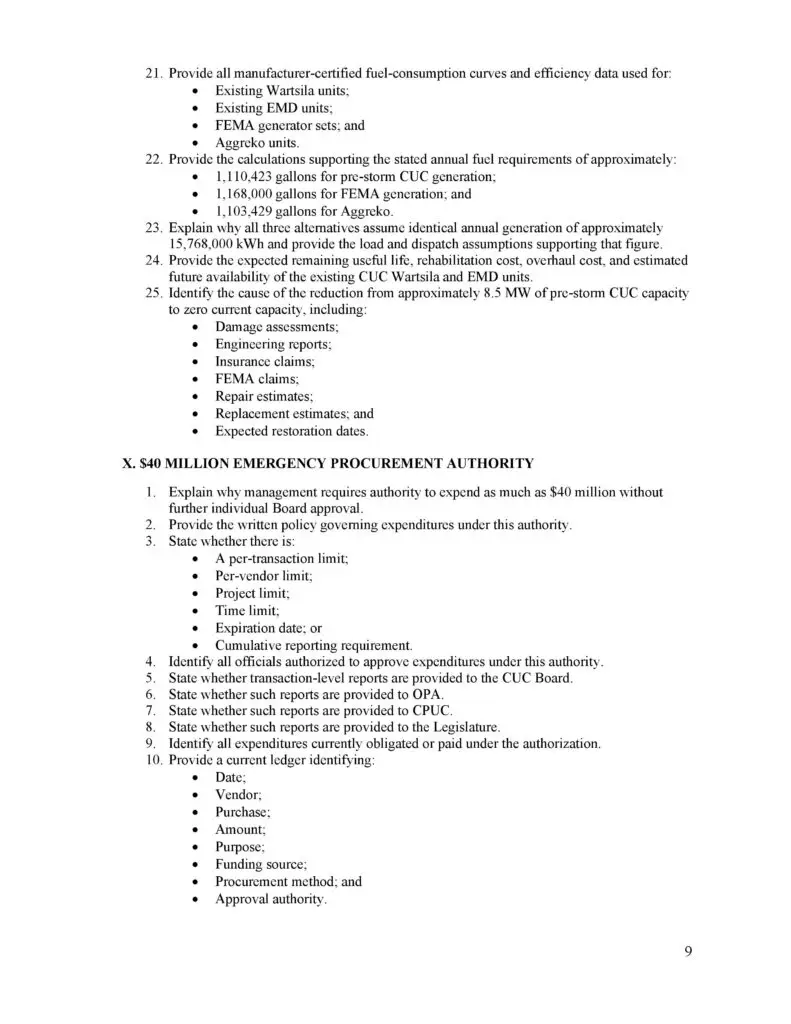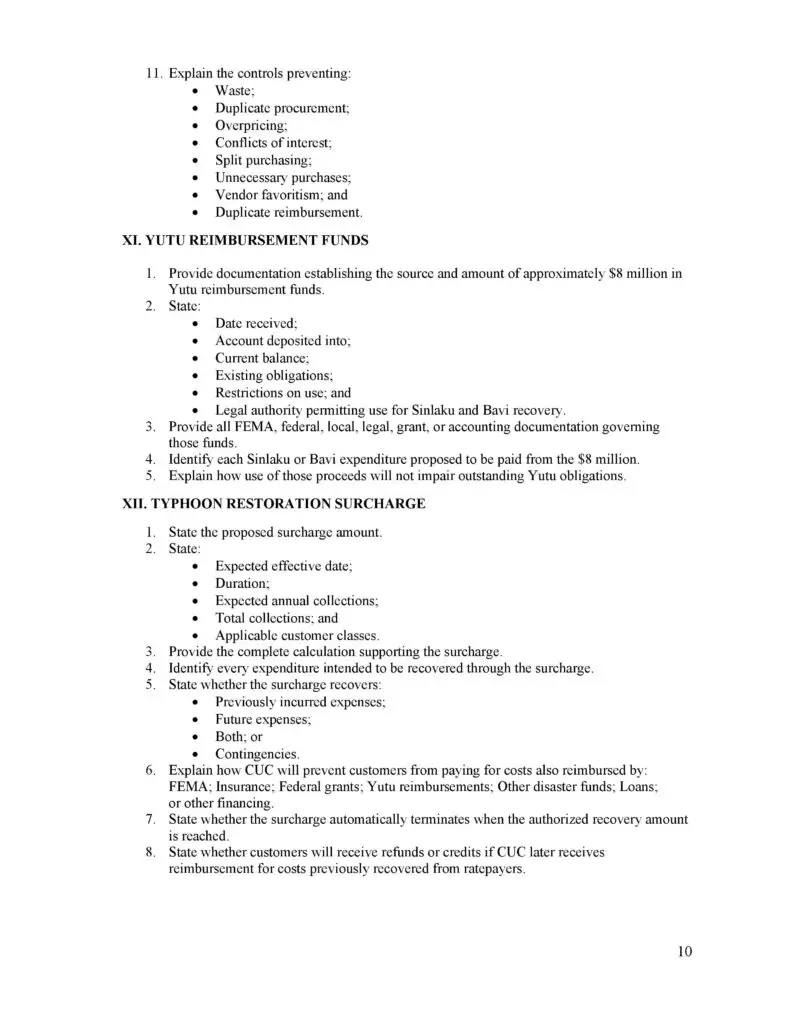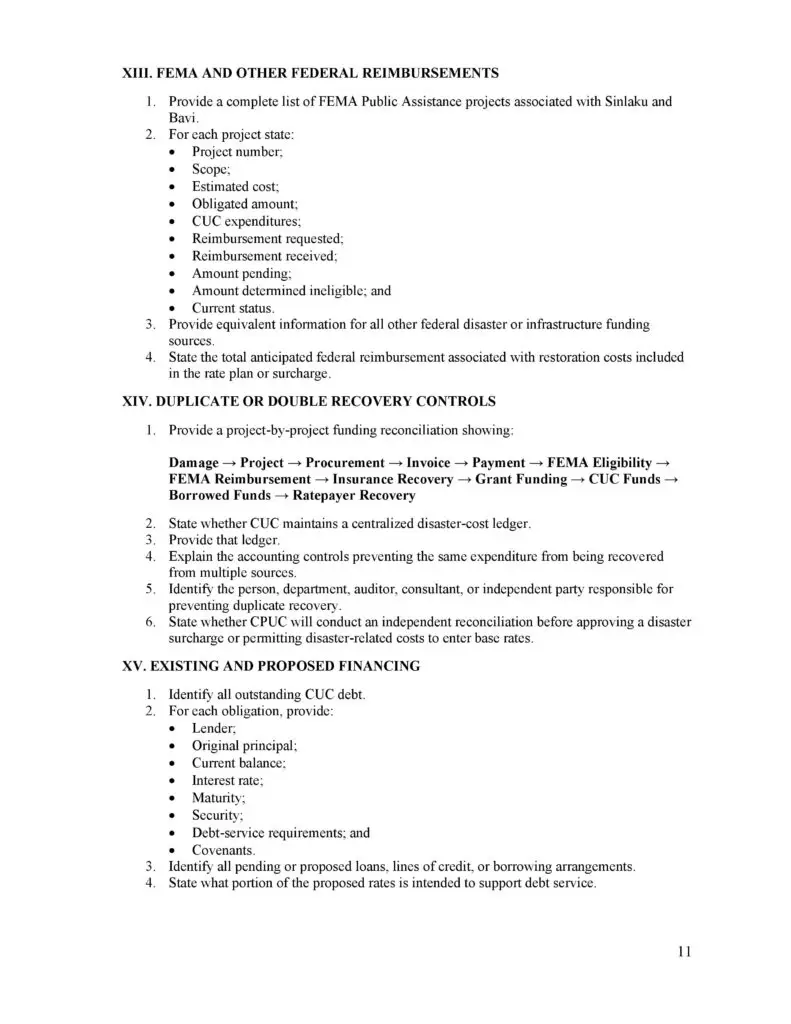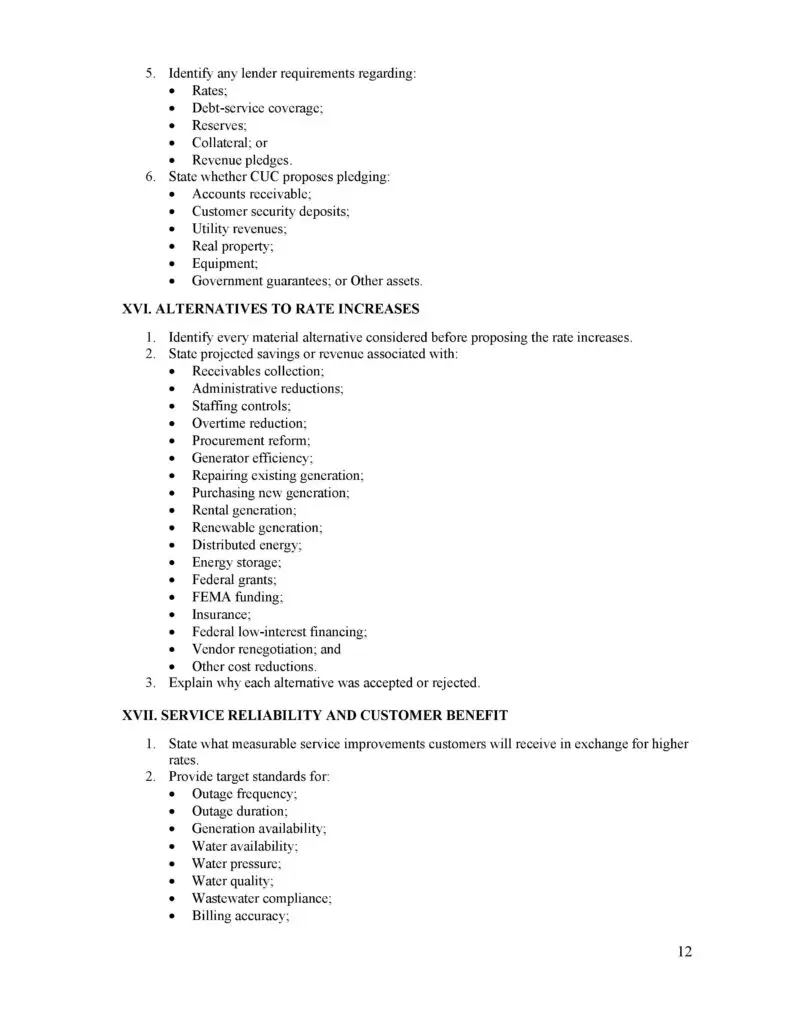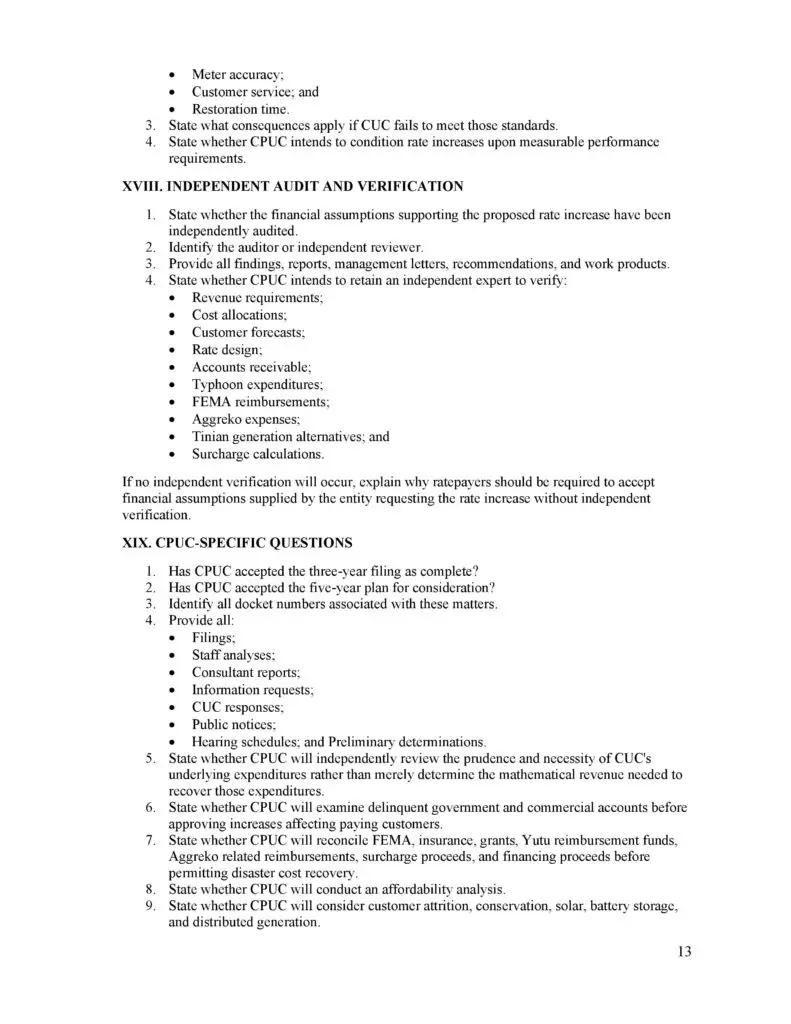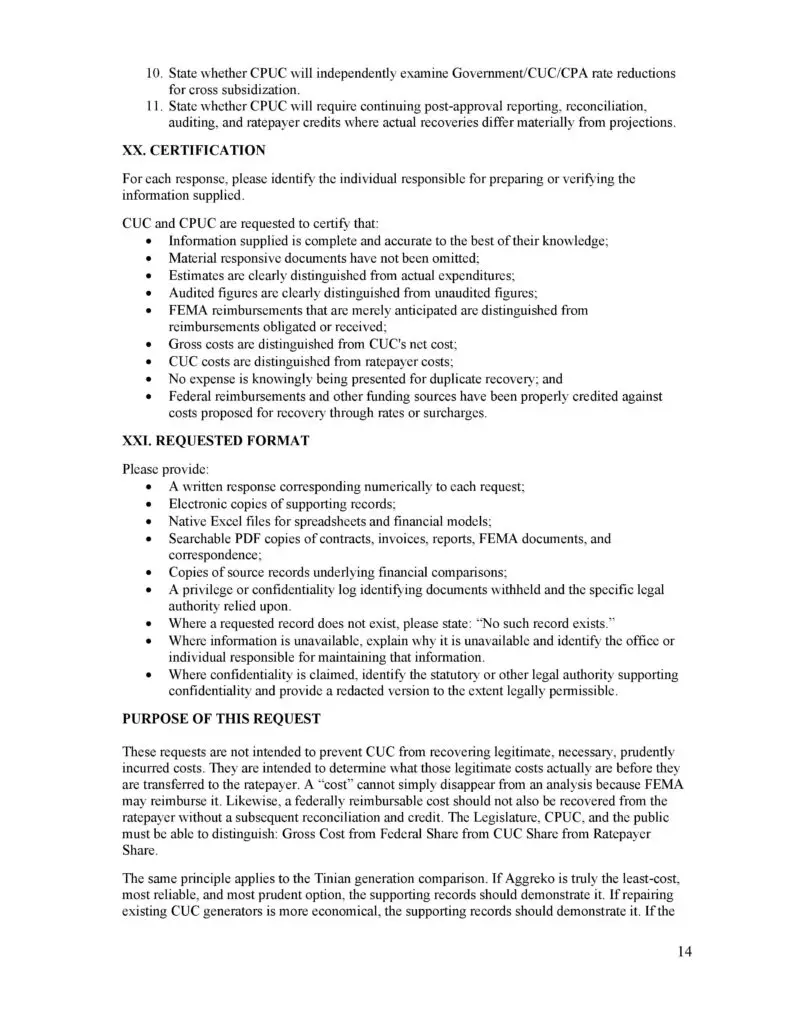


SAIPAN – Representative Vincent R. Aldan has served the Commonwealth Utilities Corporation and the Commonwealth Public Utilities Commission with a 15-page records demand covering every financial assumption behind CUC’s proposed rate recovery plans, the typhoon restoration surcharge and the Tinian generation arrangement, and warned that his committee is prepared to issue subpoenas if the response falls short.
The letter, dated August 20 and emailed to CUC Executive Director Kevin O. Watson, the CUC board and CPUC Chairman Jack Angelo, invokes the House Transportation and Infrastructure Committee’s oversight authority under Article II, Section 14(b) of the Commonwealth Constitution and 1 CMC § 1301, the statute governing legislative subpoenas. A footnote states that production of the records is required, not voluntary, and that the committee reserves the right to issue formal subpoenas duces tecum on a majority vote.
A subpoena duces tecum is a legal order requiring a person or organization to produce documents, records or other physical evidence, as opposed to an ordinary subpoena, which compels someone to appear and testify. The Latin phrase means “bring with you under penalty.” In the Commonwealth, 1 CMC § 1301 gives the Legislature and its committees the power to issue them, meaning a committee can compel CUC to hand over its financial models, contracts and invoices rather than simply request them. Ignoring one carries legal consequences, which is what separates Aldan’s letter from a routine information request.
Aldan chairs the committee. The letter follows his public statement last week calling for independent testing of the rate study’s assumptions before CPUC approves any increase.
The demand is organized into 21 sections. It asks for the complete financial models behind both the three-year and five-year recovery plans, a year-by-year comparison of bill impacts, every affordability study CUC has performed, and a rate-elasticity analysis showing what happens to required rates if electricity sales fall by 5, 10, 15 or 20 percent as customers conserve, install solar or leave the grid.
It also targets three actions the CUC board took at its August 13 meeting, according to the letter: authorizing about $8 million in Super Typhoon Yutu reimbursement funds for Sinlaku and Bavi recovery, authorizing management to petition CPUC for an additional typhoon restoration surcharge, and raising management’s emergency procurement authority from $15 million to as much as $40 million without further individual board approval.
On the $40 million authority, Aldan asks for the written policy governing it, whether there is any per-transaction, per-vendor or time limit, who can approve spending under it, whether transaction-level reports go to the board, the Office of the Public Auditor, CPUC or the Legislature, and a current ledger of everything obligated or paid so far.
A separate section takes apart a CUC document titled “CUC Tinian Generation Costs Comparison,” which weighs the pre-storm Tinian power plant against FEMA 1.8 megawatt generator sets and rental generation from Aggreko. Aldan asks CUC to reconcile the comparison’s stated Aggreko total of $1,084,361.18 a year with line items in the same table that he lists as roughly $1.2 million in annual rental fees, $902,724 in annual operations and maintenance, $216,605 in diesel exhaust fluid, $467,000 in mobilization, $203,658 in inbound freight and about $325,000 in outbound freight marked unknown or estimated. He asks whether the bottom line is a gross cost, a net cost after FEMA reimbursement, a ratepayer cost or some combination, and demands the native spreadsheet with its formulas.
The letter also asks CUC to explain the cost-of-service basis for reducing water and wastewater rates charged to the government, CUC and the Commonwealth Ports Authority while raising rates on other customers, and which customer classes would absorb the difference.
Other sections request a full accounts receivable aging report naming every government agency in arrears, five years of contracts over $100,000, every emergency procurement tied to Sinlaku and Bavi with invoices and FEMA project numbers, all outstanding and proposed debt, and a project-by-project reconciliation tracing each disaster cost from damage through FEMA reimbursement, insurance and ratepayer recovery to show no dollar is recovered twice.
Aldan wrote that the requests are not meant to stop CUC from recovering legitimate, prudently incurred costs, but to establish what those costs are before they are passed to ratepayers. “The conclusion should follow the evidence. The evidence should not be selected to support a predetermined conclusion,” he wrote.
The letter asks CUC and CPUC to certify that their responses are complete, that estimates are distinguished from actual expenditures and that anticipated FEMA reimbursements are distinguished from those obligated or received. It does not set a response deadline.
Copies went to the CPUC commissioners, the Office of the Public Auditor, the Office of the Attorney General and the committee’s members.