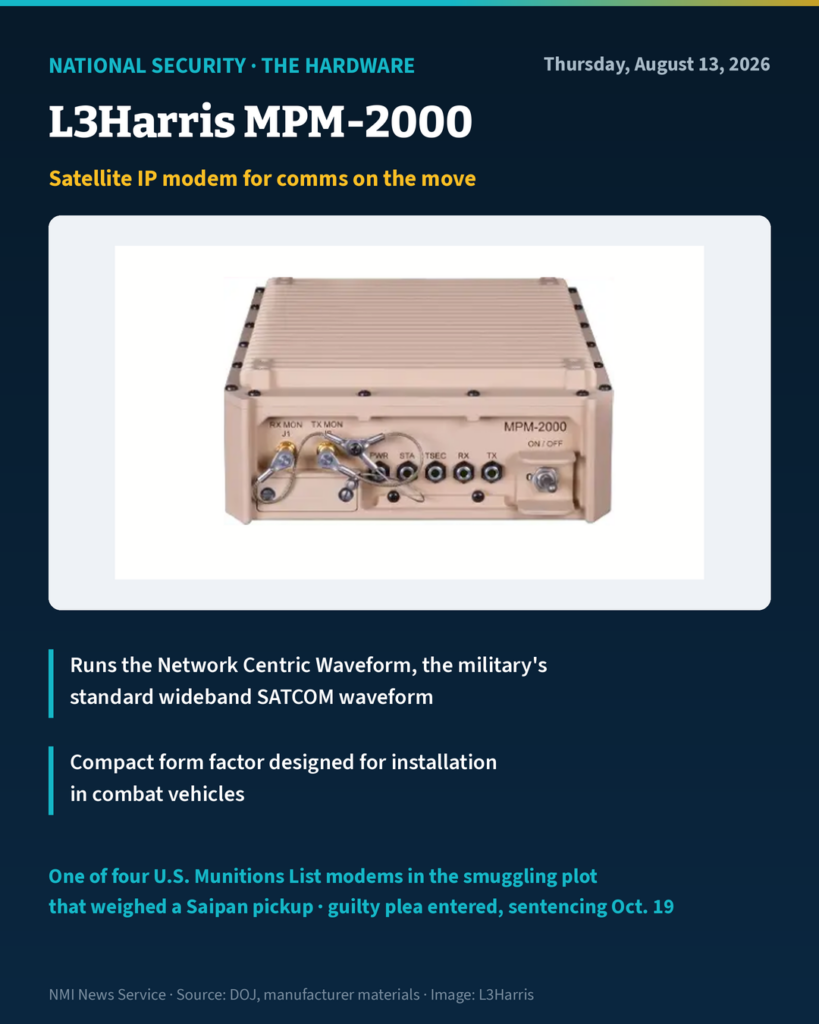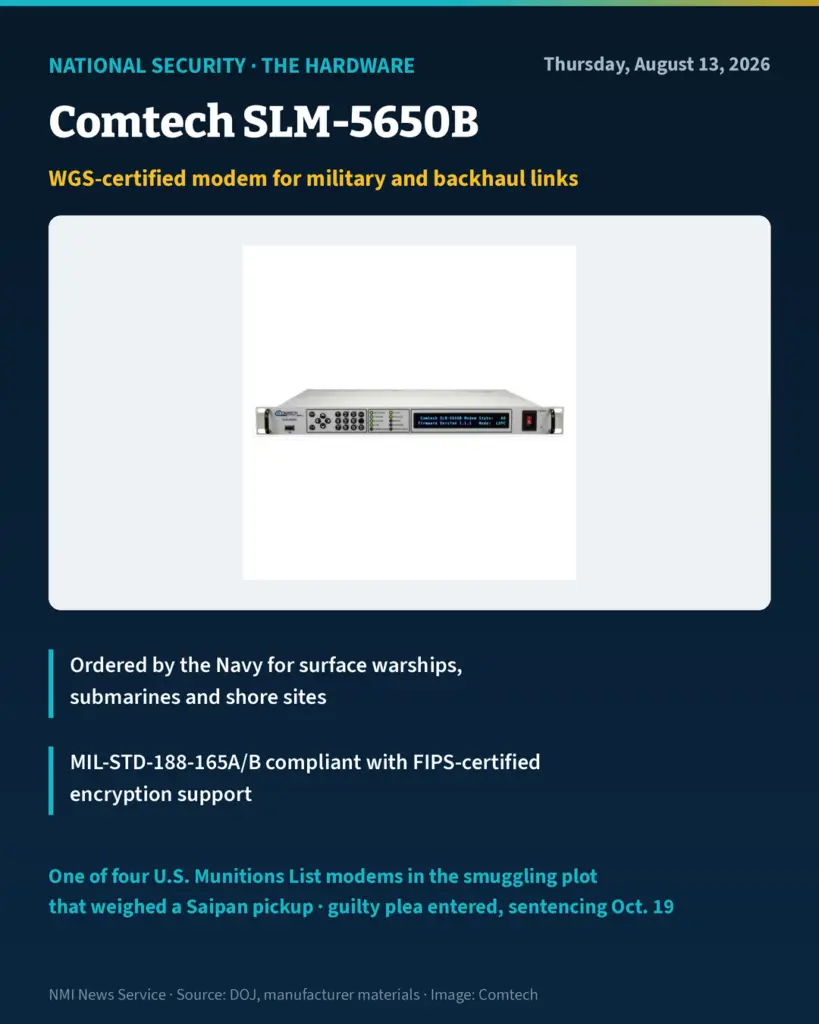
SAIPAN — A Chinese national whose plot to smuggle U.S. military communications equipment once ran through Saipan has pleaded guilty in federal court, the Department of Justice said.
Dingwei Chen, a 29-year-old citizen of the People’s Republic of China, pleaded guilty in Salt Lake City to violating the Arms Export Control Act. U.S. District Judge David Sam accepted the plea and set sentencing for Oct. 19. Chen faces a maximum of 20 years in prison.
Chen attempted to purchase military-grade satellite modems and radios manufactured for the U.S. military, hardware that cannot legally leave the United States without a State Department license that is generally not issued for military goods bound for China.
According to court records, Chen worked with others in China to acquire the equipment from foreign arms dealers on the black market, and the group weighed several routes for getting it out of the country. They first sought to transship the goods through Switzerland, then spoke about picking them up in Saipan, before finally deciding to smuggle the equipment through Mexico.
The Saipan discussions surfaced in the criminal complaint NMI News Service first reported in January. In encrypted messages quoted in that filing, Chen raised concerns about meeting on the island, telling an undercover agent “It’s still USA” and that the goods were illegal, at one point writing that Saipan “is not a safe place to meet.” The complaint identified the District of the Northern Mariana Islands as where the arrest warrant would be executed, and a DHS database query showed a person named Ding Wei Chen traveling to Saipan on Oct. 3, 2025, on an itinerary matching what he had told the undercover agent.
After an initial down payment of more than $40,000, Chen and his co-conspirators switched to cryptocurrency, paying roughly $30,000 in USDT toward the purchase of 10 modems and describing cold wallets as untraceable. Communicating over an encrypted app, Chen claimed the deal was only a beginning and that he had funding to buy tens of millions of dollars’ worth of additional military equipment.
“Chen tried to divert sensitive U.S. military technologies to the People’s Republic of China,” said Assistant Attorney General for National Security John A. Eisenberg, adding that the technologies could have been used against the United States in the future.
Acting Special Agent in Charge Spiros Karabinas of Homeland Security Investigations New Jersey said the plea underscores the consequences for those who attempt to illegally export sensitive U.S. military equipment, and credited collaboration between HSI offices across the United States and its territories and the Defense Criminal Investigative Service. DCIS Director James R. Ives said safeguarding advanced communication systems is critical to the troops who rely on them.
The modems identified in the January complaint included models made by L3Harris, Viasat and Comtech, all items on the U.S. Munitions List. The case is being prosecuted by Trial Attorney Christopher Magnani of the National Security Division’s Counterintelligence and Export Control Section.