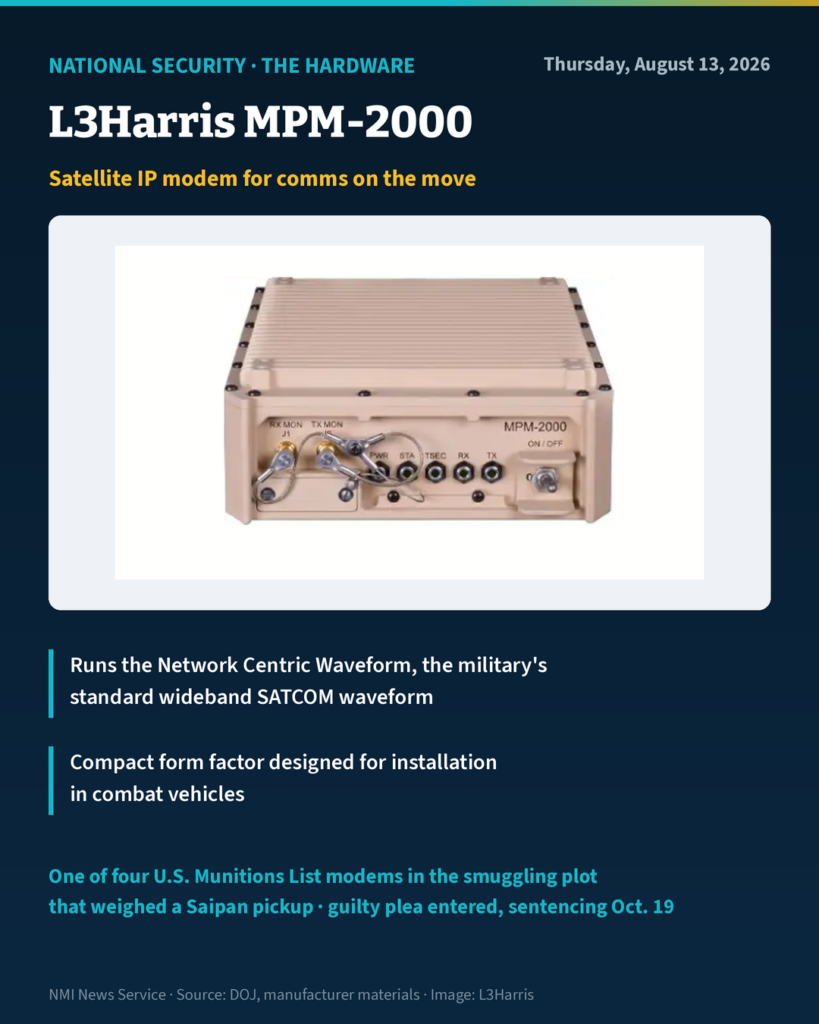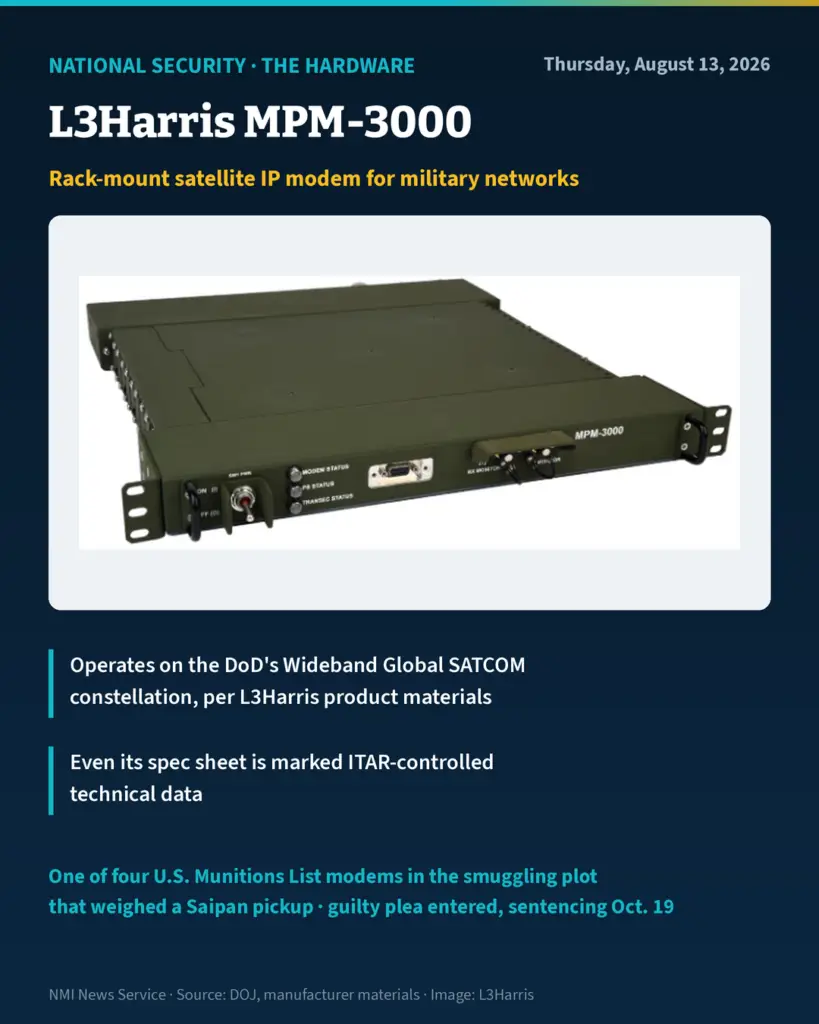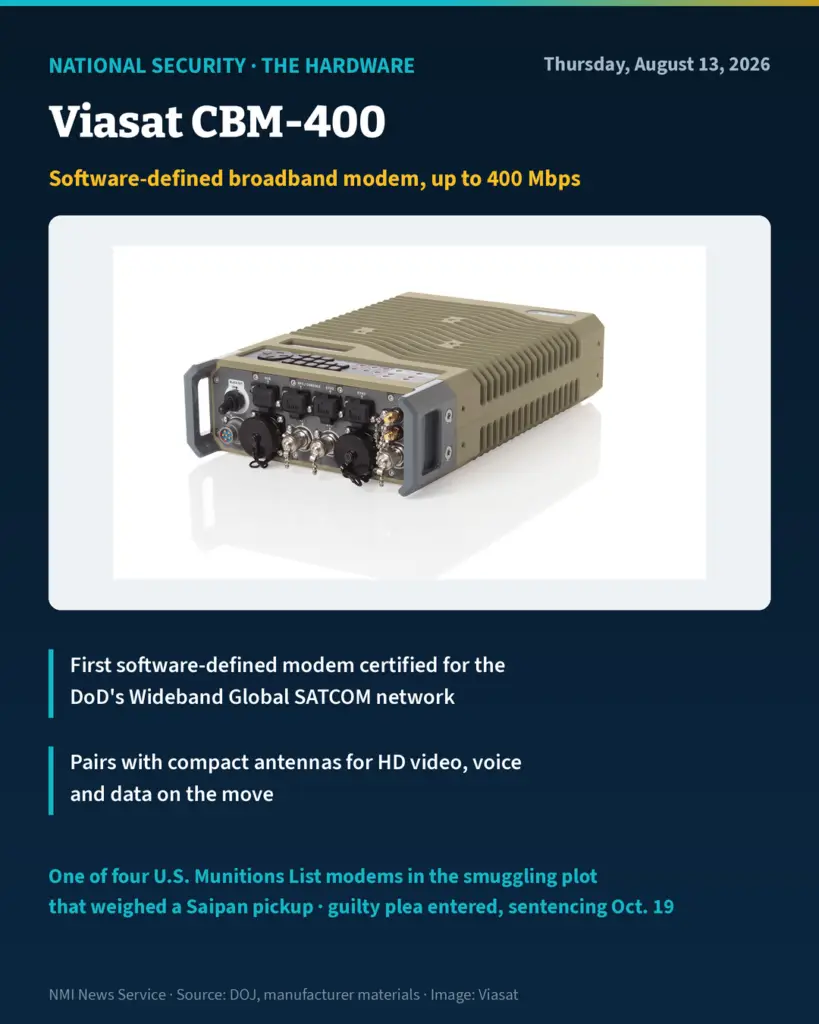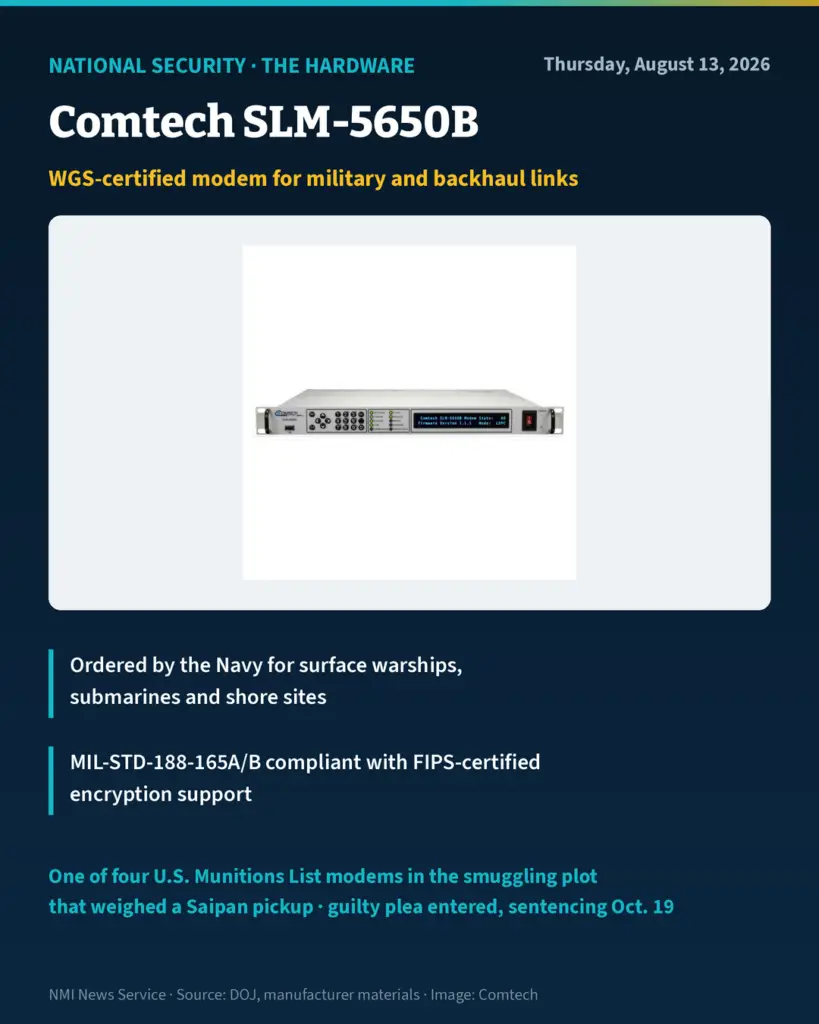
SAIPAN — The hardware at the center of the export case that once ran through Saipan looks unremarkable: four metal boxes, some small enough to bolt into a vehicle, others built for a server rack. What they do explains why federal prosecutors treated the plot as a national security case.
All four devices named in the criminal complaint are satellite modems, the equipment that connects military terminals to communications satellites, and all four sit on the U.S. Munitions List, which restricts their export under the Arms Export Control Act. L3Harris marks even the sales sheet for one of them as controlled technical data under ITAR, the International Traffic in Arms Regulations, meaning the paperwork describing the device is restricted, not just the device itself.
The L3Harris MPM-2000 is a satellite IP modem built for communications on the move. According to L3Harris product materials, it delivers full-mesh, satellite-on-the-move networking in a compact form factor designed to be installed in combat vehicles, running the Network Centric Waveform, the standard wideband satellite communications waveform for tactical military operations. The Army has weighed the MPM-2000 among the modems connecting its mounted, beyond-line-of-sight communications programs.
Its rack-mounted sibling, the L3Harris MPM-3000, is a drop-in satellite IP modem that operates on the Defense Department’s Wideband Global SATCOM constellation, the multi-beam, multi-band satellite network that carries much of the U.S. military’s wideband traffic.
The Viasat CBM-400 is a software-defined broadband modem. In 2019 it became the first software-defined modem to complete the Army Forces Strategic Command certification process, which at the time made it the only software-defined modem authorized to operate on the Wideband Global SATCOM network for Defense Department customers, according to the company. The modem delivers speeds up to 400 Mbps and can pair with ultra-compact antennas on ground vehicles or aircraft to move HD video, voice and data on the move.
The Comtech SLM-5650B is a WGS-certified modem built for critical government, military and commercial backhaul applications, compliant with military standard MIL-STD-188-165A/B and supporting FIPS 140-2 certified encryption, according to Comtech’s product documentation. It is not exotic gear gathering dust: the Naval Information Warfare Systems Command has ordered SLM-5650B modems and upgrades worth millions of dollars for surface warships, submarines and shore sites.
The common thread is the Wideband Global SATCOM network itself. Three of the four devices are certified for or designed to operate on WGS, the satellite backbone that connects U.S. forces across air, land and sea. Hardware built to talk to that network in adversary hands is precisely what export-control law exists to prevent, and equipment on the Munitions List cannot leave the United States without a State Department license that is generally not issued for military goods bound for China.
That is the context for the Justice Department’s response to the plea. Assistant Attorney General John A. Eisenberg said Chen tried to divert sensitive U.S. military technologies to the People’s Republic of China and that the technologies could have been used against the United States in the future. Dingwei Chen faces up to 20 years at his Oct. 19 sentencing.