By Gregorie Michael Towai (Eipéráng)
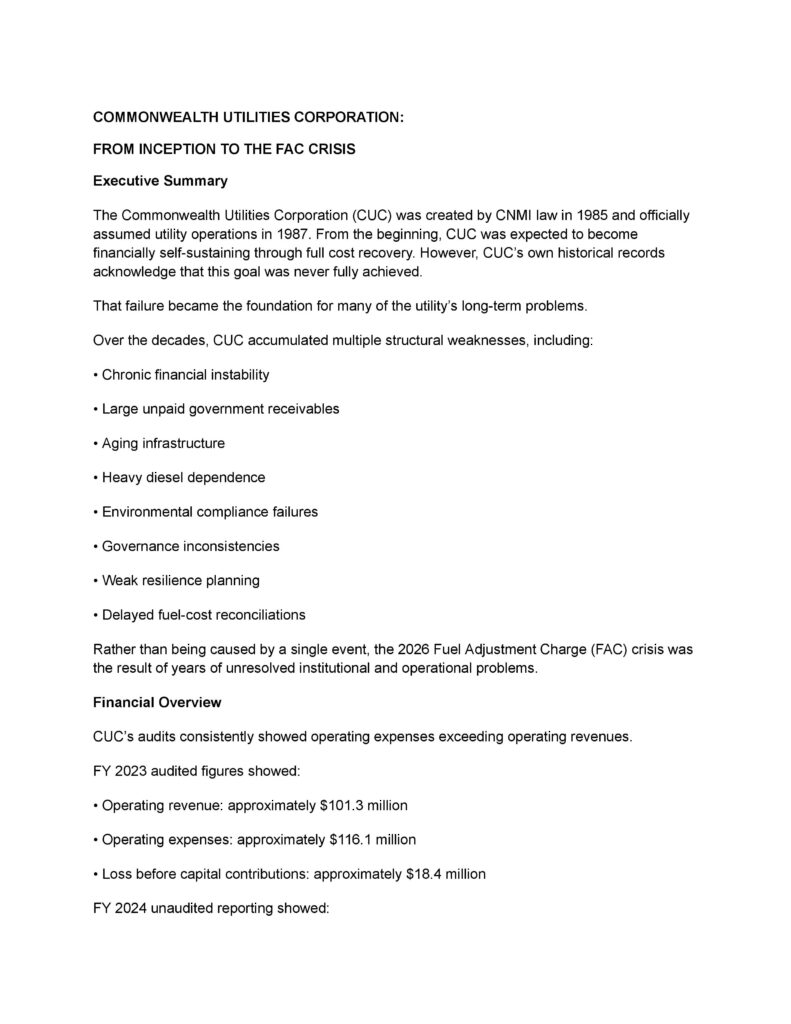
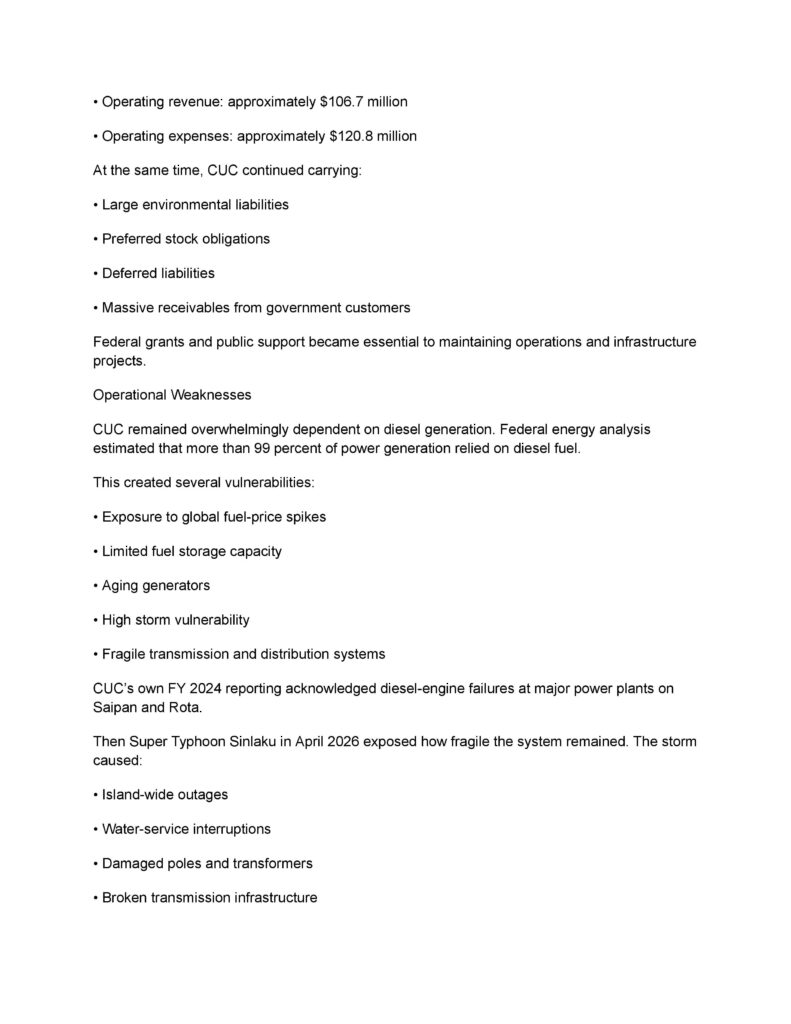
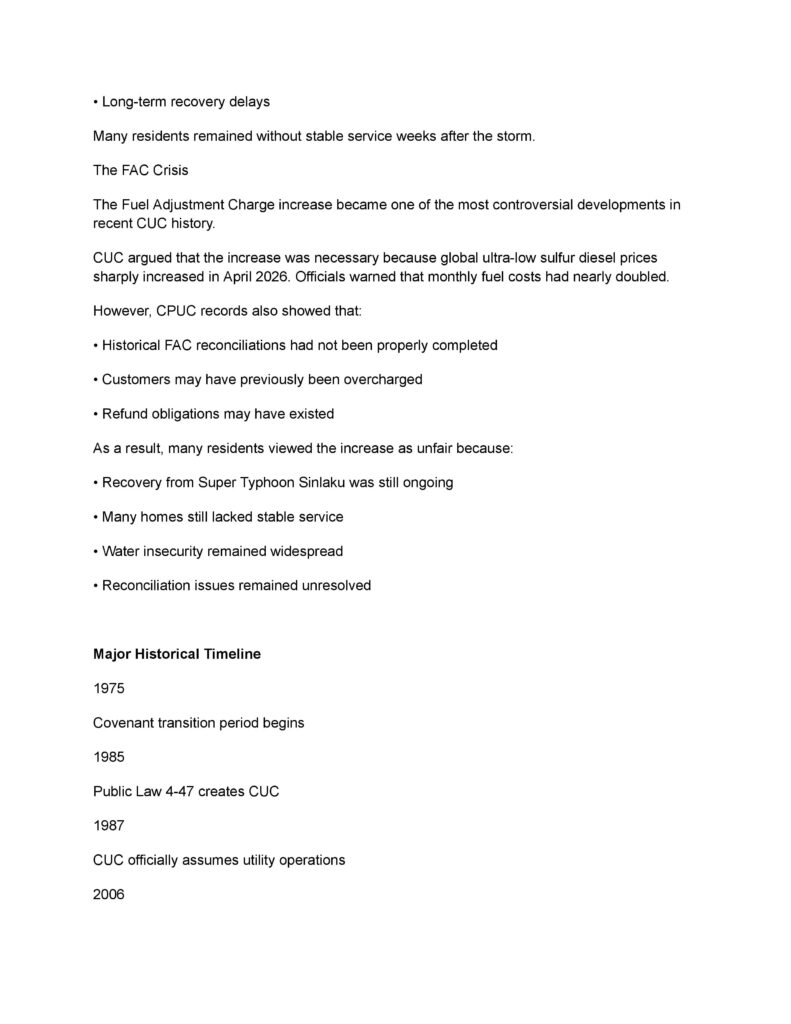
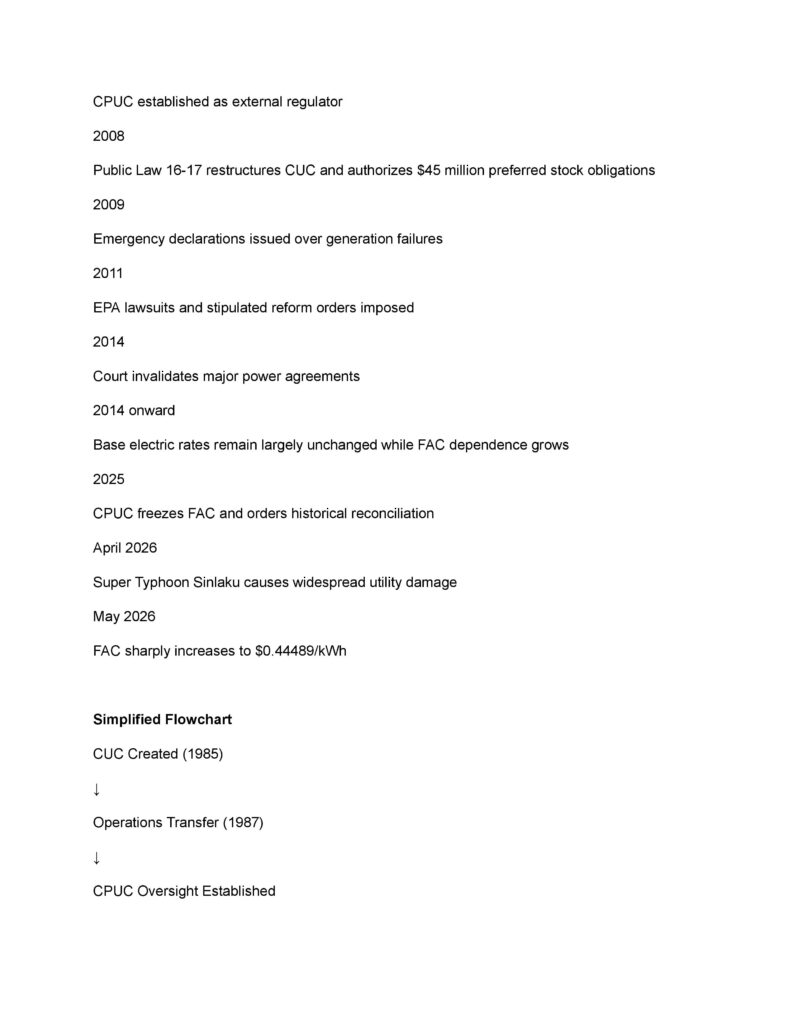
After spending the past week conducting an in depth study of the Commonwealth Utilities Corporation from its inception to the present day, reviewing its historical structure, recurring crises, operational patterns, fuel dependency, infrastructure vulnerabilities, and decades of public frustration, I came to one deeply troubling conclusion:
One of the most dangerous things that can happen to a society is not the crisis itself.
It is when the crisis becomes normal.
When children grow up assuming power outages are simply part of island life. When families instinctively buy generators before furniture. When businesses calculate losses from outages into their normal operating expectations. When disaster preparedness stops feeling temporary and starts becoming permanent lifestyle adaptation.
That is when instability quietly embeds itself into the culture.
And over time, people stop asking whether things should function better at all.
The recent Fuel Adjustment Charge increase is not just about electricity rates. It reflects something much deeper that many people across the Commonwealth are feeling but may struggle to articulate:
Fatigue.
Not simply financial fatigue. Not simply disaster fatigue.
System fatigue.
The exhaustion that comes from constantly adjusting your life around uncertainty.
People in the CNMI have become extraordinarily resilient, but resilience can sometimes become a double edged sword. The more adaptable a population becomes, the easier it is for dysfunctional systems to survive without truly changing.
Island communities become experts at improvisation. Families learn to stretch every dollar. Neighbors share resources. People develop backup plans for their backup plans.
And while these traits reflect strength, they can also unintentionally mask the seriousness of long term structural problems because communities keep finding ways to survive despite them.
But survival should not be mistaken for sustainability.
A modern society cannot continue functioning indefinitely on improvisation alone.
At some point, governments must transition from emergency response thinking into long horizon planning. Not simply reacting to the next storm, the next fuel spike, or the next infrastructure failure, but designing systems that reduce the likelihood of recurring crises altogether.
Across the Pacific and throughout the world, island jurisdictions are already beginning to rethink what resilience actually means in the twenty first century.
Resilience is no longer just about recovery.
It is about continuity.
Can communications remain functional after disasters? Can decentralized systems keep portions of communities operational? Can infrastructure failures be isolated rather than collapsing entire grids? Can governments coordinate rapidly through modern digital systems? Can schools, clinics, and emergency shelters operate independently when centralized systems fail?
These are no longer futuristic questions. They are modern governance questions.
And increasingly, younger generations are beginning to notice the gap between what is possible elsewhere and what has become normalized at home.
That realization matters.
Because perhaps the greatest risk facing the CNMI is not only economic stagnation or infrastructure vulnerability, but the gradual normalization of lowered expectations itself.
A society that begins expecting dysfunction eventually stops demanding excellence.
That is dangerous for any democracy.
The Commonwealth has talented engineers, planners, tradesmen, entrepreneurs, educators, public servants, and young people capable of helping shape a more resilient future. What has often been missing is not intelligence or capability, but long term continuity of vision beyond election cycles, political divisions, and reactive policymaking.
The CNMI does not lack potential.
It lacks systems designed with future pressures in mind.
Climate pressures will intensify. Global fuel markets will remain volatile. Supply chains will continue facing geopolitical disruptions. Pacific islands will increasingly face strategic competition, environmental uncertainty, and economic instability simultaneously.
These are not temporary conditions anymore. They are defining realities of the era ahead.
Which means the conversation can no longer remain limited to short term fixes every time another crisis emerges.
The larger question now is this:
What kind of future are we normalizing for the next generation?
One where instability is accepted as unavoidable? Or one where island communities begin demanding infrastructure, governance, and long term planning that reflects the realities of the modern Pacific?
Because eventually every society reaches a crossroad where it must decide whether resilience simply means enduring hardship or finally building systems that reduce it.
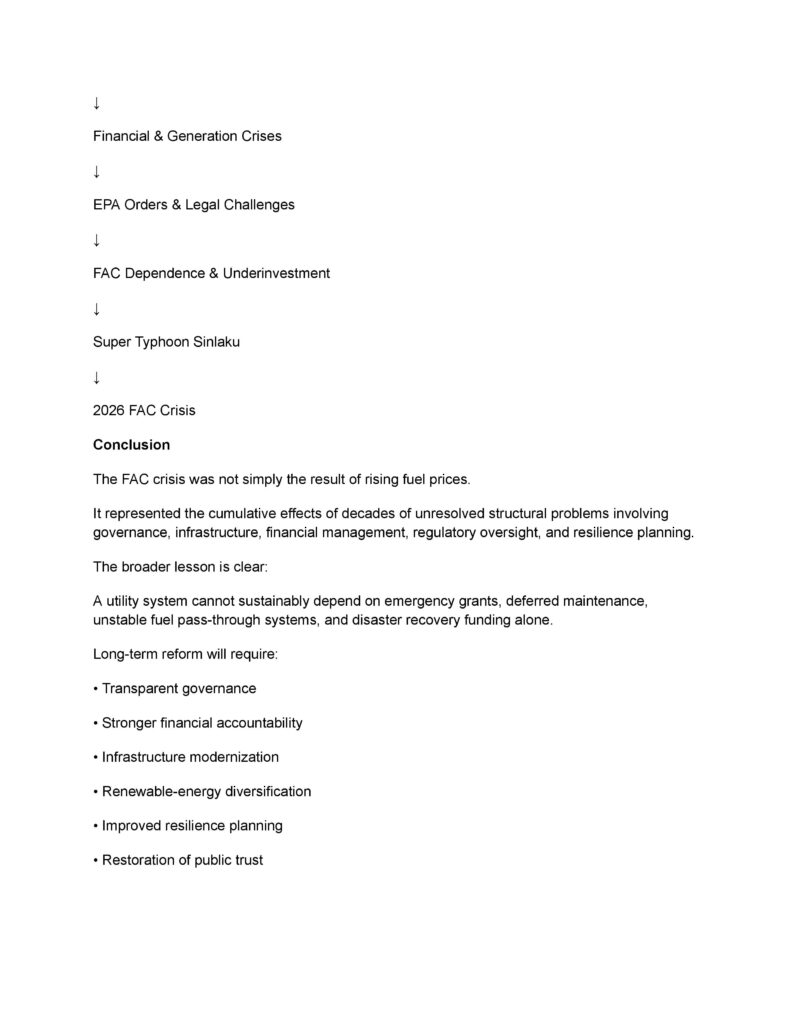
The Commonwealth may be approaching that moment now. Read my comprehensive research findings attached and decide for yourself.
Gregorie Michael Towai (Eipéráng) is a CNMI born independent researcher, cultural advocate, and founder of the Refaluwasch Journal of Knowledge and Culture (RJKC). His work focuses on Pacific governance, resilience, Indigenous stewardship, and sustainable futures for island communities.
The views expressed in this op-ed are those of the author and do not necessarily reflect the views of NMI News Service. NMI News Service welcomes op-ed submissions from the community. To submit, email brad.ruszala@nminewsservice.com.