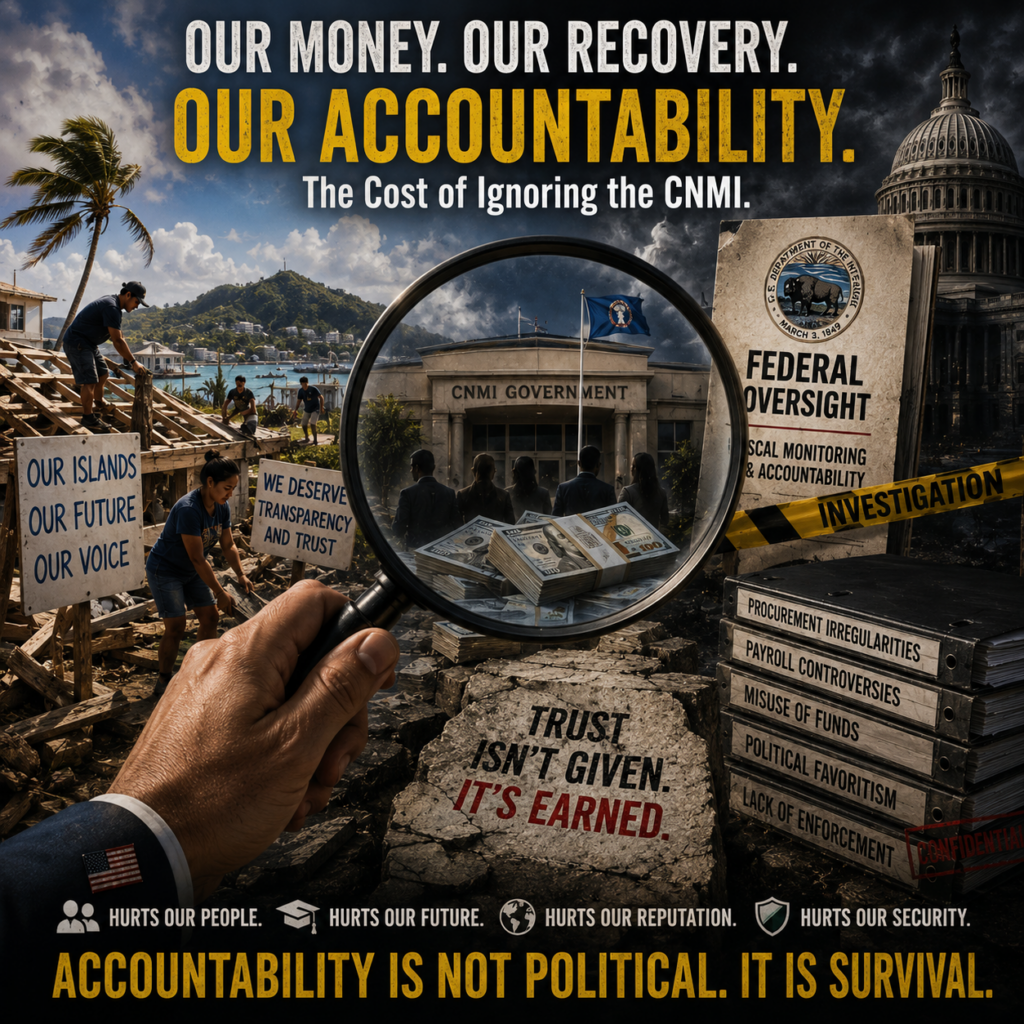
By now, many in the Commonwealth of the Northern Mariana Islands have seen the reports and social media discussions surrounding the reported arrival of U.S. Department of the Interior officials to oversee and monitor portions of federal disaster recovery funding entering the CNMI after Super Typhoon Sinlaku.
If true, this is not a small administrative adjustment. It is a profound statement.
It is Washington acknowledging, whether quietly or reluctantly, that confidence in the CNMI government’s ability to independently manage massive inflows of federal money has eroded to the point that direct oversight is now considered necessary.
That should alarm every resident of these islands regardless of political affiliation.
For years, many in our community have warned that the CNMI was drifting toward this exact moment. Concerns over accountability, transparency, procurement practices, payroll controversies, political favoritism, misuse of funds, lack of enforcement and the normalization of questionable governance practices were repeatedly raised by citizens, educators, former officials, activists, journalists and community advocates. Too often those voices were dismissed as political, divisive or inconvenient.
Now federal intervention itself appears to be validating what many residents already knew.
The tragedy is that this moment comes not during prosperity, but during recovery.
Families across Saipan, Tinian and Rota are still rebuilding from destruction. Some lost homes. Others lost businesses, vehicles, savings, crops and stability. Many remain psychologically exhausted from the repeated cycle of disaster, neglect, promises and disappointment. Federal recovery money was supposed to represent relief and hope. Instead, discussions are now centered around whether the money itself can even be trusted to reach the people who need it most without extraordinary oversight.
That is devastating for public trust.
What many leaders also fail to understand is that this situation is no longer confined to local politics or island gossip. The world is now watching the CNMI.
International analysts, defense observers, policy researchers, journalists, investors, diaspora communities and geopolitical commentators are increasingly paying attention to the Marianas because the CNMI now sits at the center of larger Indo Pacific strategic discussions involving the United States, China, military expansion, critical infrastructure, subsea cables, supply chains and ocean governance.
When stories about corruption, financial instability and federal intervention begin circulating globally alongside discussions about strategic military importance, it changes how the CNMI is perceived internationally. The islands are no longer viewed simply as a small remote territory dealing with local governance issues. The CNMI is now being examined as a test case for whether the United States can responsibly manage stability, governance and public trust in one of the most strategically important regions in the Pacific.
That carries enormous consequences.
Reputation matters. Investor confidence matters. Regional credibility matters. The ability for Pacific Islanders to advocate for themselves with dignity matters.
Right now, many outside observers are beginning to associate the CNMI not with its people, culture, resilience or history, but with scandal, dysfunction and federal concern over financial oversight. That is deeply unfair to the many honest and hardworking people across these islands, but perception becomes reality when institutions fail to inspire confidence.
What makes this even more painful is the geopolitical reality surrounding the CNMI today. Washington increasingly describes the Marianas as strategically indispensable to American national security in the Indo Pacific. Military expansion accelerates. Infrastructure discussions intensify. Billions are discussed in defense posture and regional competition. Yet while the islands are treated as strategically vital land, the people themselves often feel politically invisible.
You cannot claim the Marianas are critical to national security while allowing systemic instability, weak accountability and public distrust to deepen at the local governance level.
Real security is not only military. It is institutional trust. It is functioning infrastructure. It is reliable healthcare. It is affordable utilities. It is transparent governance. It is a population that believes public institutions work for them instead of against them.
Federal oversight arriving in the CNMI may reassure some Americans on the mainland that taxpayer dollars are finally being watched more carefully. But for many people here, it represents something far more humiliating: confirmation that our government has become associated nationally and internationally with dysfunction, corruption and financial risk.
That reputation hurts everyone.
It hurts honest public servants trying to do their jobs correctly. It hurts teachers already struggling under an overburdened system. It hurts local businesses trying to attract investment. It hurts young people deciding whether they still have a future here. It hurts our ability to advocate for ourselves internationally as Pacific peoples deserving dignity, partnership and self determination.
At the same time, accountability itself should not be feared.
If there has been waste, abuse, fraud, favoritism or exploitation of disaster recovery systems, then those matters should be investigated thoroughly and independently regardless of who is implicated. The people of the CNMI deserve clarity. They deserve transparency. They deserve to know where public money went, who benefited, who approved decisions and whether the systems meant to protect the public were functioning at all.
Oversight without consequences changes nothing.
And yet accountability must also be fair. The CNMI should not become a convenient caricature for mainland narratives about corruption in the territories while larger structural realities are ignored. Decades of dependency, federal inconsistency, economic collapse after federal policy changes, military driven land pressures, disaster vulnerability and uneven investment have all contributed to the fragility we see today.
The solution is not humiliation. The solution is reform with integrity.
This moment should become a turning point.
Not merely another scandal cycle. Not another election talking point. Not another temporary outrage forgotten after headlines fade.
The CNMI now stands at a crossroads between becoming a cautionary tale of collapse or a model for honest reconstruction and institutional renewal in the Pacific.
But that renewal cannot happen through silence.
It requires leaders willing to confront uncomfortable truths. It requires independent journalism willing to investigate beyond personalities and factions. It requires citizens willing to demand better from both local officials and federal partners. It requires systems where public service once again means stewardship instead of opportunity.
Most importantly, it requires remembering that behind every dollar discussed are real human beings trying to survive, rebuild and believe in their future again.
The people of the Marianas deserve more than oversight after disaster.
They deserve governance worthy of their resilience.
Gregorie Michael Towai (Eipéráng) is a cultural advocate and independent researcher from the Commonwealth of the Northern Mariana Islands, currently residing in Oregon. He writes on Pacific governance, ocean policy and diaspora political affairs. ORCID: 0009-0002-3004-8972.
Editor’s note: The views and opinions expressed in this op-ed are those of the author and do not necessarily reflect the views of NMI News Service or its staff. All assertions are the sole responsibility of the writer. To submit an op-ed for consideration, email your piece to brad.ruszala@nminewsservice.com.