



By Luis John Castro
The Commonwealth of the Northern Mariana Islands often celebrates its rich cultural heritage with pride. Throughout the year, we gather for festivals, cultural demonstrations, traditional dances, music performances, weaving exhibitions, canoe building, storytelling, and educational programs that showcase the beauty of Chamorro and Carolinian traditions. We applaud the artists, master craftsmen, musicians, dancers, and cultural practitioners who dedicate their lives to preserving these traditions and passing them on to future generations.
Yet today, many of those same individuals have found themselves waiting—FAR TOO LONG—for compensation they have already earned.
This issue is no longer simply about invoices or administrative paperwork. It has become a question of trust, accountability, and how seriously we value the very people who safeguard our cultural identity.
Public reporting over the past year has documented concerns from artists who completed work for the Commonwealth Council for Arts & Culture (CCAC), under the Dept. of Community & Cultural Affairs (DCCA), but experienced lengthy delays in receiving payment. Some have spoken publicly about the financial hardship these delays have created. Others have described the frustration of repeatedly following up on invoices with little certainty about when they would finally be compensated.
For many people, creating art is not merely a hobby. It is their profession. It helps support their families, pay for transportation, purchase materials, maintain equipment, and continue teaching the next generation. When artists agree to perform at community events, conduct workshops, demonstrate traditional crafts, or participate in government-sponsored cultural programs, they do so with the understanding that the Commonwealth will honor its commitments just as they honor theirs.
Most artists do not have the luxury of waiting indefinitely…yet that’s what the Council has made them do.
Many purchase supplies with their own money. Others dedicate countless hours preparing performances or demonstrations before ever stepping onto a stage. Cultural practitioners often spend years mastering skills handed down through generations, skills that cannot simply be replaced if today’s practitioners become discouraged from sharing them.
When payment is delayed, the effects extend far beyond the individual artist.
It affects families.
It affects cultural organizations.
It affects community programs.
Most importantly, it affects the future preservation of our indigenous heritage.
Fortunately, this issue has not gone unnoticed.
Appreciation must be given to Senator Corina L. Magofna, Representative Marissa Flores, Representative Julie Ogo, their colleagues in the Legislature, and the many community stakeholders who have brought public attention to this matter. Through legislative hearings, public statements, and continued oversight, they have amplified the voices of artists whose concerns might otherwise have remained unheard.
Legislative oversight is not about assigning blame for political purposes. It exists to ensure that government functions effectively, fulfills its obligations, and remains accountable to the people it serves. By asking difficult questions and encouraging transparency, these lawmakers have demonstrated that the concerns of our artists deserve to be treated with the seriousness they warrant.
The public also owes gratitude to the artists who had the courage to speak openly about their experiences. It is never easy to publicly discuss financial hardship, particularly when one hopes to continue participating in future government-sponsored programs. Their willingness to come forward has helped illuminate an issue that affects not only those awaiting payment today but also the long-term credibility of our cultural institutions.
Now comes the difficult—but necessary—part.
Awareness alone is not enough.
The time has come for decisive action.
The Secretary of the Department of Community and Cultural Affairs, the Executive Director of the Commonwealth Council for Arts & Culture, and the members of the CCAC Board of Directors MUST make resolving these outstanding payments a priority.
The Legislature has raised concerns. Artists have spoken. Community members are paying attention.
The next chapter should be about solutions…rather than saying something, then committing the same actions over and over, which some artists might take as being “fa’gaga’-ed” again by the CCAC.
If administrative bottlenecks remain, explain them publicly, and give regular follow-ups so there can be understanding for the delays.
If documentation is incomplete, identify what is needed and communicate directly with those affected.
If grant reimbursement procedures are contributing to delays, provide realistic timelines and regular progress updates.
If additional staffing or procedural reforms are necessary, work collaboratively with policymakers to implement them, which some of our lawmakers have offered to assist you with.
Silence and uncertainty only deepen frustration…and distrust.
Equally important, publicly reported concerns about grant administration and financial management should be viewed as opportunities for improvement rather than reasons for defensiveness. Strong internal controls, clear procedures, consistent communication, and timely processing protect everyone involved—the artists, the agencies, the taxpayers, and the Commonwealth itself.
Resolving this matter promptly is not only about fulfilling existing obligations. It is also about preserving confidence in future cultural programs.
Every artist who experiences significant payment delays may understandably think twice before accepting another government-sponsored project. Every nonprofit organization may hesitate before volunteering its expertise. Every master artisan who wonders whether their work will be valued may choose to step away rather than continue navigating uncertainty.
That would represent a loss that cannot easily be measured in dollars.
It would mean fewer teachers passing on traditional skills.
Fewer apprentices learning ancient crafts.
Fewer cultural demonstrations.
Fewer opportunities for our children to experience living traditions firsthand.
Culture survives because people choose to share it.
Government programs exist to support those people—not discourage them.
The concerns raised publicly by lawmakers regarding potential administrative and grant-related consequences also deserve thoughtful attention. Whether those concerns ultimately result in additional oversight or simply encourage stronger internal practices, they should be viewed as constructive reminders of the importance of sound financial management and transparent administration.
Addressing these issues now serves everyone’s interests.
It protects artists who are waiting to be paid.
It protects the agencies responsible for administering public funds.
It strengthens public confidence in government.
It demonstrates responsible stewardship of federal and local resources.
And it reinforces the Commonwealth’s reputation as a trustworthy partner for future cultural initiatives.
There is still time to turn this story into one of accountability, responsiveness, and good governance.
Doing so will require communication.
It will require transparency.
It will require urgency.
Above all, IT WILL REQUIRE ACTION.
The people affected by these delays are not anonymous contractors. They are our neighbors, our elders. They are the musicians whose songs accompany our celebrations. They are the master weavers who preserve traditions centuries old. They are the carvers, dancers, storytellers, teachers, and cultural leaders who dedicate their lives to ensuring that Chamorro and Carolinian heritage remains vibrant for generations yet to come.
Their work cannot be postponed.
Neither should their compensation.
The Commonwealth has long recognized that culture is one of its greatest strengths. Our government has invested in programs designed to preserve language, history, traditional arts, and community identity because these are the foundations of who we are as island people.
Those investments must extend beyond ceremonies and proclamations. They must be reflected in how we treat the individuals who carry that responsibility every day.
Paying artists promptly is not merely an accounting exercise. It is an affirmation that their contributions matter. It sends a message that the Commonwealth honors its commitments, values professionalism, and respects the people entrusted with preserving our shared heritage.
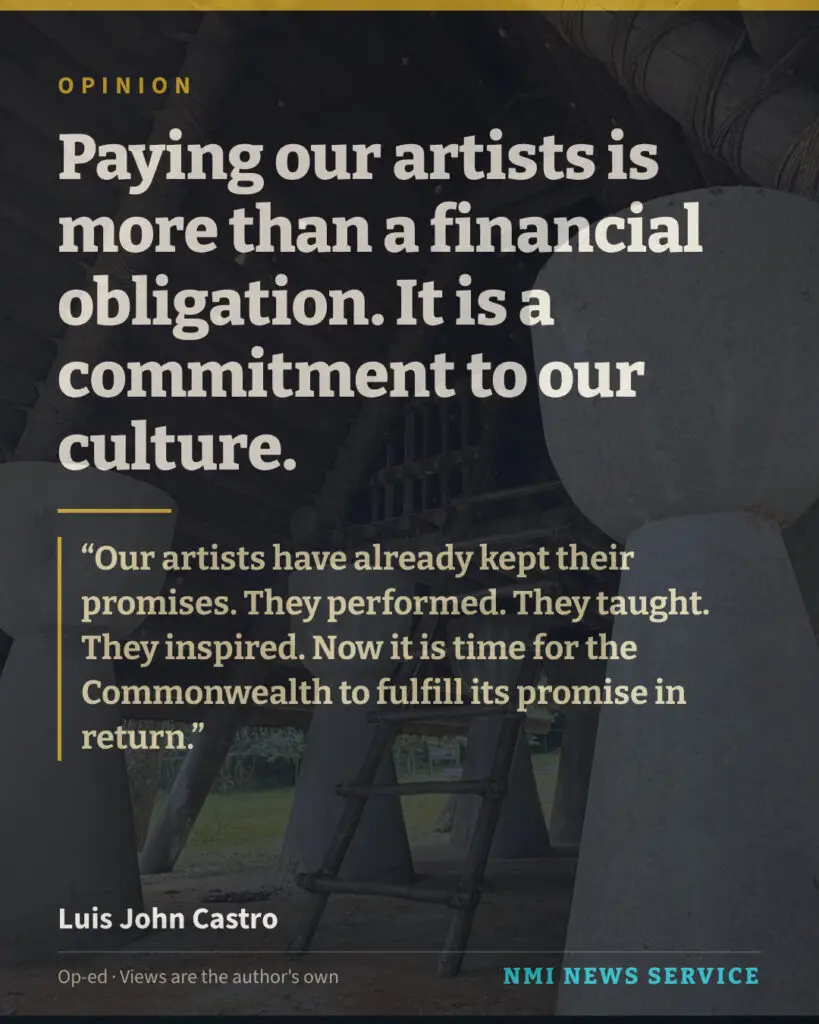
Our artists have already kept their promises. They performed. They taught. They inspired. They preserved traditions that might otherwise be lost.
Now it is time for the Commonwealth to fulfill its promise in return.
The path forward is clear. Resolve the outstanding payments. Communicate openly with those affected. Strengthen administrative procedures where necessary. Work collaboratively with the Legislature to ensure these problems are not repeated.
Doing so will not simply close a chapter of controversy. It will reaffirm an enduring principle: that in the Northern Mariana Islands, we value not only our culture, but also the people whose hands, voices, knowledge, and dedication keep that culture alive.
The views expressed are those of the author and do not necessarily reflect those of NMI News Service.