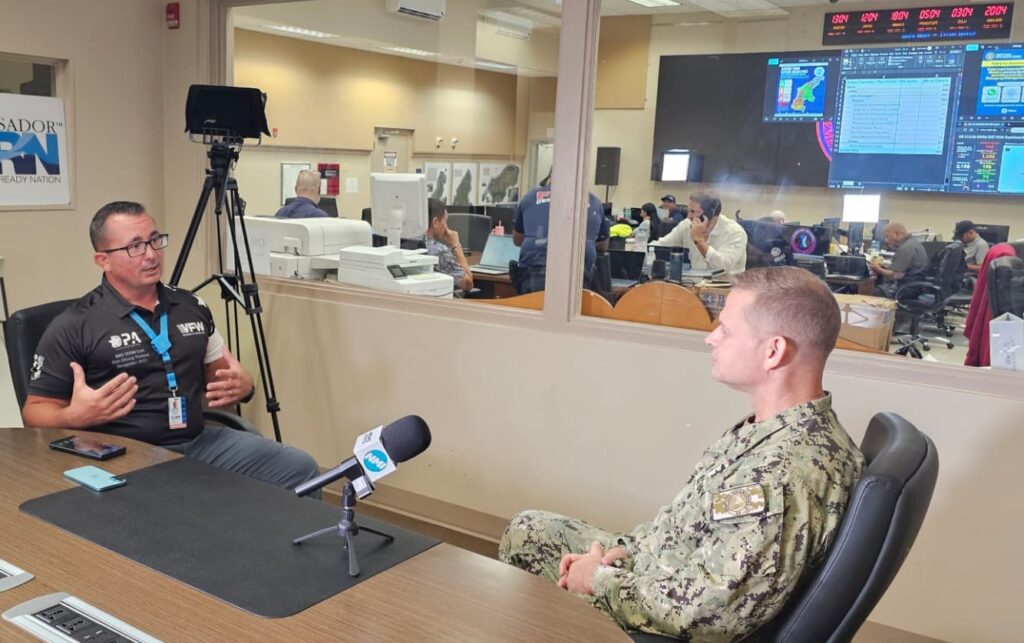
SAIPAN — Rear Adm. Joshua Lasky, commander of Joint Task Force Micronesia, said the military’s Super Typhoon Sinlaku response has transitioned from opening ports and clearing routes to a focus on shelter, in an interview with the NMI News Service at the CNMI Emergency Operations Center on Wednesday.
Lasky said roughly 9,600 people are supporting the operation on any given day, the bulk of them working behind the scenes from Guam and Hawaii.
“Of course we don’t see most of those,” Lasky said. “We only see numbers in the hundreds and a few aircraft here and there. But there’s a ton of people behind the scenes, both in Guam and in Hawaii, and some important units involved.”
JTFM was established by U.S. Indo-Pacific Command to coordinate preparations for disaster response and homeland defense in the region, Lasky said. The Sinlaku response falls under the Defense Support of Civil Authorities mission, with FEMA serving as the lead federal agency and JTFM operating in support.
“What’s also been notable to me as I’ve been watching this event unfold,” Lasky said, “is how much of the work that was done to prepare for homeland defense has prepared us for response to the disaster.”
The 36th Wing has run all air operations, Lasky said. Helicopter Sea Combat Squadron 25 played a critical role in the early days of the response, including moving supplies into Kagman after roads were impassable. Navy construction battalion personnel, some already on the ground in Tinian, have provided engineering capability alongside the 36th Wing and the Air Force.
The U.S. Army Corps of Engineers and the U.S. Coast Guard have also been integrated into the response, Lasky said. The Coast Guard led the search for the missing CNMI mariners, with support from HSC-25 and the Air Force.
“We coordinate so routinely that that was seamless at the transition to the response,” Lasky said of working with the Coast Guard.
The arrival of the USS Boxer Amphibious Ready Group and the 11th Marine Expeditionary Unit added significant capability, Lasky said. The USS Portland used landing craft air cushion vessels to move trucks and Marines from Guam into the CNMI. Boxer ARG personnel also assisted with community relations and cleanup in Guam.
Lasky said U.S. Army Pacific holds the lead under Indo-Pacific Command for coordinating Defense Support of Civil Authorities across Hawaii and the Pacific territories, and was central to mobilizing Department of War assets out of Hawaii in the early days of the response.
Asked about a timeline for the military presence, Lasky said the duration depends on FEMA and territorial requirements as other capabilities come online.
“We were heavily involved in opening the airports and the ports in cooperation with the Coast Guard, clearing routes, distribution of water and supplies, and now we’ve really transitioned to a focus on shelter,” Lasky said.
Lasky pushed back on the framing of Tinian and Saipan as separate or competing recovery efforts.
“We certainly don’t see them as dueling disasters,” Lasky said. “I think they’re, you know, they’re one of them, so we’re working to balance the requirements in both places.”
Lasky said he is approaching the one-year mark in command of JTFM and has met with Governor Apatang and his team roughly eight times across the CNMI, Washington, D.C., and Hawaii.
“We’re grateful to have such a good partner in the governor and his team,” Lasky said. “You walk into an experience like this, and you’re thankful that it’s not the first time that you’re meeting somebody.”
Lasky said the federal-territorial coordination on Sinlaku ran well from the beginning, beginning with emergency declarations issued before landfall and presidential declarations that allowed federal resources to move into position ahead of the storm.
“From declarations of emergencies before landfall, followed up by President’s declarations that allowed resources to flow ahead of time, and then the execution of the operation in collaboration with the government was really, really well done, I thought,” Lasky said.
Lasky credited FEMA’s coordination and singled out the agency’s posture going into the response.
“I look at FEMA and how forward-leaning they were and how skillful they were at bringing that whole network together,” Lasky said.
Lasky said service members across the response have shown a sense of pride in the mission.
“Everybody that joined, joined to help people and protect their fellow citizens,” Lasky said. “What you can see in the service members as you go around and get to see them is a tremendous sense of pride and a real sense of honor in the opportunity to help out citizens of the United States.”