SAIPAN — The new deputy commander of the U.S. Army Corps of Engineers Japan Engineer District said the pace of Super Typhoon Sinlaku recovery across the Marianas has outrun his expectations, telling Good Morning Marianas on Friday that the community’s resilience stood out from his first days on the ground.
Lieutenant Colonel Simratpal Singh appeared on the show after taking over from Lieutenant Colonel Biggerstaff in a recent change of command. Singh said he had about a week of handover before stepping into the role and has since toured operations on both Saipan and Tinian.
“The recovery and the resilience of the people here, and the pace of the recovery we’ve made in what, a month now, is incredible,” Singh said. He said he had expected to find poles still down and trash everywhere, but instead found agencies including FEMA, CNMI DPW and Corps partners working together.
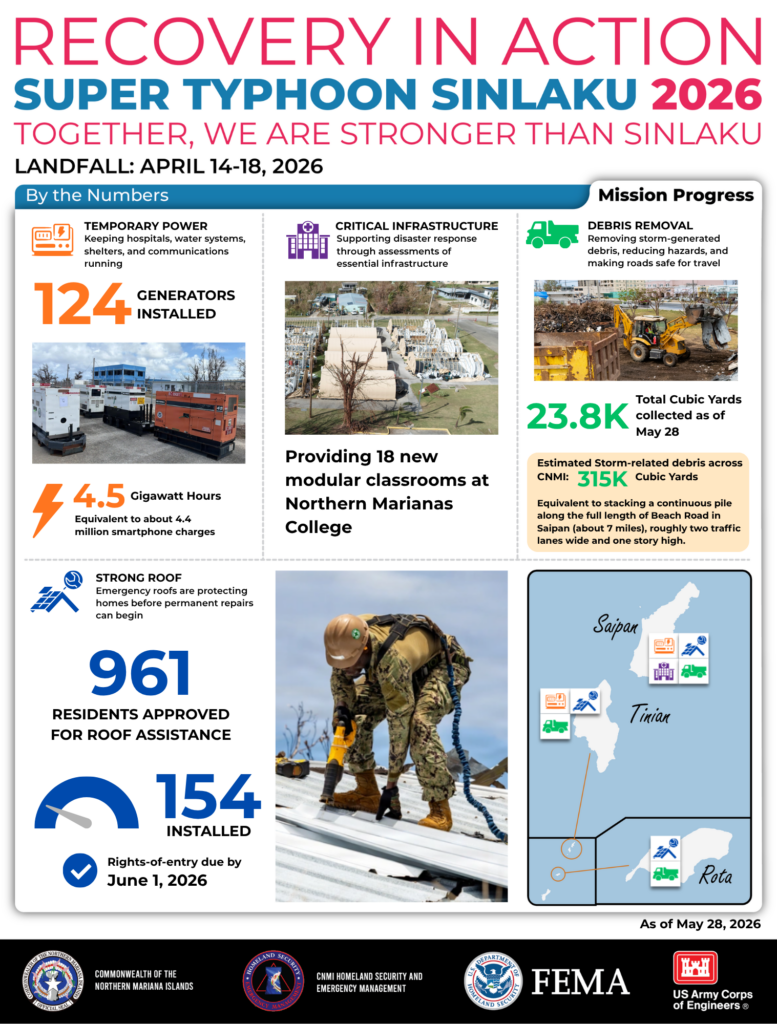
Singh said crews have installed 154 roofs so far, with 961 residents approved for the roof assistance program. He urged residents to submit roofing requests by the June 1 deadline and to make intake forms as specific as possible, keep the work area clear, and stay reachable so crews can coordinate access.
On Tinian, Singh said the Corps’ 249th Prime Power battalion has three generators producing about 1.5 megawatts, with a second facility set to produce a similar amount, bringing capacity to roughly three megawatts. He said additional generators are on the way to build redundancy, and the figure is well above current requirements. The Corps handles power generation while a FEMA partner works the distribution side.
Singh said the Tinian power plant sustained heavy damage and faces two parallel questions: whether the building itself can be repaired and what the power generation systems will require. A Corps of Engineers team will assess the plant while Navy NAVFAC has already assessed the infrastructure, and the two will make a joint recommendation to FEMA and CNMI leadership. He credited CUC plant operators for tarping the facility and salvaging a shed now housing temporary power control systems.
On debris, Singh said removal is underway on Saipan, Tinian and Rota, with contractors surging crews on Saipan and Beach Road among the prioritized routes. He said the single biggest help residents can provide is separating debris into the correct streams, such as vegetative, construction, metal, household hazardous waste, electronics, solar panels and white goods, and keeping regular household trash out of the storm debris piles. Mixed piles force crews to spend resources sorting, which slows pickup.
Singh said crews rotate on 30 to 45-day cycles with deliberate knowledge handovers to keep the same pace and resources in place. He said the work ranks among the most rewarding assignments of his more than 15 years in the Army.
“The Corps of Engineers, along with FEMA, along with our CNMI partners, along with DPW, we are full speed ahead on making sure that we can restore normalcy to folks here as quickly as we can,” Singh said.