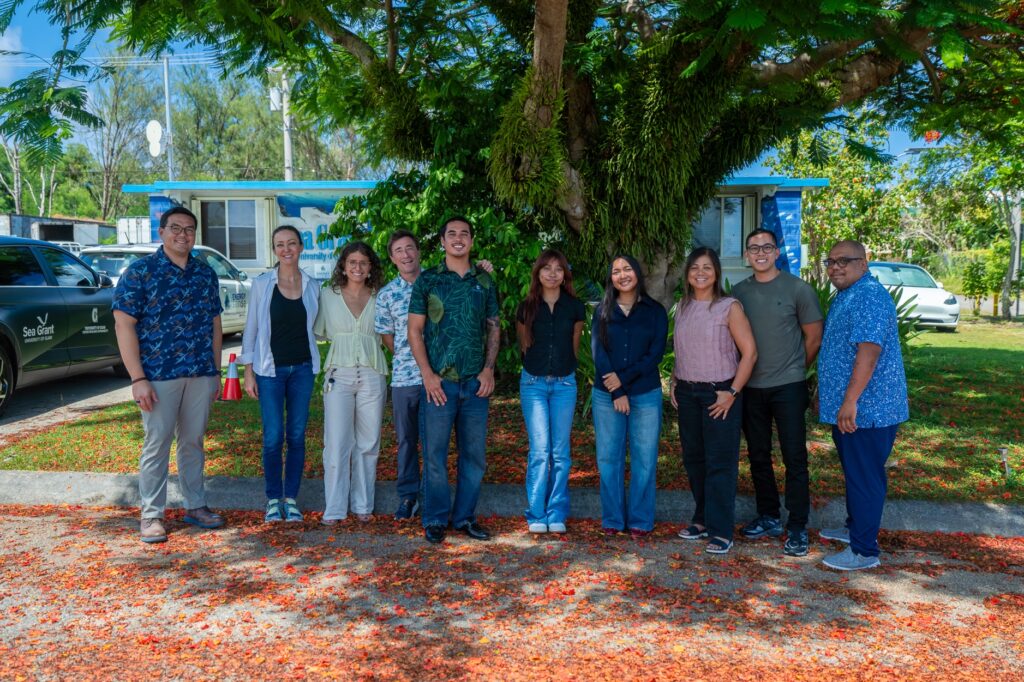
SAIPAN — Three undergraduate students from Guam and the Northern Marianas monitored the health of coral reefs across Micronesia through a University of Guam fellowship, presenting findings they hope will shape conservation and fisheries decisions in the region.
Dominic Torres, Ale’a Duenas and Angelie Denguines took part in the Research and Environmental Education Fellowship, known as REEF, run by the UOG Center for Island Sustainability and Sea Grant, the center said in a release. The students presented their work to a room of researchers, scientists and administrators.
The fellows worked with the Micronesia Coral Reef Monitoring Data Portal, a regional program established under the Micronesia Challenge that provides standardized coral reef data and tools to support science-based management across Micronesia. Each student was assigned a different island to monitor and used artificial intelligence on the CoralNet platform to identify and analyze coral abundance and health.
The fellows monitored three reefs across Yap and Kosrae, all of which showed signs of steady decline in coral populations, the release said. Water heating events in those areas are believed to be the cause.
Peter Houk, a National Geographic project researcher and UOG Marine Laboratory faculty member who served as research lead for the project, said coral monitoring in the region has room to grow and can support climate justice cases and broader conservation efforts.
Torres, who is from Saipan, said his research could benefit coral populations and ocean diversity around the Marianas. “I hope the fisheries take a look at this,” he said. “This data can really help to either loosen or tighten certain regulations.”
Denguines, who is from Guam, said she had not pictured herself working with coral, having been more interested in sea turtle and fisheries research, but changed her view after seeing the need. “Now, knowing that this can make a huge impact globally, I feel like I want people to know more about what’s going on in our world and not just the surface level,” she said.
Duenas, who is from the CNMI and has taken part in other STEM fellowships, said the data can help people understand their reefs. “It is one thing to go out and swim and just see it with your own eyes, but it’s another to look at the data and see it all on the graphs and compare it,” she said.
The center said the REEF program is ongoing and pairs undergraduates with mentors in STEM research fields. All three students intend to finish their undergraduate studies and serve their islands and the region.