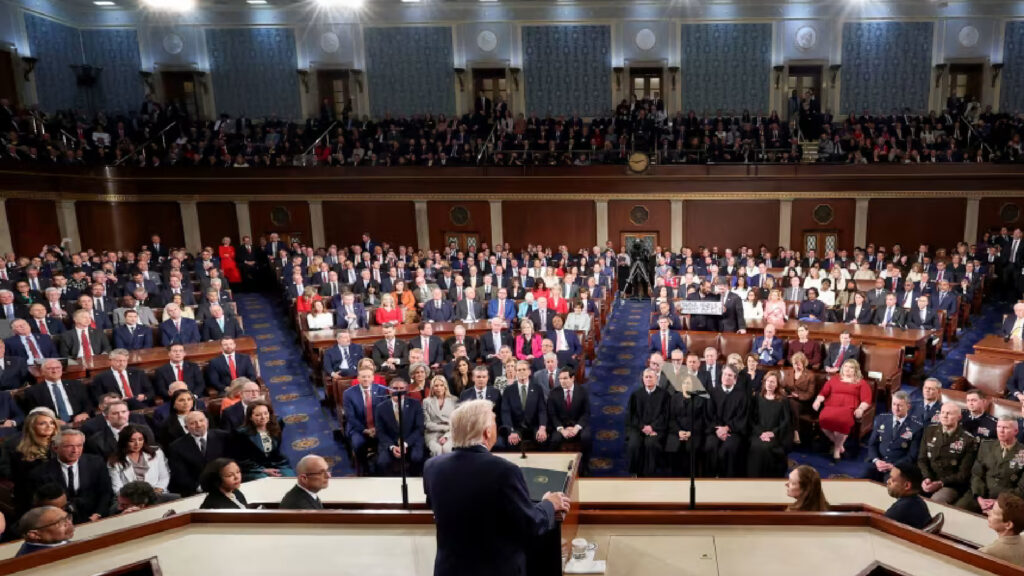
Saipan — President Donald Trump used his State of the Union address Tuesday night in Washington, Wednesday morning in the Marianas, to declare what he called a national turnaround and a “golden age of America,” delivering a wide-ranging speech focused on the economy, immigration enforcement, tariffs, crime, military power and foreign policy.
Speaking before a joint session of Congress, Trump opened by describing the country as “back, bigger, better, richer and stronger than ever before” and tied the speech to the upcoming 250th anniversary of American independence this July.
The President repeatedly contrasted his administration with his predecessor, claiming major improvements in border security, inflation, gasoline prices, mortgage rates, employment and investment. He said the border is now secure, that illegal admissions had fallen to zero in the past nine months, and that fentanyl flows and crime had dropped sharply. He also claimed core inflation had fallen, gas prices had declined in most states, and the stock market had hit dozens of record highs.
Trump also credited tariffs as a major driver of economic gains and said they would remain central to his policy even after what he described as an unfavorable recent U.S. Supreme Court ruling. He said alternative legal authorities would be used to keep tariff policies in place and argued tariffs could eventually reduce reliance on income taxes.
A major section of the speech focused on tax and household policy. Trump praised Republican majorities for passing what he described as large tax cuts, including no tax on tips, no tax on overtime, and no tax on Social Security benefits for seniors. He also highlighted tax-deductible auto loan interest for U.S.-made vehicles and promoted “Trump Accounts,” which he described as tax-free investment accounts for American children.
On health care and prescription drugs, Trump called for Congress to codify his “Most Favored Nation” drug pricing program and said his administration was pushing lower costs through transparency and direct-to-consumer purchasing changes. He also announced what he called a “Ratepayer Protection Pledge,” saying large tech companies developing AI infrastructure should build their own power generation to avoid increasing utility bills for households.
Trump devoted a substantial portion of the address to immigration and border policy, including calls for Congress to increase homeland and border security funding, end sanctuary city protections, and pass new voter identification and citizenship proof requirements for elections. He also used personal stories of crime victims and family members in the gallery to support his immigration and public safety arguments.
The speech also included cultural and social policy themes, including criticism of school gender transition policies and a call for Congress to prohibit states from allowing gender transitions for minors without parental consent.
On foreign policy and national security, Trump claimed his administration had ended multiple wars and was working to end the Russia-Ukraine war. He also referenced a U.S. military strike on Iran’s nuclear program, said negotiations with Iran were ongoing, and reiterated that Iran would not be allowed to obtain a nuclear weapon. He announced a $1 trillion military budget and said NATO countries had agreed to raise defense spending to 5 percent of GDP.
Trump also highlighted military operations in the Western Hemisphere, including actions tied to Venezuela and anti-cartel efforts, and used the address to honor military personnel, athletes, first responders and civilians in the House gallery. Several segments of the speech featured on-the-spot announcements of honors and medals for individuals he recognized during the address.
Throughout the speech, Trump frequently sparred rhetorically with Democrats in the chamber, criticized past Democratic policies on immigration, inflation and crime, and urged Congress to adopt his administration’s agenda on elections, border enforcement, public safety and economic policy.