SAIPAN — A federal-territorial partnership is providing free emergency tents to CNMI residents whose homes were left uninhabitable by Super Typhoon Sinlaku, according to the CNMI Government’s program guide.
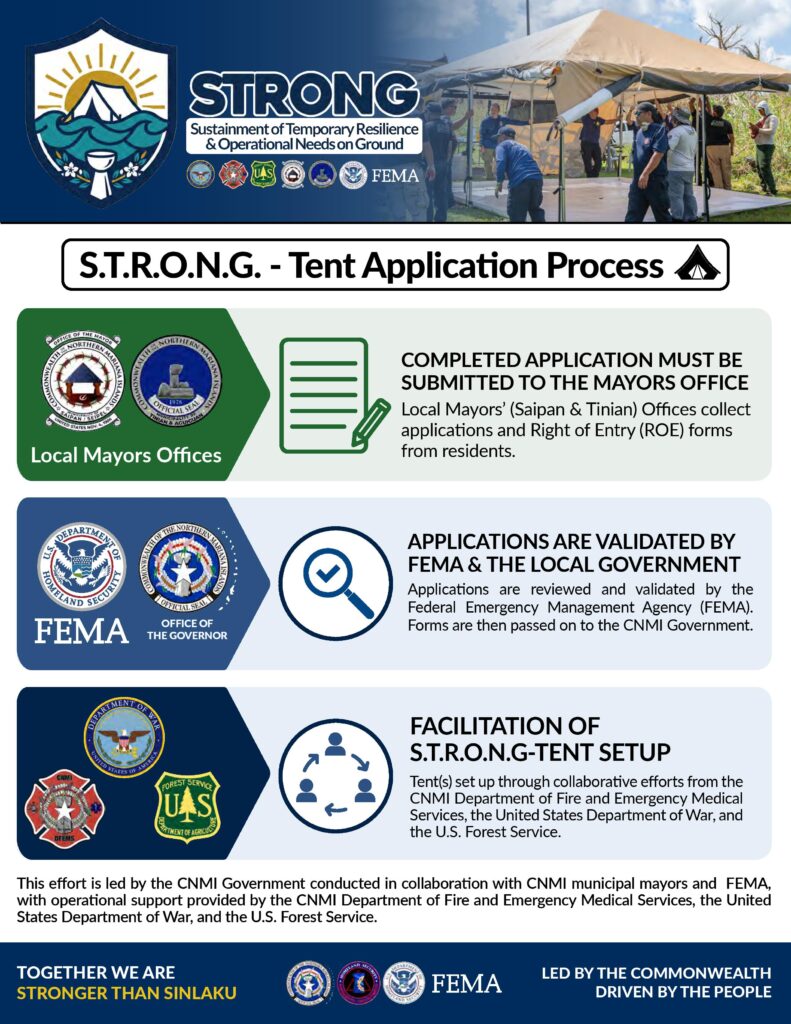
The program is called Sustainment of Temporary Resilience and Operational Needs on Ground, or S.T.R.O.N.G. It is coordinated by the CNMI Government, Saipan and Tinian Mayors’ Offices, the CNMI Department of Fire and Emergency Medical Services and the CNMI Office of Homeland Security and Emergency Management, in conjunction with the Federal Emergency Management Agency, the U.S. Department of War and the U.S. Forest Service.
The CNMI Government said S.T.R.O.N.G. is a priority mission to provide homeowners temporary non-congregate sheltering while their homes undergo repairs. The goal is to give typhoon survivors an opportunity to leave shelters and stay closer to their homes where they can oversee permanent repairs.
Who is eligible
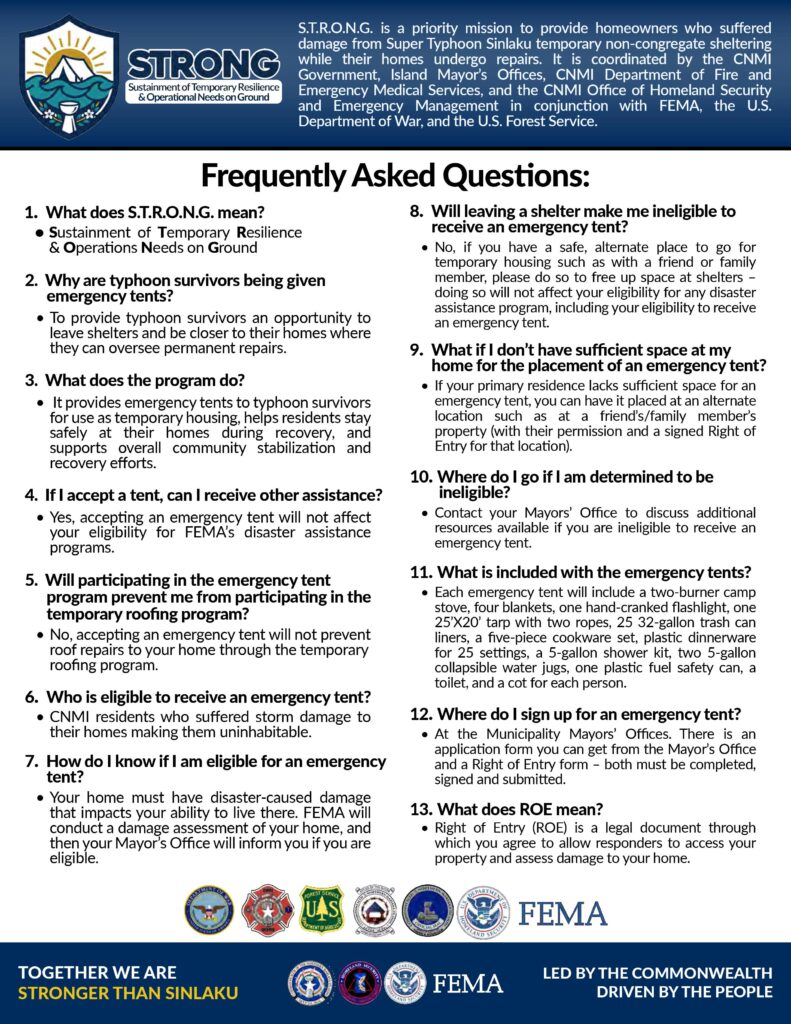
CNMI residents who suffered storm damage to their homes making them uninhabitable are eligible to receive an emergency tent, according to the program guide. FEMA will conduct a damage assessment, and the local Mayor’s Office will inform applicants whether they are eligible.
Accepting an emergency tent will not affect a household’s eligibility for FEMA’s disaster assistance programs, the CNMI Government said. It will also not prevent participation in the temporary roofing program. Residents who leave shelters for alternate housing such as a friend’s or family member’s home will not lose their eligibility for an emergency tent, and the CNMI Government encouraged those with safe alternate housing to do so to free up shelter space.
How to apply
Completed applications must be submitted to the local Mayor’s Office on Saipan or Tinian, the program guide said. Both an application form and a Right of Entry form must be completed, signed and submitted. The Right of Entry is a legal document through which the resident agrees to allow responders to access their property and assess damage to the home.
FEMA reviews and validates applications, then forwards them to the CNMI Government. Tent setup is coordinated by FEMA and the CNMI Government and executed by the U.S. Department of War and the CNMI Department of Fire and Emergency Medical Services.
What is included
Each emergency tent supports occupancy of four to five people and is provided at no cost to Sinlaku survivors. Each tent includes a two-burner camp stove, four blankets, one hand-cranked flashlight, one 25-by-20-foot tarp with two ropes, 25 32-gallon trash can liners, a five-piece cookware set, plastic dinnerware for 25 settings, a five-gallon shower kit, two five-gallon collapsible water jugs, one plastic fuel safety can, a toilet and a cot for each person. Restroom facilities are included with all emergency tents.
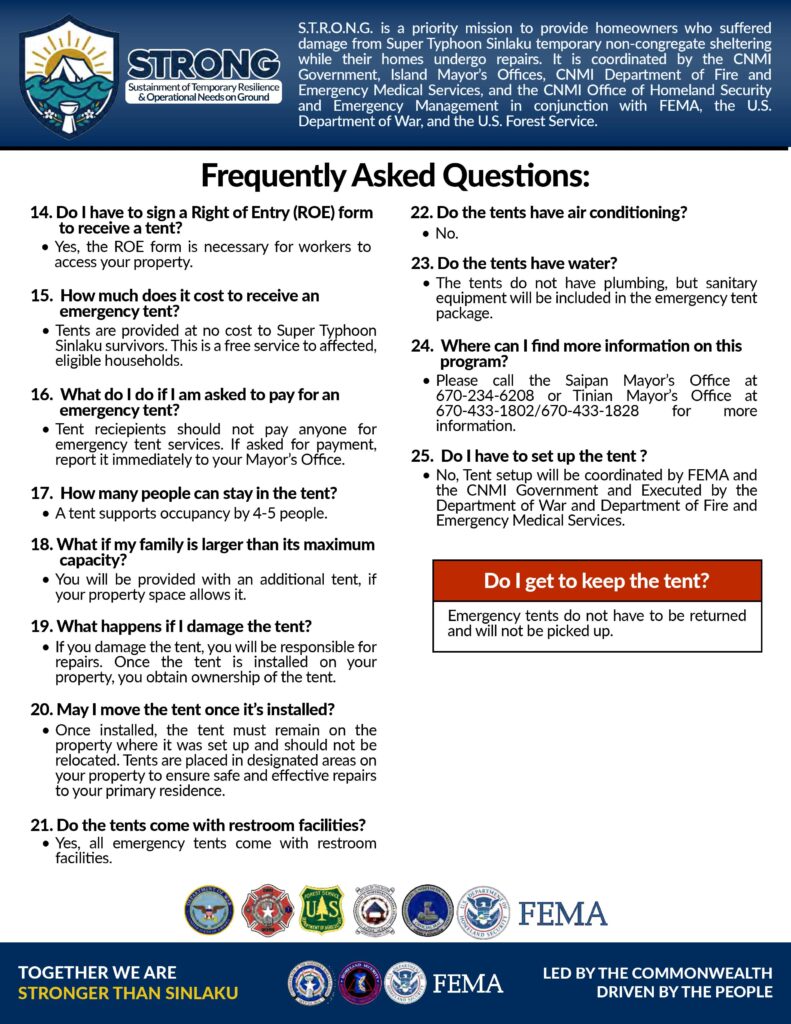
The tents do not have air conditioning or plumbing, but sanitary equipment is included in the package. If a family is larger than the tent’s capacity, an additional tent will be provided if the property allows space for it.
Other key information
Once installed, a tent must remain on the property where it was set up and cannot be relocated, the CNMI Government said. Recipients obtain ownership of the tent and are responsible for any repairs if it is damaged. The tents do not have to be returned and will not be picked up.
If a primary residence lacks sufficient space for an emergency tent, the tent can be placed at an alternate location such as a friend’s or family member’s property with their permission and a signed Right of Entry for that location.
Tents are provided free of charge and recipients should not pay anyone for emergency tent services, the program guide said. Anyone asked for payment should report it immediately to their Mayor’s Office. Residents determined to be ineligible should contact their Mayor’s Office to discuss additional resources.
Where to apply
Applications can be obtained from the Saipan Mayor’s Office at 670-234-6208 or the Tinian Mayor’s Office at 670-433-1802 or 670-433-1828.