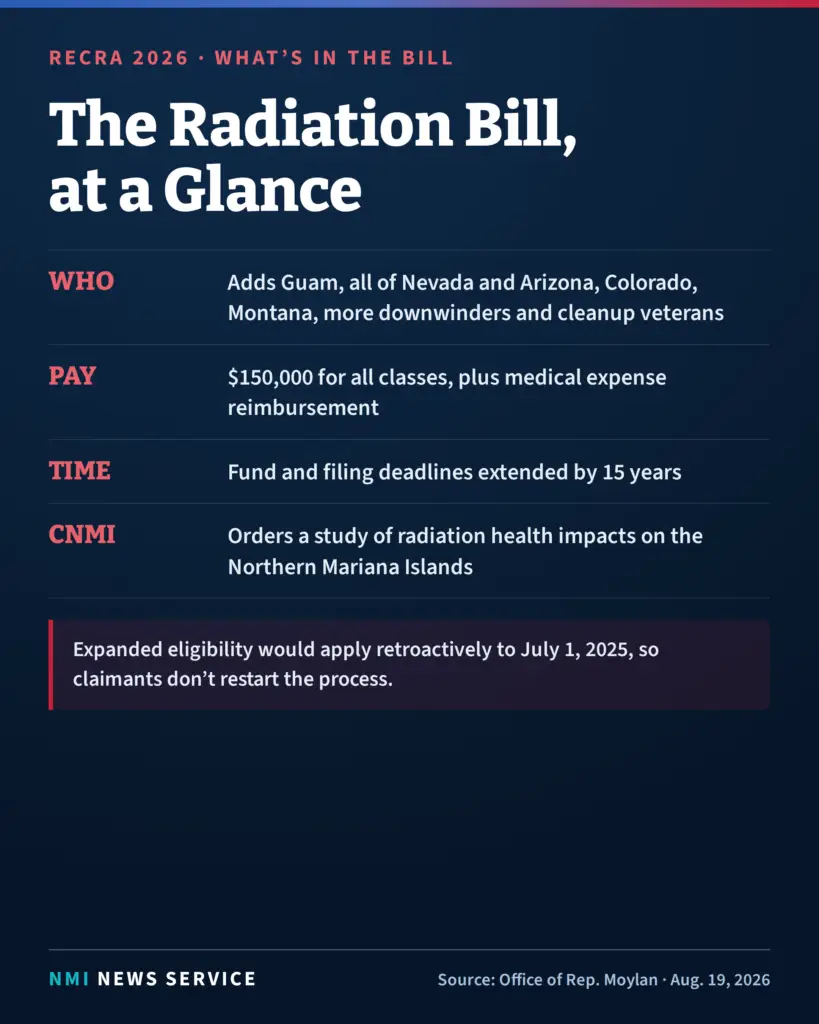


HAGÅTÑA, Guam — Congressman James Moylan announced the introduction of the Radiation Exposure Compensation Reauthorization Act of 2026, bipartisan legislation that would expand eligibility for radiation exposure compensation to Guam and other communities, raise payments to $150,000 and direct a study of radiation health impacts on the Northern Mariana Islands.
The bill, known as RECRA, builds on Moylan’s efforts since his first year in Congress to secure compensation and recognition for communities harmed by the nation’s nuclear weapons testing program, his office said Wednesday. It seeks to address gaps remaining after Congress partially expanded the Radiation Exposure Compensation Act in 2025.
“This legislation brings together a strong bipartisan coalition of Members of Congress, survivors, advocates, and communities who have refused to give up this fight,” Moylan said. “Together, our voices are stronger, and together, we will keep fighting until every American harmed by radiation exposure receives the justice they have been denied. I’m not backing down until we get this across the finish line for the people of Guam who were impacted and all those still left behind.”
The legislation would expand eligibility to additional radiation-exposed communities, including Guam, Colorado, Montana and all of Nevada and Arizona, along with downwinders exposed to residual radiation from atmospheric testing, onsite participants, cleanup veterans and communities affected by Manhattan Project waste. It would provide $150,000 compensation payments for all classes, authorize reimbursement of medical expenses, extend the program fund and claims deadlines by 15 years, broaden the list of eligible diseases and streamline claims through the use of affidavits where records are unavailable.
Of particular note for the Commonwealth, the bill directs studies on the health impacts of radiation exposure, including impacts on the Northern Mariana Islands, descendants of affected individuals and other exposed populations. It would also establish a process for adding future classes of eligible individuals without requiring additional acts of Congress, and expanded eligibility would apply retroactively to July 1, 2025, ensuring individuals are not required to restart the claims process.
Enacted in 1990, RECA provides one-time compensation to individuals who developed cancer or other specified illnesses after exposure to radiation from U.S. atmospheric nuclear weapons testing. Although the program was reauthorized and expanded through 2028, Moylan’s office said it continues to impose restrictive eligibility criteria, exclude exposed communities, create complicated documentation requirements and provide limited support for long-term care costs.
The measure is co-led by Reps. Wesley Bell of Missouri, Teresa Leger Fernández of New Mexico and Brittany Pettersen of Colorado, with additional members signed on as cosponsors.
“Families from across my district have suffered from terrible cancers, thyroid issues, and even death because of the improper storage of this deadly waste,” Bell said, calling the expansion of compensable diseases and the increase in benefits from $50,000 to $150,000 “a huge step in the right direction. Nothing can fully right this wrong, but this effort tips the scales toward justice — for everyone from St. Louis to Guam.”