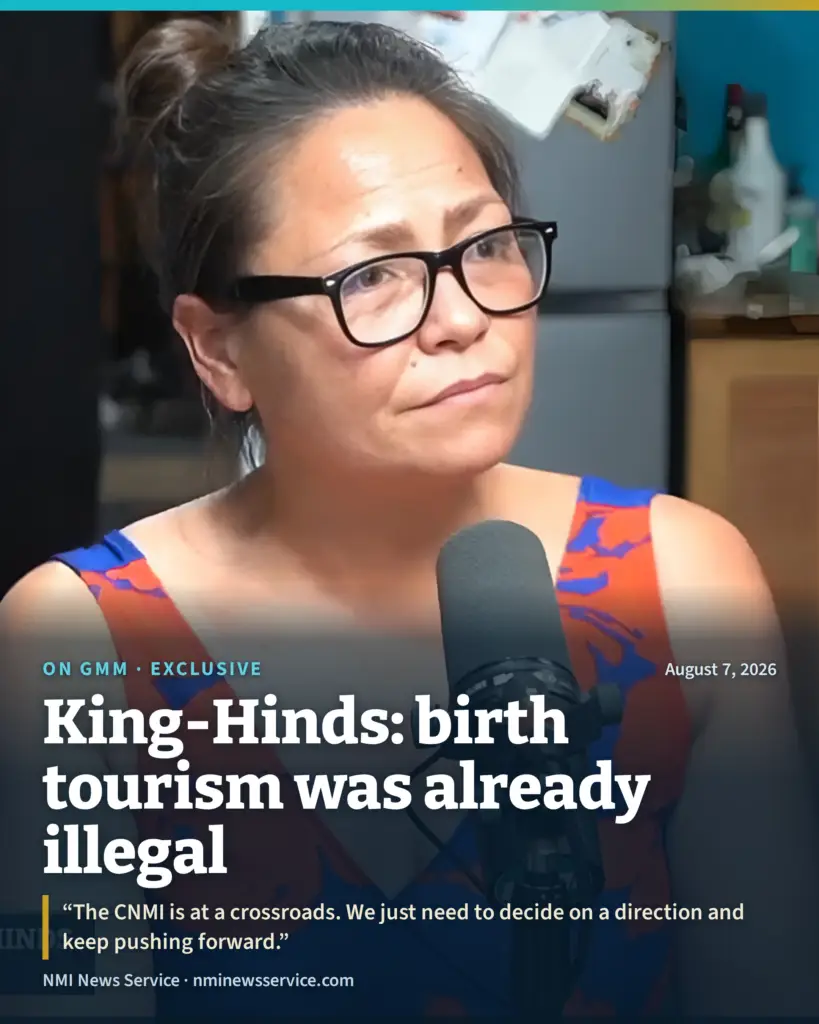


SAIPAN — Congresswoman Kimberlyn King-Hinds read the White House’s new birth tourism executive order on her drive to the Good Morning Marianas studio Friday, and her first read for the CNMI was reassurance: the practice was already against the law, and the new order sharpens enforcement against the industry built around it.
“Immigration is an intent-based law. And if you’re applying to come in as a tourist, but are lying, because you’re actually coming here to give birth, that is already illegal,” King-Hinds said on the show, minutes after the order reached her. “It’s a lot more precise… as far as getting DHS more authority to target these operators… who are facilitating that industry.” She said the order does not get into the Fourteenth Amendment conversation and added, “I don’t think it was targeting the folks who live here.”
The live reaction capped an interview that ranged across the Congresswoman’s August agenda at home. She confirmed she and Guam’s delegate have introduced legislation to remove cabotage restrictions, the federal rules limiting foreign carriers between U.S. points that the CNMI has long blamed for thin air service, and said Senate interest in the issue “has been piqued” amid the back-and-forth over the EVS-TAP visitor program. She hopes to push the bill after election season.
On utilities, King-Hinds said she is working to connect federal partners on infusing “the much needed cash that the CUC needs” and on a plan to finance replacing the utility’s aging, inefficient engines, work she framed alongside the planned 53-megawatt solar build-out across the three islands.
King-Hinds said she declined a 15-day congressional delegation trip to Malaysia to spend the August recess at home, where her office interns recently completed a community survey across Saipan, Tinian and Rota that found the economy topping residents’ concerns, with a video of the findings to be shared with the press. She spoke candidly about the money culture of Congress, noting committee chairs are expected to raise seven figures in party dues, and about voting alone against her party when the district requires it: “There’s a saying in D.C., district first… I was like, God, my district.”
On the Commonwealth Ports Authority, she said seaport revenues are being used to sustain airport operations, limiting reinvestment in seaport infrastructure, while crediting the ports team for aggressively pursuing grants including a recently awarded $30 million federal grant. She described the 40-year-old airport terminal’s chronic leaks as a condensation problem born of sealing up a building never designed to be enclosed, with federal aviation grants generally unavailable for terminal improvements.
Her closing message tied the threads together: “This community, honestly, is the most resilient community on the planet… The CNMI is at a crossroads. And we just need to decide on a direction and keep pushing forward.”