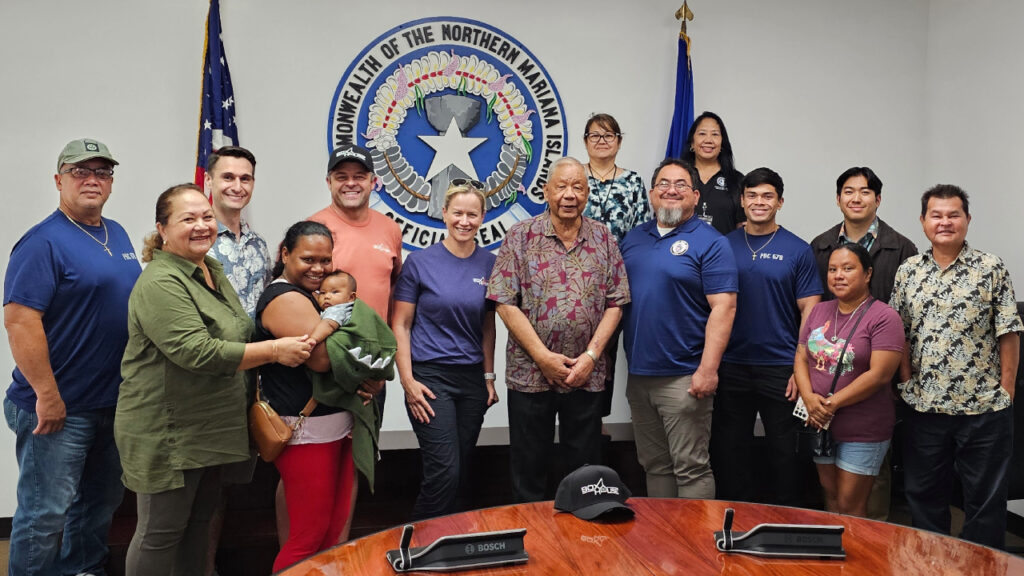
SAIPAN — Utah-based housing company BoxHouse will donate 10 rapid-deployment homes to Commonwealth veterans who lost their homes to Super Typhoon Sinlaku, in a project announced Tuesday at the governor’s office and coordinated with Project Buddy Check 670, the governor’s office, and the Church of Jesus Christ of Latter-day Saints.
Gov. David M. Apatang welcomed the company’s representatives and the veterans present, saying the storm left many across the islands without homes and that permanent housing is a pressing need. “I wish every veteran in the Commonwealth can avail to that kind of a home,” the governor said, thanking the team for traveling a long distance to assist.
Clement Bermudez, president of Project Buddy Check 670, a grassroots organization supporting Commonwealth veterans and their families, said the donation gave the veteran community hope after many lost nearly everything in the storm. “Without this support, it would have been a longer delay for them to be rehoused,” he said, adding that the homes mean “the whole world” to the organization.
Amanda Breslin, president of Ready Pod, a division of BoxHouse, said the project was possible only through cooperation among nonprofit, church, and government partners, and that processes that would normally take weeks were being pushed through in hours. “People deserve to have homes and dignified living,” she said. “If we can do that for 10 units today and more units eventually, that would be such a fantastic feat.”
Ryan Andersen, construction director for BoxHouse, said it was an honor to be involved and credited the range of organizations working together. He described the homes as a steel-framed structure with insulated fiberglass panels that unfold from shipping containers, cutting build time from five or six months to as little as a week. The units are engineered to withstand 150 mph winds, he said, with additional hardware being specified to raise that to 200 mph, and on Saipan will be set on foundations rather than placed on the ground.
The homes were prepped at a facility in Utah, loaded into containers, trucked to Long Beach, and shipped to Guam before transferring to a smaller vessel bound for Saipan. Breslin said the first batch includes four different models, among them bunk houses with split air-conditioning units, a duplex unit, and configurations with space for appliances. She said Ready Pod’s mission is to build a strategic housing reserve so inventory is staged and ready to deploy when disaster strikes.
Recipients were identified through Project Buddy Check 670, the governor’s office, and the LDS congregation, prioritizing those who are disabled, elderly, or have families, with an application process for selection. Officials said the effort focused on Saipan for this first batch to centralize labor, though partners are discussing blanket permits that could expedite future homes on Tinian and Rota.
The company said the units cleared customs and that plans have been submitted to the Division of Public Works, with zoning approval still to come. A demonstration unit is planned near the port so the public can walk through one. Once approvals are in hand, organizers estimate about a week to set a foundation and another week to assemble each home, with all 10 expected within roughly a month to a month and a half. A three-person BoxHouse team will train and work alongside a paid local contractor crew.
Apatang thanked the company on behalf of the Commonwealth’s veterans. “We serve and they serve for our country,” he said. “Thank you from the bottom of our hearts.”