By Rep. Vincent “Kobre” Aldan
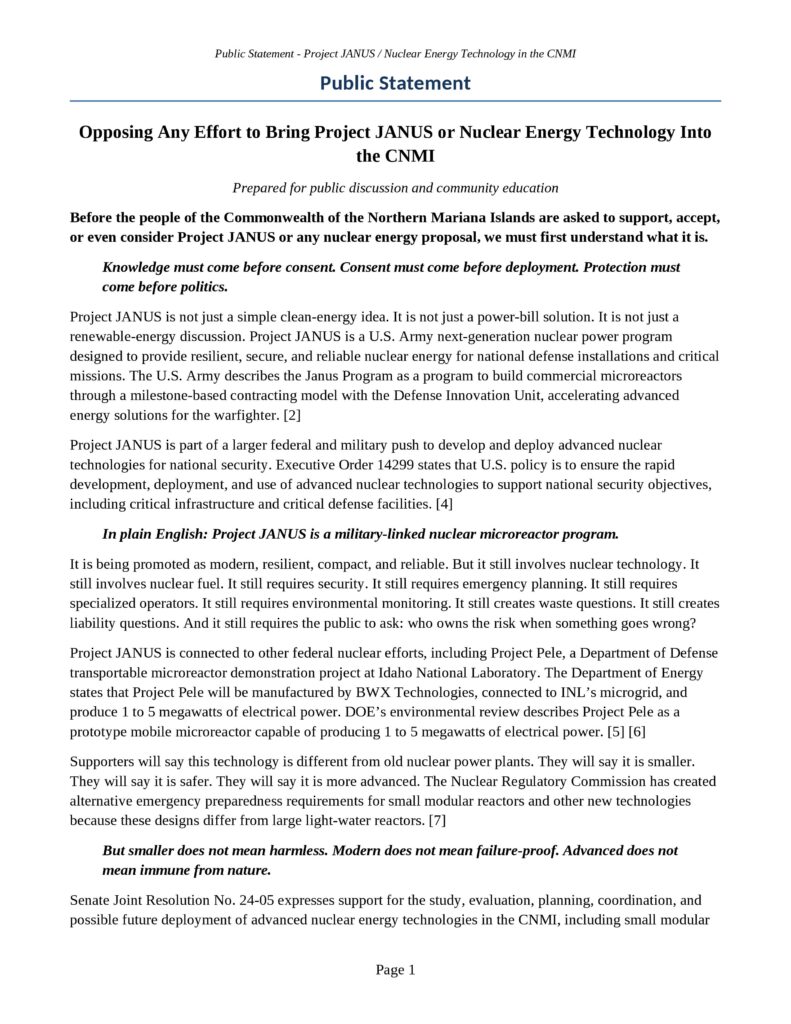
Before the people of the Commonwealth of the Northern Mariana Islands are asked to support, accept, or even consider Project JANUS or any nuclear energy proposal, we must first understand what it is. Knowledge must come before consent. Consent must come before deployment. Protection must come before politics.
Project JANUS is not just a simple clean-energy idea. It is not just a power-bill solution. It is not just a renewable-energy discussion. Project JANUS is a U.S. Army next-generation nuclear power program designed to provide resilient, secure, and reliable nuclear energy for national defense installations and critical missions. The U.S. Army describes the Janus Program as a program to build commercial microreactors through a milestone-based contracting model with the Defense Innovation Unit, accelerating advanced energy solutions for the warfighter. [2]
Project JANUS is part of a larger federal and military push to develop and deploy advanced nuclear technologies for national security. Executive Order 14299 states that U.S. policy is to ensure the rapid development, deployment, and use of advanced nuclear technologies to support national security objectives, including critical infrastructure and critical defense facilities. [4]
In plain English: Project JANUS is a military-linked nuclear microreactor program.
It is being promoted as modern, resilient, compact, and reliable. But it still involves nuclear technology. It still involves nuclear fuel. It still requires security. It still requires emergency planning. It still requires specialized operators. It still requires environmental monitoring. It still creates waste questions. It still creates liability questions. And it still requires the public to ask: who owns the risk when something goes wrong?
Project JANUS is connected to other federal nuclear efforts, including Project Pele, a Department of Defense transportable microreactor demonstration project at Idaho National Laboratory. The Department of Energy states that Project Pele will be manufactured by BWX Technologies, connected to INL’s microgrid, and produce 1 to 5 megawatts of electrical power. DOE’s environmental review describes Project Pele as a prototype mobile microreactor capable of producing 1 to 5 megawatts of electrical power. [5] [6]
Supporters will say this technology is different from old nuclear power plants. They will say it is smaller. They will say it is safer. They will say it is more advanced. The Nuclear Regulatory Commission has created alternative emergency preparedness requirements for small modular reactors and other new technologies because these designs differ from large light-water reactors. [7]
But smaller does not mean harmless. Modern does not mean failure-proof. Advanced does not mean immune from nature.
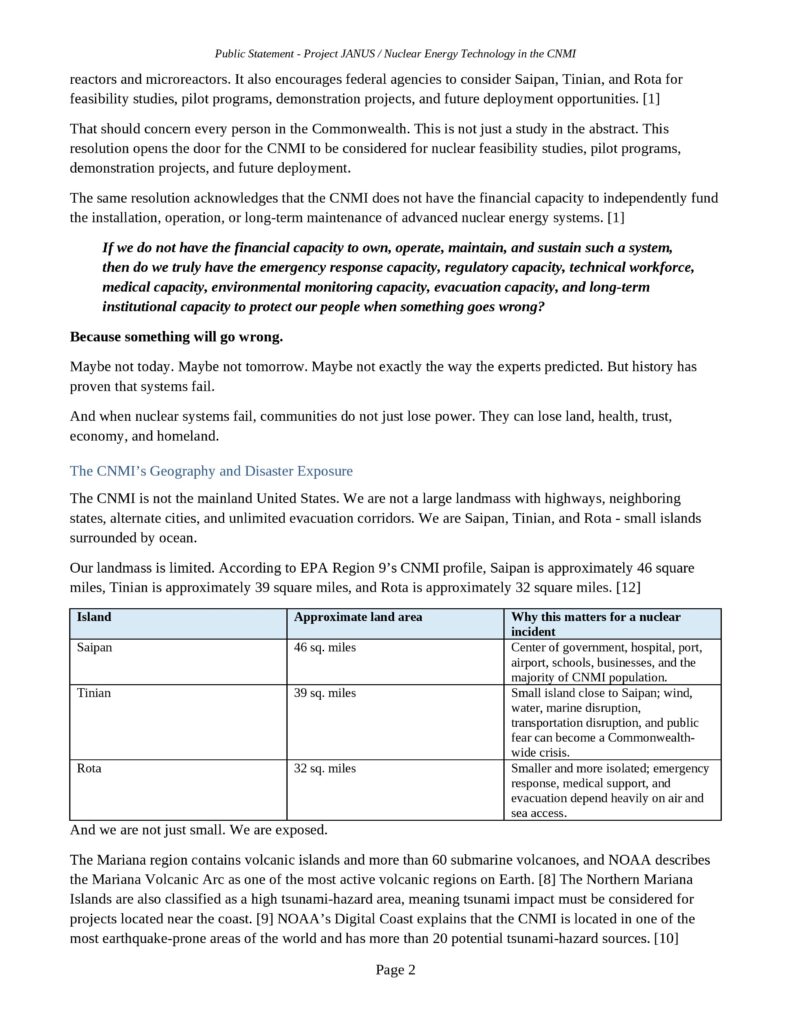
Senate Joint Resolution No. 24-05 expresses support for the study, evaluation, planning, coordination, and possible future deployment of advanced nuclear energy technologies in the CNMI, including small modular reactors and microreactors. It also encourages federal agencies to consider Saipan, Tinian, and Rota for feasibility studies, pilot programs, demonstration projects, and future deployment opportunities. [1]
That should concern every person in the Commonwealth. This is not just a study in the abstract. This resolution opens the door for the CNMI to be considered for nuclear feasibility studies, pilot programs, demonstration projects, and future deployment.
The same resolution acknowledges that the CNMI does not have the financial capacity to independently fund the installation, operation, or long-term maintenance of advanced nuclear energy systems. [1]
If we do not have the financial capacity to own, operate, maintain, and sustain such a system, then do we truly have the emergency response capacity, regulatory capacity, technical workforce, medical capacity, environmental monitoring capacity, evacuation capacity, and long-term institutional capacity to protect our people when something goes wrong?
Because something will go wrong.
Maybe not today. Maybe not tomorrow. Maybe not exactly the way the experts predicted. But history has proven that systems fail.
And when nuclear systems fail, communities do not just lose power. They can lose land, health, trust, economy, and homeland.
The CNMI’s Geography and Disaster Exposure
The CNMI is not the mainland United States. We are not a large landmass with highways, neighboring states, alternate cities, and unlimited evacuation corridors. We are Saipan, Tinian, and Rota – small islands surrounded by ocean.
Our landmass is limited. According to EPA Region 9’s CNMI profile, Saipan is approximately 46 square miles, Tinian is approximately 39 square miles, and Rota is approximately 32 square miles. [12]
Saipan, at 46 square miles, is the center of government, hospital, port, airport, schools, businesses, and the majority of the CNMI population. Tinian, at 39 square miles, is a small island close to Saipan; wind, water, marine disruption, transportation disruption, and public fear there can become a Commonwealth-wide crisis. Rota, at 32 square miles, is smaller and more isolated; emergency response, medical support, and evacuation depend heavily on air and sea access.
And we are not just small. We are exposed.
The Mariana region contains volcanic islands and more than 60 submarine volcanoes, and NOAA describes the Mariana Volcanic Arc as one of the most active volcanic regions on Earth. [8] The Northern Mariana Islands are also classified as a high tsunami-hazard area, meaning tsunami impact must be considered for projects located near the coast. [9] NOAA’s Digital Coast explains that the CNMI is located in one of the most earthquake-prone areas of the world and has more than 20 potential tsunami-hazard sources. [10]
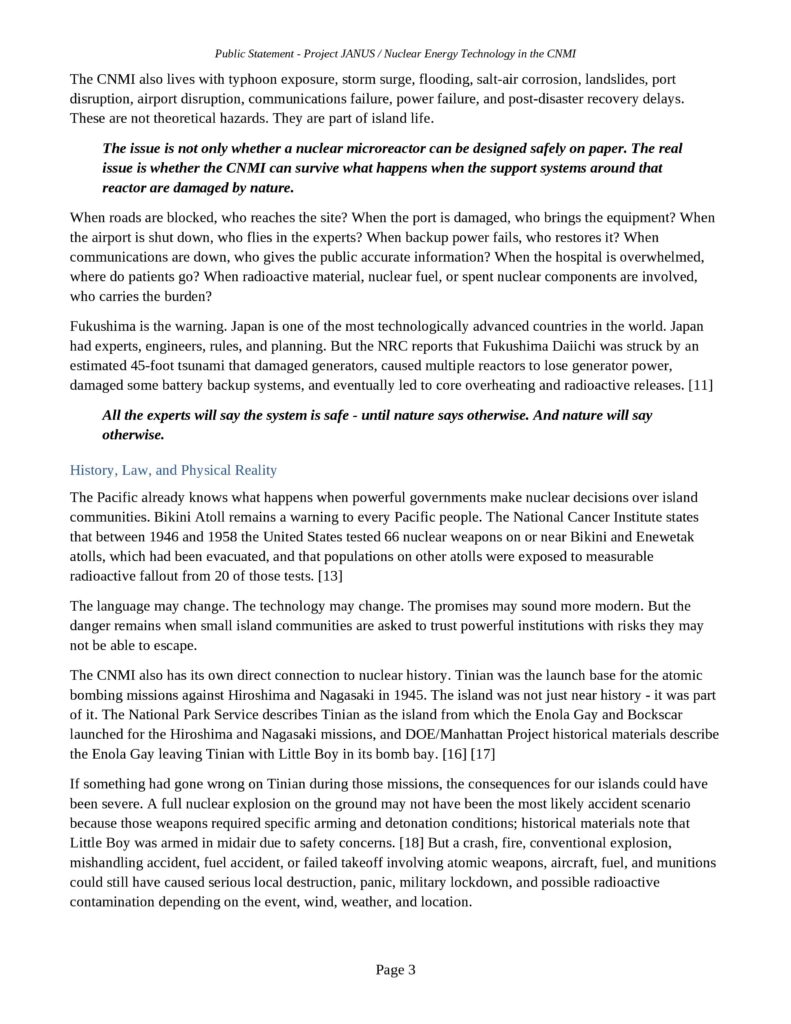
The CNMI also lives with typhoon exposure, storm surge, flooding, salt-air corrosion, landslides, port disruption, airport disruption, communications failure, power failure, and post-disaster recovery delays. These are not theoretical hazards. They are part of island life.
The issue is not only whether a nuclear microreactor can be designed safely on paper. The real issue is whether the CNMI can survive what happens when the support systems around that reactor are damaged by nature.
When roads are blocked, who reaches the site? When the port is damaged, who brings the equipment? When the airport is shut down, who flies in the experts? When backup power fails, who restores it? When communications are down, who gives the public accurate information? When the hospital is overwhelmed, where do patients go? When radioactive material, nuclear fuel, or spent nuclear components are involved, who carries the burden?
Fukushima is the warning. Japan is one of the most technologically advanced countries in the world. Japan had experts, engineers, rules, and planning. But the NRC reports that Fukushima Daiichi was struck by an estimated 45-foot tsunami that damaged generators, caused multiple reactors to lose generator power, damaged some battery backup systems, and eventually led to core overheating and radioactive releases. [11]
All the experts will say the system is safe – until nature says otherwise. And nature will say otherwise.
History, Law, and Physical Reality
The Pacific already knows what happens when powerful governments make nuclear decisions over island communities. Bikini Atoll remains a warning to every Pacific people. The National Cancer Institute states that between 1946 and 1958 the United States tested 66 nuclear weapons on or near Bikini and Enewetak atolls, which had been evacuated, and that populations on other atolls were exposed to measurable radioactive fallout from 20 of those tests. [13]
The language may change. The technology may change. The promises may sound more modern. But the danger remains when small island communities are asked to trust powerful institutions with risks they may not be able to escape.
The CNMI also has its own direct connection to nuclear history. Tinian was the launch base for the atomic bombing missions against Hiroshima and Nagasaki in 1945. The island was not just near history – it was part of it. The National Park Service describes Tinian as the island from which the Enola Gay and Bockscar launched for the Hiroshima and Nagasaki missions, and DOE/Manhattan Project historical materials describe the Enola Gay leaving Tinian with Little Boy in its bomb bay. [16] [17]
If something had gone wrong on Tinian during those missions, the consequences for our islands could have been severe. A full nuclear explosion on the ground may not have been the most likely accident scenario because those weapons required specific arming and detonation conditions; historical materials note that Little Boy was armed in midair due to safety concerns. [18] But a crash, fire, conventional explosion, mishandling accident, fuel accident, or failed takeoff involving atomic weapons, aircraft, fuel, and munitions could still have caused serious local destruction, panic, military lockdown, and possible radioactive contamination depending on the event, wind, weather, and location.
Tinian would have faced the immediate danger. Saipan, because of its closeness to Tinian, could also have faced danger from smoke, contamination, emergency disruption, military restrictions, fear, medical overflow, and supply interruption. Rota could have faced regional consequences depending on wind, ocean conditions, and military response.
In 1945, our people had no real say. There was no CNMI government. There was no modern emergency management system. There was no public consent. There was no practical evacuation option for island residents. The Mariana Islands were under wartime military control, and if something had gone wrong, the people of these islands would have carried consequences they did not choose.
That history matters today. Tinian’s atomic history proves that the CNMI has already been used as a strategic platform for nuclear warfare. Today, we must ask whether we are being asked to become a strategic platform again, only under different language – modern, advanced, resilient, microreactor, or national security.
The lesson from Tinian 1945 is not to blindly trust the plan. The lesson is to ask what happens when the plan fails.
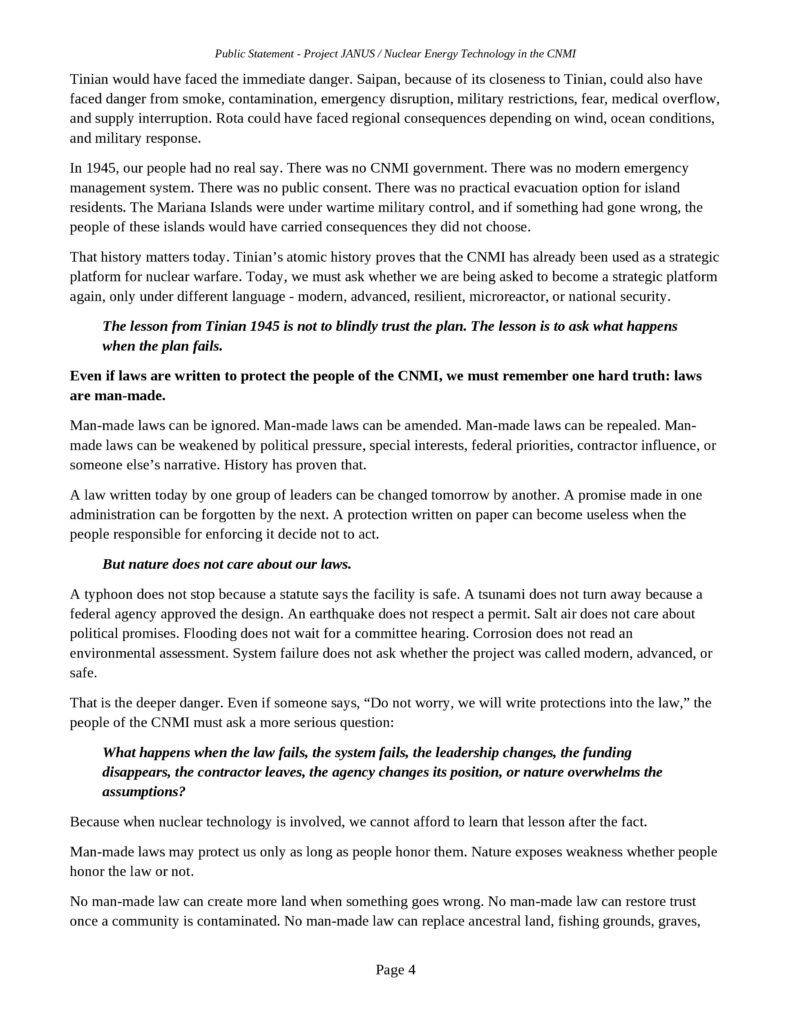
Even if laws are written to protect the people of the CNMI, we must remember one hard truth: laws are man-made.
Man-made laws can be ignored. Man-made laws can be amended. Man-made laws can be repealed. Man-made laws can be weakened by political pressure, special interests, federal priorities, contractor influence, or someone else’s narrative. History has proven that.
A law written today by one group of leaders can be changed tomorrow by another. A promise made in one administration can be forgotten by the next. A protection written on paper can become useless when the people responsible for enforcing it decide not to act.
But nature does not care about our laws.
A typhoon does not stop because a statute says the facility is safe. A tsunami does not turn away because a federal agency approved the design. An earthquake does not respect a permit. Salt air does not care about political promises. Flooding does not wait for a committee hearing. Corrosion does not read an environmental assessment. System failure does not ask whether the project was called modern, advanced, or safe.
That is the deeper danger. Even if someone says, “Do not worry, we will write protections into the law,” the people of the CNMI must ask a more serious question:
What happens when the law fails, the system fails, the leadership changes, the funding disappears, the contractor leaves, the agency changes its position, or nature overwhelms the assumptions?
Because when nuclear technology is involved, we cannot afford to learn that lesson after the fact.
Man-made laws may protect us only as long as people honor them. Nature exposes weakness whether people honor the law or not.
No man-made law can create more land when something goes wrong. No man-made law can restore trust once a community is contaminated. No man-made law can replace ancestral land, fishing grounds, graves, churches, homes, farms, culture, and future generations. And no man-made law can stop mother nature from doing what mother nature has always done.
What Happens to Saipan, Tinian, and Rota When the System Fails
The CNMI must not become another Pacific experiment. The CNMI must not become a testing ground. The CNMI must not become a storage site. The CNMI must not become a sacrifice zone.
If something goes wrong on Saipan, it affects the center of government, the hospital, the port, the airport, schools, businesses, homes, and the majority of our population.
If something goes wrong on Tinian, the entire island is at risk, and Saipan is close enough that wind, water, marine contamination, transportation disruption, and public fear can quickly make it a Commonwealth-wide crisis.
If something goes wrong on Rota, the island’s isolation becomes the danger. Help will not arrive instantly. Medical support will not be unlimited. Evacuation will depend on air and sea access, and those are exactly the systems that natural disasters can shut down.
If Project JANUS fails in the CNMI, where do our people go?
Where do the people of Saipan go? Where do the people of Tinian go? Where do the people of Rota go?
Do we abandon our homes? Do we abandon our land? Do we abandon our graves? Do we abandon our churches? Do we abandon our farms? Do we abandon our fishing grounds? Do we abandon our culture? Do we abandon our children’s future?
Our people’s lives are here. Our homes are here. Our families are here. Our future is here. Our ancestors are here. Our children will inherit what we protect – or what we allow others to risk.
We have nowhere else to go.
That is why this issue cannot be treated like a simple energy proposal. Nuclear technology in the CNMI is not just an infrastructure decision. It is a homeland decision.
The CNMI’s Real Energy Needs
I understand very well the energy crisis we are facing. The CNMI remains dangerously dependent on imported fuel. Our people are being crushed by high utility costs. Our power system is vulnerable to storms, fuel disruptions, aging infrastructure, poor planning, and weak accountability. CUC has serious problems that must be addressed.
But Project JANUS is not a shortcut around fixing CUC. Nuclear technology is not a shortcut around renewable energy. Nuclear promises are not a substitute for grid modernization, battery storage, distributed solar, hardened transmission and distribution systems, storm-resilient substations, water security, honest utility management, and real accountability.
Public Consent, Environmental Justice, and Affected-Island Rights
This is also an environmental justice issue. Pacific island communities have too often been asked to carry risks created by decisions made far away, justified by national security, science, or progress. The CNMI must not be placed in that position again without full knowledge, full consent, and full protection.
No nuclear-related activity should proceed on Saipan, Tinian, or Rota unless the people of that specific island have been fully informed and have clearly consented. One island should not be forced to carry a risk approved somewhere else. The affected island must have a voice before any study, site evaluation, pilot project, demonstration project, fuel movement, storage plan, or deployment decision moves forward.
We must also be honest that a “study” is not always neutral. A feasibility study can become the first step toward site selection, funding, contractor involvement, federal planning, political momentum, and public pressure. The people must be involved before the process begins, not after the path has already been shaped.
Our land is not only real estate. It is ancestral land. It is cultural land. It is burial ground, family history, farming ground, fishing ground, and the inheritance of future generations. No project should be allowed to place that inheritance at irreversible risk.
Civilian Ratepayer Benefit and End-of-Life Responsibility
If this proposal is being presented as an energy solution for the people, then the public deserves proof that it will actually reduce civilian utility costs, strengthen the civilian grid, protect ratepayers, and not simply serve federal or military energy objectives while leaving the CNMI with the risk.
Any proposal must answer the end-of-life question before anything is brought here: who decommissions the reactor, who removes the equipment, who removes the fuel, who restores the site, who monitors the land and water afterward, and who pays if the project is abandoned, damaged, obsolete, or no longer needed?
Minimum Questions and Conditions Before Any Nuclear Activity
Before anyone talks about Project JANUS, nuclear microreactors, small modular reactors, pilot projects, demonstration projects, nuclear fuel, or spent nuclear material in the CNMI, the people deserve binding answers.
Not promises. Not assurances. Not expert opinions. Not political talking points. Not language that says protections “should” be included.
We need language that says nothing shall proceed unless the people of the CNMI are protected by law – and even then, the physical risk must still be judged against reality, not theory.
Full public disclosure before any nuclear-related activity occurs.
Full public consent from the people of the specific affected island and the Commonwealth, before any study, siting, pilot project, demonstration project, fuel movement, storage plan, or deployment decision proceeds.
Full federal liability for any accident, contamination, health impact, cleanup, relocation, property loss, economic loss, or environmental damage.
Guaranteed removal of all nuclear fuel, spent nuclear material, and related components from the CNMI.
A binding prohibition against the CNMI becoming a nuclear storage site.
Independent technical review not controlled by CUC, contractors, political interests, or the agencies trying to deploy the technology.
Permanent environmental monitoring of land, air, ocean, groundwater, marine life, farms, and drinking water.
Fully funded emergency response, evacuation, medical, communication, and disaster recovery plans.
A clear disaster plan for typhoons, earthquakes, tsunamis, flooding, storm surge, corrosion, power failure, port failure, airport failure, and communications failure.
Protection for ratepayers so our people are not left paying for federal experiments.
A binding commitment that if the federal government brings the technology, the federal government owns the risk, the liability, the cleanup, the waste, and the consequences.
Proof that any project will directly benefit civilian ratepayers, reduce civilian utility costs, and strengthen the civilian grid – not only serve federal or military energy objectives.
A complete decommissioning and end-of-life plan before any equipment or fuel is brought to the CNMI, including who removes the reactor, removes the fuel, restores the site, monitors the environment afterward, and pays for every stage.
A cultural, ancestral land, fisheries, farming, and community impact review that recognizes land and ocean are not just property, but inheritance.
Until those protections are written into law, and until the people are fully informed and have given clear consent, I cannot and will not support this direction. But I will also say this clearly: even written protections cannot change the physical reality that the CNMI is small, exposed, and irreplaceable.
Moral Duty to Protect Our Homeland
This position is not fearmongering. This position is not anti-science. This position is not anti-energy. This position is not anti-progress. This position is about responsibility.
It is reasonable to ask hard questions before allowing nuclear technology into small islands with limited land, limited evacuation options, limited emergency capacity, and a painful Pacific history of nuclear decisions made by powerful governments.
It is factual to say that systems fail. It is factual to say that nature has overwhelmed advanced technology before. It is factual to say that the CNMI has nowhere else to go if our homeland is harmed.
It is morally right to protect our people. It is morally right to protect our homes. It is morally right to protect our land and ocean. It is morally right to protect our children’s future. It is morally right to protect the graves, memories, sacrifices, and history of those who came before us.
No government, contractor, federal agency, or expert class has the right to ask an island people to carry irreversible risk without full knowledge, full consent, full protection, and a clear answer to the most basic question: Where do our people go if the system fails?
The CNMI is not just a location on a federal planning map. The CNMI is our homeland. And protecting our homeland is not only reasonable. It is our duty.
Position
I am not anti-science. I am not anti-energy. I am not anti-progress. I am not against studying every possible solution to help our people.
But I am pro-CNMI. I am pro-people. I am pro-safety. I am pro-accountability. I am pro-future. I am pro-homeland.
And because of that, I oppose any effort to bring Project JANUS or any nuclear energy technology into the CNMI unless the people are fully informed, fully protected, and have given clear consent under binding and enforceable law – and unless the physical risk to our homeland is proven acceptable to the people themselves.
We should not allow the word modern to blind us. We should not allow the word safe to silence us. We should not allow the word federal to pressure us. We should not allow the word resilient to make us forget history.
History has already spoken. When systems fail, communities suffer. When nuclear systems fail, communities can lose more than power. They can lose land. They can lose trust. They can lose health. They can lose their economy. They can lose their future. They can lose their homeland.
The CNMI is our home. Our people’s lives, homes, and future are here – not somewhere else. When the system fails, we cannot simply drive away. When nature does what nature has always done, we cannot create more land. When history repeats itself, we cannot say we were not warned.
The CNMI is not a nuclear experiment. The CNMI is not a federal testing ground. The CNMI is not a sacrifice zone. The CNMI is our homeland – and we have nowhere else to go.
References and Source Materials for Public Review
The following source materials were used to ground this statement. Members of the public are encouraged to read them directly and reach their own informed conclusions.
[1] Senate Joint Resolution No. 24-05. CNMI Legislature, uploaded document reviewed in this discussion.
[2] Army announces Janus Program for next-generation nuclear energy. U.S. Army, Oct. 14, 2025. https://www.army.mil/article/288903/army_announces_janus_program_for_next_generation_nuclear_energy
[3] Army announces next steps on Janus Program for next-generation nuclear energy. U.S. Army, Nov. 18, 2025. https://www.army.mil/article/289074/army_announces_next_steps_on_janus_program_for_next_generation_nuclear_energy
[4] Executive Order 14299: Deploying Advanced Nuclear Reactor Technologies for National Security. The White House, May 23, 2025. https://www.whitehouse.gov/presidential-actions/2025/05/deploying-advanced-nuclear-reactor-technologies-for-national-security/
[5] Department of Defense Breaks Ground on Project Pele Microreactor. U.S. Department of Energy, Sept. 24, 2024. https://www.energy.gov/ne/articles/department-defense-breaks-ground-project-pele-microreactor
[6] DOE/EIS-0546: Construction and Demonstration of a Prototype Mobile Nuclear Microreactor, Idaho National Laboratory, Idaho. U.S. Department of Energy NEPA. https://www.energy.gov/nepa/doeeis-0546-construction-and-demonstration-prototype-mobile-nuclear-microreactor-idaho
[7] Emergency Preparedness Rulemaking for Small Modular Reactors and Other New Technologies. U.S. Nuclear Regulatory Commission. https://www.nrc.gov/reactors/new-reactors/advanced/modernizing/rulemaking/emergency-preparedness
[8] Marianas Submarine Volcanoes. NOAA Pacific Marine Environmental Laboratory. https://www.pmel.noaa.gov/eoi/marianas_site.html
[9] Northern Mariana Islands – Tsunami Hazard. ThinkHazard / Global Facility for Disaster Reduction and Recovery. https://thinkhazard.org/en/report/185-northern-mariana-islands-u-s/TS
[10] Building Tsunami Preparedness in the Commonwealth of the Northern Mariana Islands. NOAA Digital Coast, May 21, 2026. https://coast.noaa.gov/digitalcoast/stories/tsunami-preparedness.html
[11] Backgrounder on NRC Response to Lessons Learned from Fukushima Daiichi Accident. U.S. Nuclear Regulatory Commission. https://www.nrc.gov/reading-rm/doc-collections/fact-sheets/japan-events
[12] Commonwealth of the Northern Mariana Islands Profile. U.S. Environmental Protection Agency Region 9 archived profile. https://19january2017snapshot.epa.gov/www3/region9/islands/cnmi.html
[13] Dose Estimation and Predicted Risk for Marshall Islands Residents. National Cancer Institute. https://dceg.cancer.gov/research/how-we-study/exposure-assessment/nci-dose-estimation-predicted-cancer-risk-residents-marshall-islands
[14] Backgrounder on the Three Mile Island Accident. U.S. Nuclear Regulatory Commission. https://www.nrc.gov/reading-rm/doc-collections/fact-sheets/3mile-isle
[15] Advanced Nuclear Power for Installations Program. Defense Innovation Unit / Department of Defense, related military microreactor initiative. https://www.diu.mil/latest/DOD-selects-eligible-companies-for-the-Advanced-Nuclear-Power-for-Installations-Program
[16] Tinian Island during the Manhattan Project. U.S. National Park Service, Jan. 8, 2025. https://www.nps.gov/articles/000/tinian-island-during-the-manhattan-project.htm
[17] Assembling and Delivering the Uranium Bomb. U.S. Department of Energy / OSTI OpenNet Manhattan Project History. https://www.osti.gov/opennet/manhattan-project-history/Processes/BombTesting/assembly.html
[18] Dangers from Accidental Detonations. Atomic Heritage Foundation / Nuclear Museum primary-source summary. https://ahf.nuclearmuseum.org/ahf/key-documents/dangers-accidental-detonations/
Editor’s note: The views and opinions expressed in this op-ed are those of the author and do not necessarily reflect the views of NMI News Service or its staff. All assertions are the sole responsibility of the writer. To submit an op-ed for consideration, email your piece to brad.ruszala@nminewsservice.com.