Across the Freely Associated States and territories of the Pacific, migration is not an exception. It is a defining reality of modern island life. Families move for education, military service, health care, and economic opportunity while remaining deeply connected to their home islands through remittances, cultural ties, and civic participation. In this context, a growing debate in the Federated States of Micronesia is drawing attention beyond its borders and raising important questions about representation, belonging, and the role of diaspora citizens in shaping their nation’s future.
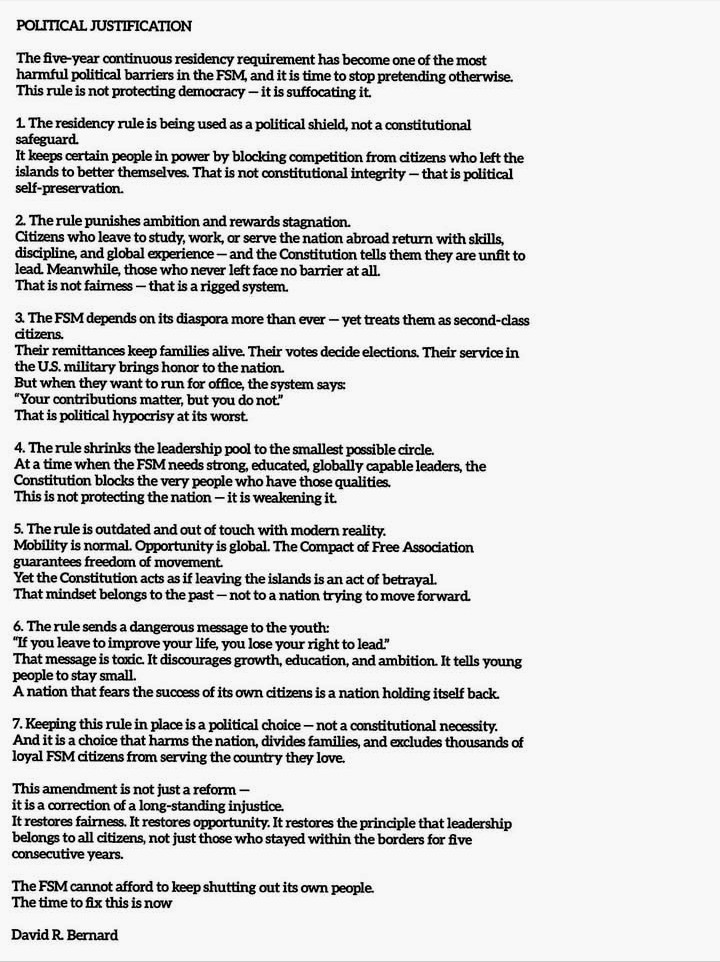
David R. Bernard, a longtime CNMI resident now living in Oregon and a citizen of the Federated States of Micronesia, has entered the race for the FSM House of Senate, representing the Northwest Region. His candidacy has amplified discussion around the country’s five year continuous residency requirement for national office, a rule that he argues no longer reflects the realities of mobility under the Compact of Free Association or the lived experience of Micronesian citizens abroad.
In a recent public statement, Bernard framed the requirement as a structural barrier that limits political participation for citizens who leave the islands to pursue education, employment, or service opportunities. He argues that many of those who depart return with skills, professional experience, and global networks that could strengthen governance and national development. Yet under the current framework, their absence may disqualify them from leadership at precisely the moment their experience could be most valuable.
The issue resonates strongly across the CNMI, where communities are shaped by similar patterns of movement and return. Thousands of Compact migrants contribute to island economies, serve in the United States military at high rates, and maintain transnational family networks that sustain both home and host communities. The question raised by Bernard’s campaign is therefore not solely about FSM constitutional interpretation, but about a broader regional tension involving how Pacific societies balance territorial rootedness with transoceanic citizenship.
Supporters of residency requirements often view them as safeguards that ensure leaders remain grounded in local realities and accountable to the communities they serve. Critics contend that rigid interpretations risk excluding diaspora citizens whose economic contributions, cultural engagement, and political participation remain active despite geographic distance. In smaller island nations where outward migration is structurally embedded in development pathways, the consequences of exclusion may extend beyond electoral fairness to questions of national cohesion.
Bernard’s statement also highlights the symbolic implications for younger generations. Many Pacific youth are encouraged to seek opportunities abroad while simultaneously being reminded that leadership at home requires uninterrupted presence. This contradiction can produce a sense that mobility is both necessary for advancement and penalized in civic life, a dynamic that policymakers across the region are increasingly confronting.
For CNMI readers, the conversation offers a mirror rather than a distant political dispute. The Marianas themselves are part of a broader Blue Pacific network where identity, citizenship, and belonging are shaped by movement across islands and oceans. Debates over diaspora representation, voting rights, and pathways to leadership are emerging in different forms throughout the region and reflect a shared need to modernize governance structures while maintaining cultural grounding.
Whether FSM ultimately reforms its residency requirement will be decided through its own constitutional and democratic processes. Yet the discussion sparked by Bernard’s candidacy underscores a larger regional reality. Pacific nations cannot easily separate homeland from diaspora, nor can they ignore the growing influence of citizens who contribute from afar while remaining deeply invested in the future of their islands.
At its core, this is not simply a legal question but a philosophical one. It asks whether leadership is defined primarily by physical presence or by sustained commitment, cultural continuity, and the willingness to serve regardless of where opportunity temporarily carries Pacific Islanders.
As mobility continues to shape the Pacific century, the answers to these questions may influence how island nations harness the strength of their people across oceans rather than within borders alone.
By Eipéráng (Gregorie Michael Towai)
Gregorie Michael Towai is a cultural advocate and independent researcher from the Commonwealth of the Northern Mariana Islands currently residing in Oregon.
Editor’s note: The views and opinions expressed in this op-ed are those of the author and do not necessarily reflect the views of NMI News Service or its staff. All assertions are the sole responsibility of the writer.
To submit an op-ed for consideration, email your piece to brad.ruszala@nminewsservice.com