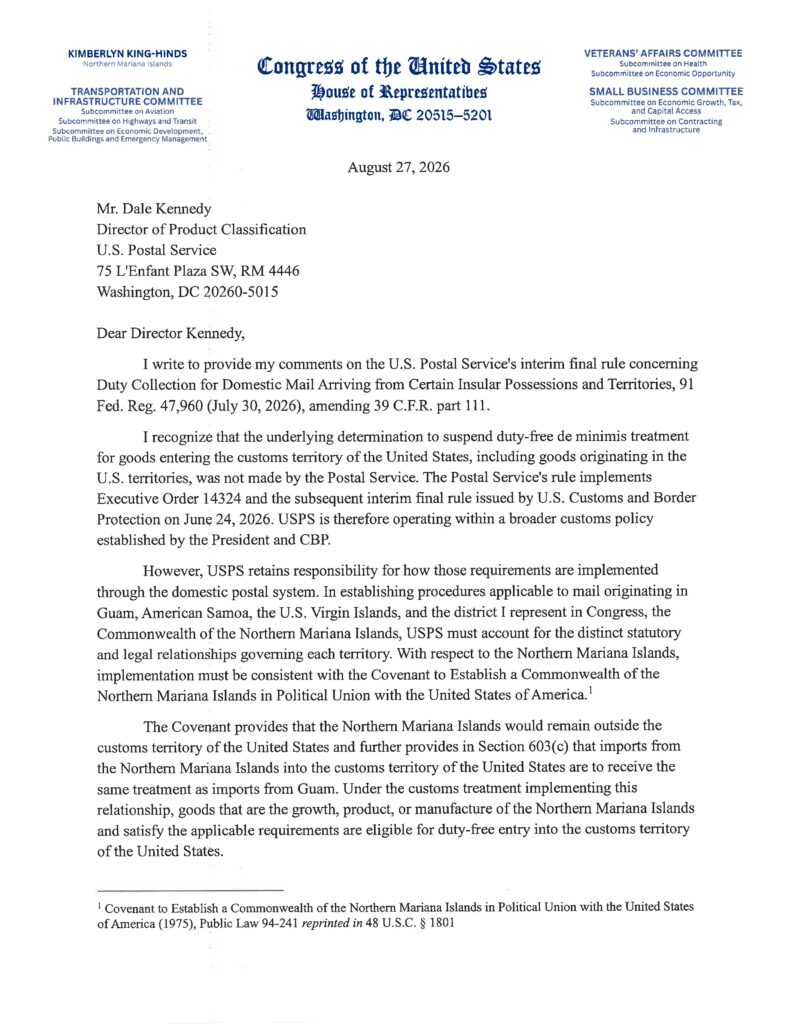




SAIPAN — Congresswoman Kimberlyn King-Hinds has submitted formal comments urging the U.S. Postal Service to suspend implementation of new duty collection requirements for mail originating in the U.S. territories until legal and administrative concerns affecting territorial residents are addressed.
The USPS interim final rule establishes procedures for collecting and prepaying customs duties, taxes and fees on certain goods mailed from the CNMI, Guam, American Samoa and the U.S. Virgin Islands into the customs territory of the United States. The rule follows the suspension of federal de minimis treatment under Executive Order 14324 and subsequent Customs and Border Protection regulations.
King-Hinds acknowledged USPS did not make the underlying decision but said the Postal Service remains responsible for ensuring its implementation complies with the distinct laws governing each territory. For the CNMI, she pointed to the Covenant: Section 603(c) provides that imports from the Northern Mariana Islands receive the same treatment as imports from Guam, and qualifying goods that are the growth, product or manufacture of the CNMI may enter the U.S. customs territory duty-free.
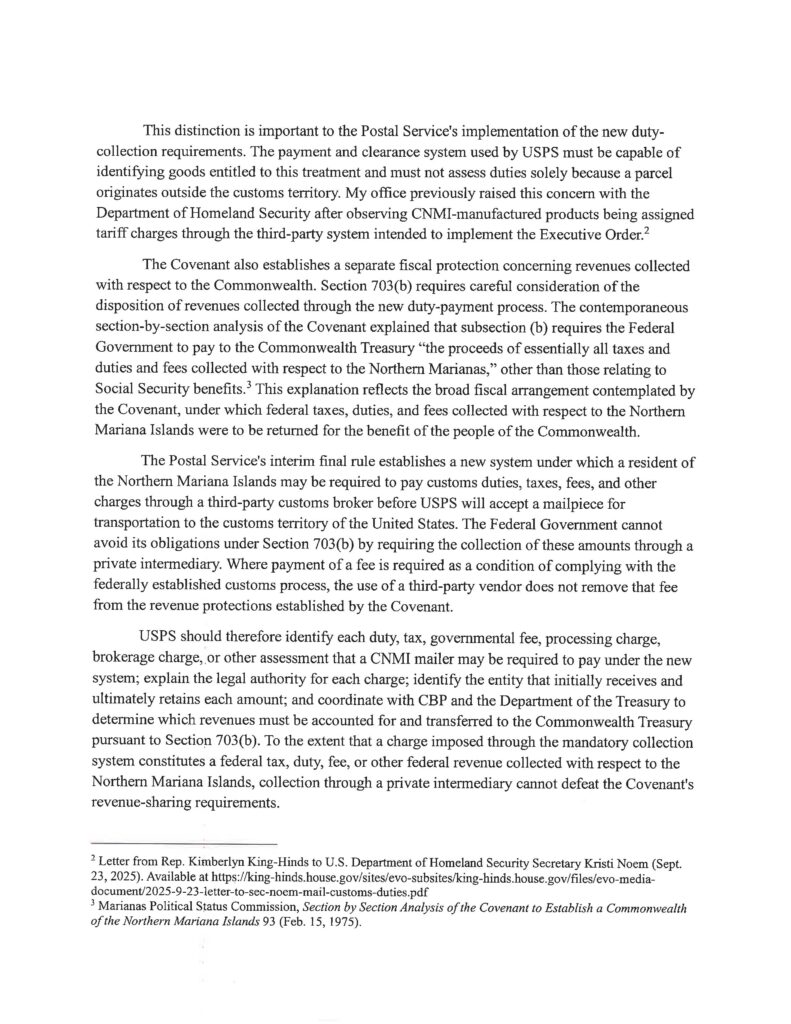
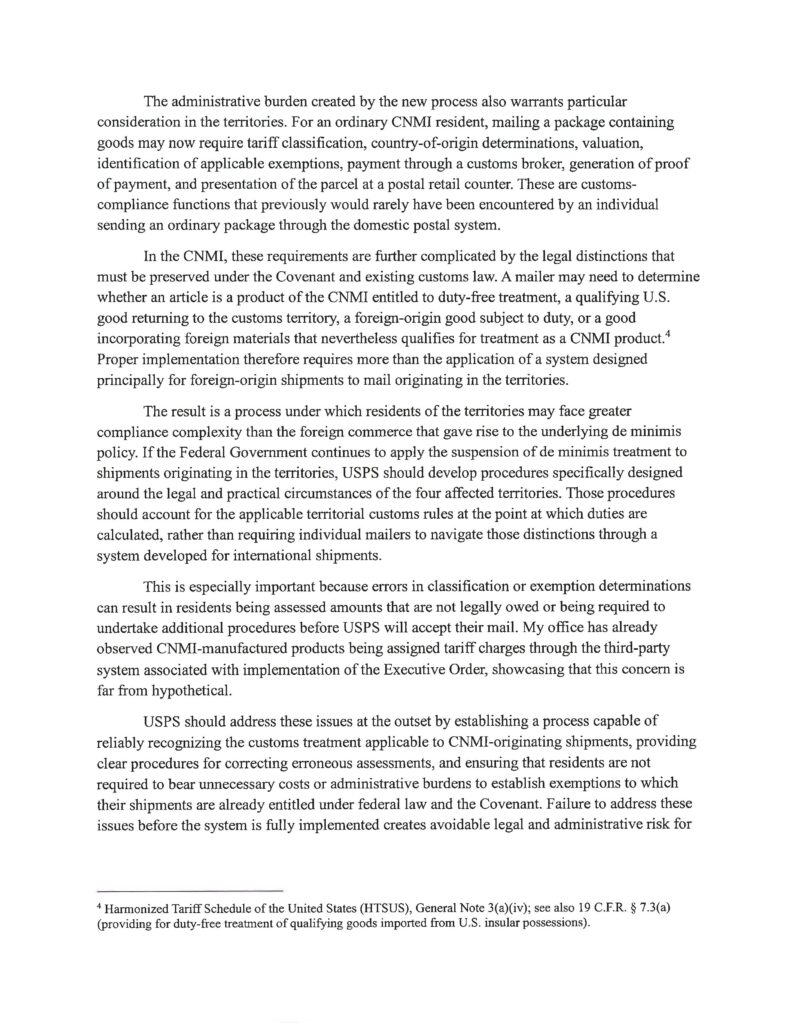
“The payment and clearance system used by USPS must be capable of identifying goods entitled to this treatment and must not assess duties solely because a parcel originates outside the customs territory,” King-Hinds wrote. Her office has already observed CNMI-manufactured products being assigned tariff charges through the third-party system implementing the executive order, a concern she previously raised with the Department of Homeland Security.
She also cited Section 703(b), understood to require payment to the Commonwealth Treasury of “the proceeds of essentially all taxes and duties and fees collected with respect to the Northern Marianas” apart from Social Security. “The Federal Government cannot avoid its obligations under Section 703(b) by requiring the collection of these amounts through a private intermediary,” she wrote.
The comments describe the burden on ordinary mailers, who may now face tariff classification, country-of-origin determinations, valuation, exemption identification, payment through a customs broker and proof of payment at the retail counter. King-Hinds calls on USPS to identify every charge a CNMI mailer may pay, its legal authority, who retains it, and which revenues belong to the Commonwealth Treasury.
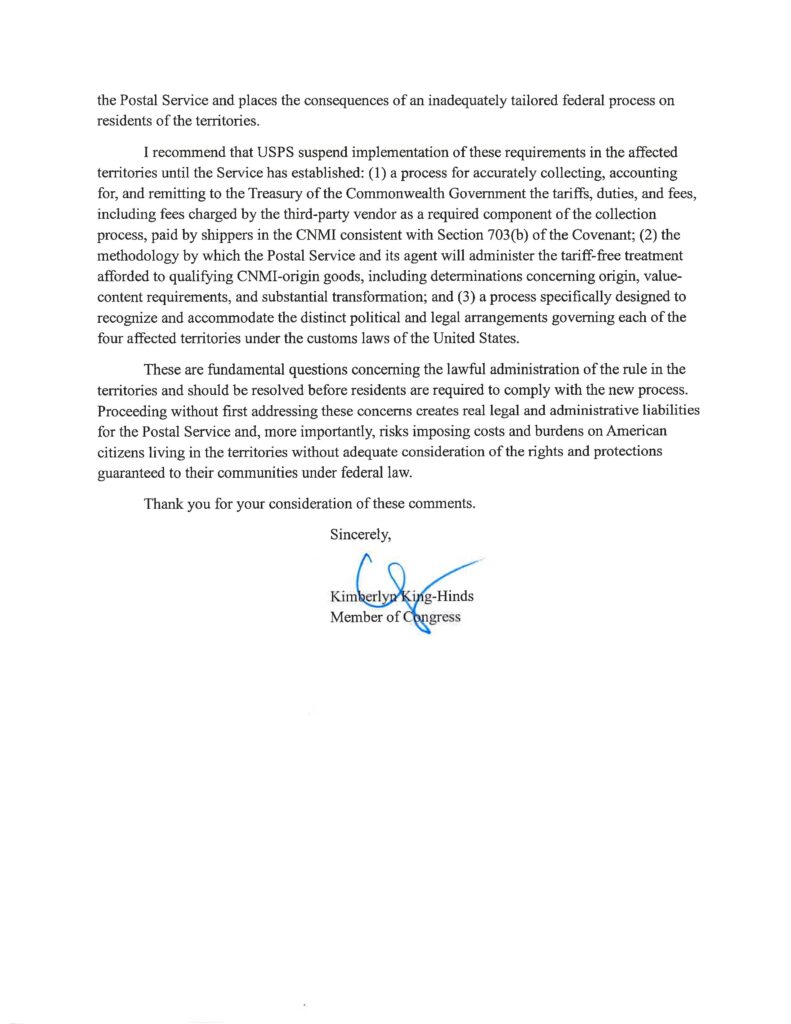
King-Hinds recommended suspension in the affected territories until USPS establishes a Covenant-consistent collection and remittance process, a methodology for administering tariff-free treatment of qualifying CNMI-origin goods, and procedures recognizing the distinct legal arrangements of the four territories. “These are fundamental questions concerning the lawful administration of the rule in the territories and should be resolved before residents are required to comply,” she wrote.