SAIPAN — The U.S. Army Corps of Engineers is working on a plan to bring temporary generators to Tinian that could energize the island’s power system before CUC completes repairs to the Tinian power plant, CUC officials said at a press briefing Friday.
CUC Executive Director Kevin Watson, Utility Coordinator Joel Hoepner and T&D Engineer Jonathan Camacho briefed reporters at NMI News Service on power and water restoration progress.
Tinian
The auger needed to set new power poles in Tinian was repaired Thursday and is being put to work setting poles Friday, Watson said. CUC is sending Guam Power Authority mechanics from the power plant and an additional line crew to assist on Tinian. CUC is also hiring a private company to send another crew with a bucket truck and is renting a second auger.
“We’ll have two operational augers and about five, six bucket trucks with four crews, six men and crews,” Watson said. “We should have transmission distribution done within three to four weeks in Tinian.”
The Tinian power plant is the bigger question, Watson said. The plant building still has structural damage that has to be repaired before the engines can dry out. CUC is bringing heaters in from Guam, and the military is providing bucket trucks to assist with repairs to the building’s ceiling and sidewalls.
“You were there, you saw that there’s big holes letting the rain come in still in both the ceiling and the sidewalls,” Watson said. “We have to stop the rain from coming in the building to protect the equipment. Otherwise, it’s just going to keep getting recurring. You dry it out, it’s going to get wet.”
USACE is working on temporary power solutions for Tinian that would allow the island to come online ahead of plant repairs. Camacho said the federal team is sharing plans with CUC for energizing both feeders through temporary generators.
“Don’t lose hope though, because we were informed by the Army Corps of Engineers that they’ve done their assessments in Tinian Power Plant and they’re working away to provide temporary power for Tinian,” Camacho said. “These guys are working magic.”
Tinian has 111 damaged poles and about 60 in stock, Camacho said.
“Don’t be surprised that they get to 100% before we do,” Camacho said. “Once those temporary generators land, the only setback would be the poles… they might have power first thing in the evening, 100% energized.”
Watson said the Tinian power plant is over 25 to 40 years old, and CUC has been in long-term discussions with the Department of War for funding for new engines or a new plant for both Tinian and Saipan. A council meeting on April 21 was postponed due to the typhoon and is expected to resume in the summer.
“All the options will be analyzed,” Watson said. “Yes, it is an expensive process, both in Tinian and here. But we have military buildup in Tinian, as you’re aware of, and other industries are looking to come in… and that power plant is over 25 to 40 years old. And the same is here in Saipan. So we do need a long-term plan.”
A specialist from the American Public Power Association traveled from Massachusetts under a mutual aid agreement to assess Tinian transmission and distribution and is working on a repair plan. The specialist had visited Tinian twice earlier in the week, with another visit planned for Saturday, Watson said. Guam Power Authority engine mechanics have also assessed Tinian’s engines.
Saipan power
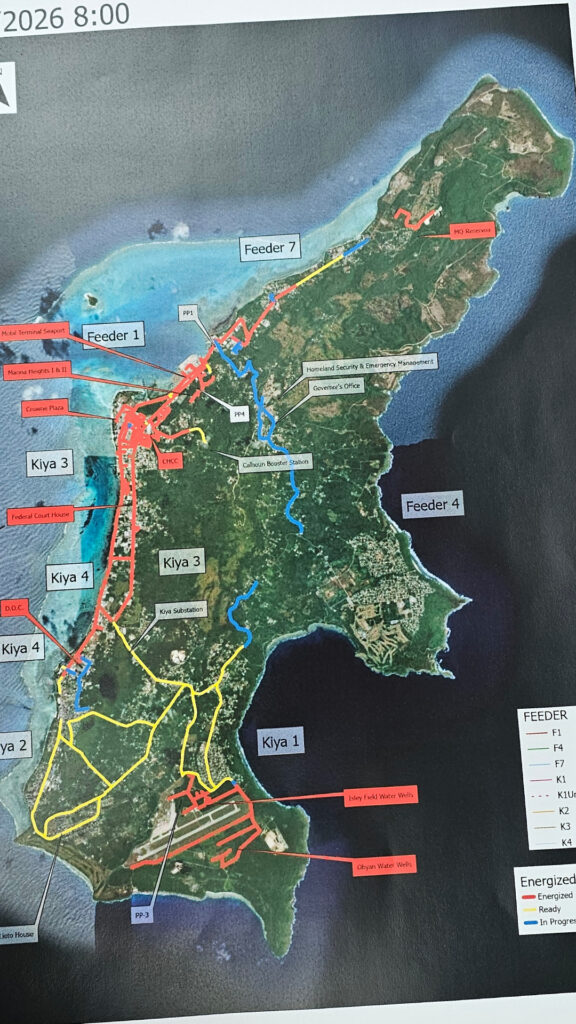
CUC Saipan power generation is stabilizing on Engine 1 at Power Plant 1, which is producing 5.5 megawatts and powering a primary network from Puerto Rico through Garapan, Middle Road and Beach Road extending to Susupe, Camacho said. Aggreko has 13 megawatts of generation available, with 2 megawatts currently in use and 11 in reserve to bring online as more loads connect. Power Plant 4 has 4 available megawatts on standby.
Total Saipan load is currently around 7 megawatts. Two feeders are operational, with a third, Feeder 4, expected online soon.
“We’re expecting all primary lines to be energized within the next week,” Camacho said. “So now all of our line crews are going to start focusing on preparing laterals, houses, commercial facilities for energization.”
Camacho said that with multiple feeders operational, CUC can isolate faults to single feeders rather than risk island-wide blackouts.
“In the case of any kind of fault event, which we’re hoping not going to happen, we can load shed,” Camacho said. “We’ll trip one feeder just to protect the rest of the feeders, and then once the fault’s been detected, isolated and cleared, we can go ahead and re-energize.”
Pre-typhoon peak load on Saipan was approximately 38 megawatts, Camacho said. Engine 2 at Power Plant 1 is undergoing testing and is showing promise. Additional generation capacity is expected to come online as more residents become ready for energization.
A specialist from Guam Power Authority is now embedded on Feeder 4 and is making strong progress, Watson said. GPA crews may be reassigned to assist on additional feeders.
CUC is asking the public to stay clear of line crews working in the field. Camacho said residents have been approaching crews directly to request power restoration at their homes, creating safety concerns.
“That becomes a hazard in our situation because now our line crews can’t operate correctly with a safety concern now within their work area,” Camacho said. “We’re getting there. The line crews are working in the process. They’ll get to your house. We promise you that.”
The biggest remaining setback is materials, Camacho said. Damaged transformers are being tested and salvaged where possible. Service drop conductor lead times can run up to three months, and CUC has urged residents not to cut or remove drop lines, and to watch for wire theft.
“Some of our lead times for those conductors are three months,” Camacho said. “Secure your drop lines. Make sure no one’s stealing it. Don’t cut your own drop lines and get rid of it because you’re looking at maybe three months for that to be repaired.”
Watson said a new round of concrete pole installations will continue replacing wood poles damaged by Sinlaku, with shipments arriving from Guam and South Korea every two weeks at 40 to 60 poles per shipment, manufactured to 2018 standards rated for sustained winds above 200 mph. CUC had 100 concrete poles in stock before the typhoon, all of which are now installed. Wood poles are being used as a stopgap and will be replaced with concrete as supply allows.
When asked about rumors that some areas could wait a year or more for power, Watson said the timeline is being revised continuously as additional assistance arrives.
“It won’t be a year or two years,” Watson said. “Depending on where they are, it could take longer than others. But as Jonathan pointed out, we’re making tremendous progress.”
To check whether their home has been re-energized, Camacho said residents should turn on their main breaker, but only after disconnecting any generator they have hooked into the home circuit. Visually, residents can check their service drop and the transformer serving their home: a fuse cutout hanging down means the line is not energized; a closed cutout means the line is most likely energized.
Saipan water
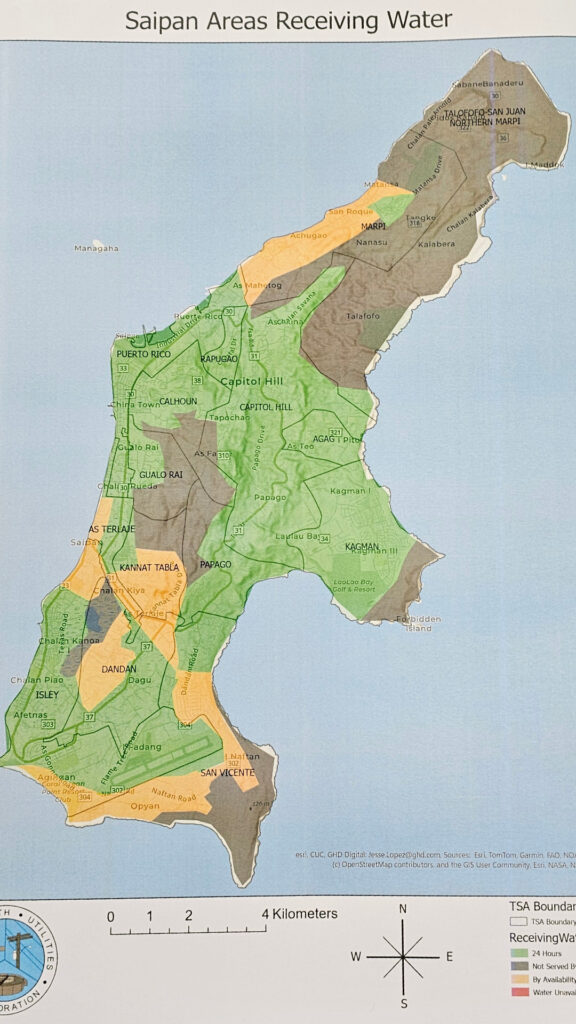
Approximately 80% of Saipan now has 24-hour water service, Hoepner said.
“The Army Corps and FEMA, their generators are keeping our water wells pumping water as well,” Hoepner said. “Thanks to the Army Corps and the FEMA for all they’ve done on the water distribution side.”
Several tank service areas reached 100% service this week. The Isley Tank Service Area, which serves Susupe, Chalan Kanoa, Afetnas, San Antonio and parts of Koblerville, has been at 100% for approximately four days. The Dandan Tank Service Area, including Airport Road and parts of Koblerville, is also at 100%.
Six additional wells in Kagman came online this week with USACE generators and a booster pump, allowing CUC to push approximately 500 gallons per minute from Kagman to Papago and the San Vicente tanks. As a result, San Vicente Village has been receiving 24-hour service for about a day. Dandan Homestead and the Olsen area have seen extended water hours, beyond the prior 9 a.m. to 1 p.m. window.
The added Kagman capacity also took pressure off the Isley well field, which had been carrying the south end. Garapan now has 100% water service, from the cemetery road north to Tanapag and south to the federal courthouse.
Kannat Tabla, the last tank service area marked red on the CUC map, was restored Thursday at approximately 1 p.m. after vendors installed a bypass in the transmission and distribution piping. Some areas of Kannat Tabla received normal water; others had lower pressure. CUC is operating the system on pumps and is working to dial in the process over the next day or two, which is expected to also restore service to upper Chalan Kiya.
CUC is still losing significant water in the As Matuis, San Roque and Tanapag areas. As Matuis has pressure most of the time. Tanapag and San Roque have water for a few hours from morning to mid-afternoon. Crews are continuing leak detection and pipe repairs in the north.
A new 1 million gallon water tank for the Dandan Tank Service Area passed final inspection Thursday. CUC expects it online in the coming weeks, which Hoepner said will significantly improve service to the area. There will be water service interruptions to clean and fill the tank, with public notice in advance.
About 35 to 45 FEMA generators are powering wells across Saipan, Hoepner said. Approximately 40 CUC team members are divided into three field groups working in the north, central and south, identifying and repairing more than 100 leaks per day.
Next briefing
CUC said it will hold its next briefing the same time next week, on Friday, with earlier updates if major progress occurs in the meantime.