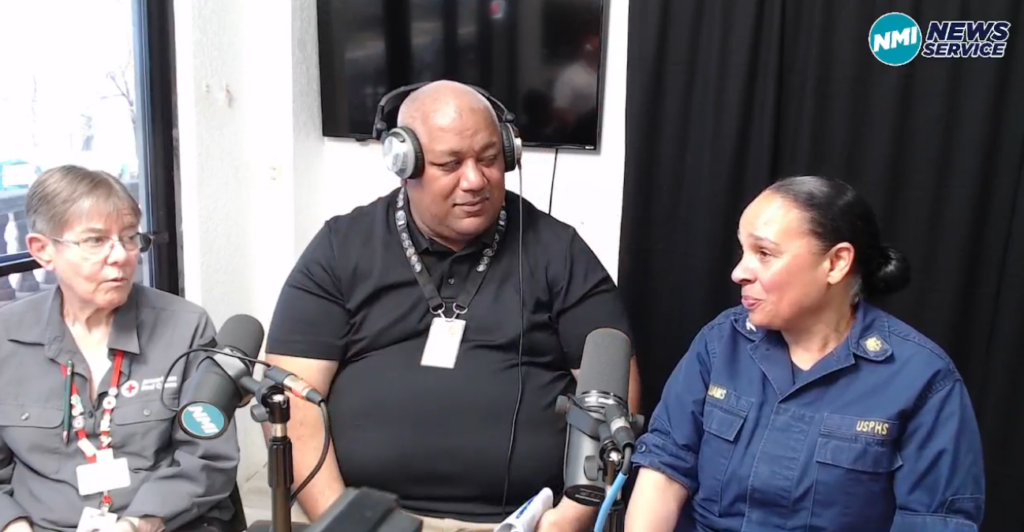
SAIPAN — Mental health professionals from the American Red Cross, the U.S. Public Health Service and CHCC Community Outreach joined the NMI News Service Thursday to deliver a message to a community now two weeks into recovery from Typhoon Sinlaku: what you are feeling is normal, help is available, and you do not have to go through it alone.
Tory Fiedler, disaster mental health manager for the American Red Cross with 25 years of disaster response experience, said the goal of mental health support during a disaster is not treatment, it is helping people return to the emotional equilibrium they had before the storm.
“We know that people are fundamentally well and it’s our job to help them remember and return to the things that kept them well before the disaster,” Fiedler said.
She said the most accessible self-regulation tool available to anyone is breathing. Five deep breaths in the morning, at noon, at dinner and before bed can lower adrenaline levels enough to reduce emotional brittleness and prevent people from being overwhelmed when difficult moments arise.
Captain Aimee Williams of the U.S. Public Health Service, disaster behavioral health lead for the Administration for Strategic Preparedness and Response within the U.S. Department of Health and Human Services, said her team of five is working alongside CHCC supporting community outreach and participating in trainings and long-term recovery planning. ASPR had pre-positioned a health and medical task force on island prior to Sinlaku to support the hospital.
Fred Fatialofa of CHCC AOC Community Outreach introduced the PAUSE-RESET-NOURISH framework his team is using in community outreach. He shared that during the storm itself, while sheltering with his family, he paused to listen to his daughters, one of whom was grieving a cancelled prom, and the reset came when they recognized others around them had lost far more. In the days since, his daughters have gone out voluntarily to help elderly neighbors clear debris.
“It’s okay to really not be okay,” Fatialofa said. “As manly as we try, sometimes this is not as easy as I thought. I don’t feel strong today, and that’s okay.”
Fiedler emphasized that competitive suffering, or feeling guilty that others have it worse, is not productive. “Grief is not a competition,” she said. “It’s relative, it’s unique to each person, and it’s a real thing.”
A caller named Evelyn Cangco shared that her 10-year-old autistic grandson was deeply distressed by the damage to the beaches and trees he loves photographing. Fiedler encouraged the family to help him find beauty in what is there now and to document the change, while Fatialofa suggested using his before-and-after photos as a way to give hope that what was broken can return.
The Red Cross has 349 volunteers on the ground across Saipan, Guam, Tinian and Rota providing shelter, supplies, healthcare and mental health support. Red Cross can also replace lost prescriptions, durable medical equipment including wheelchairs, walkers, prosthetics and CPAP machines, and disability supplies, as long as the person had an active prescription and the item was lost as a result of the disaster.
Mental Health Resources:
- National mental health crisis line: 988 (24 hours, available in every language)
- Disaster Distress Line: 1-800-985-5990 (24 hours, all languages)
- CHCC Community Guidance Center mental health line: (670) 287-4063
- Addiction services line: (670) 788-0114
- American Red Cross: (670) 234-3459
- ASPR Emergency Prescription Assistance Program: ASPR.gov
- CHCC outpatient hours: 7:30 a.m. to 4:30 p.m.
Watch the full interview on the NMI News Service Facebook page or YouTube channel.