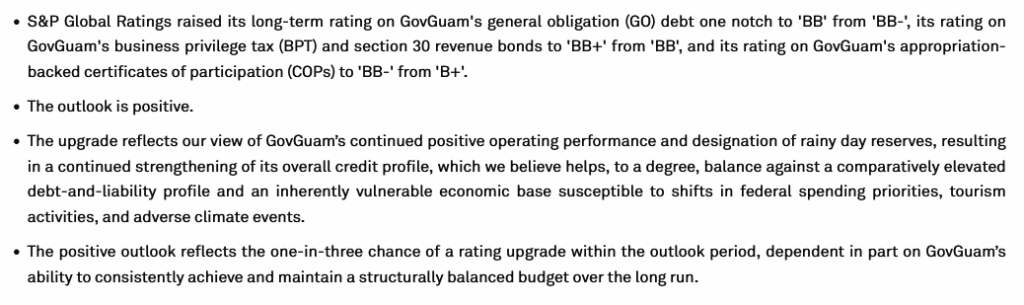
Saipan — S&P Global Ratings has raised Guam’s long-term rating on its general obligation debt one notch to BB from BB-, citing continued positive operating performance and the designation of rainy day reserves, while assigning the territory a positive outlook that signals the possibility of another upgrade within the next two years.
The rating action, announced by S&P on February 25, also included upgrades for other Guam-backed debt. S&P raised its rating on Guam’s business privilege tax and Section 30 revenue bonds to BB+ from BB, and lifted its rating on appropriation-backed certificates of participation to BB- from B+.
S&P said the upgrade reflects continued strengthening in Guam’s overall credit profile, driven by recent operating performance and reserve building. At the same time, the agency said those gains are still being weighed against what it described as a comparatively elevated debt and liability burden, along with an economic base that remains vulnerable to outside shocks.
The ratings agency pointed to Guam’s exposure to changes in federal spending priorities, shifts in tourism activity, and climate-related threats as continuing risk factors in its analysis. It also cited governance risk tied to the territory’s unique relationship with the federal government, saying that relationship can create budget uncertainty in ways that differ from U.S. states.
S&P said Guam’s economy remains heavily concentrated in two major sectors, the military and international tourism. That leaves the island especially sensitive to changes in travel demand and federal policy.
Even with the upgrade, Guam remains below investment grade. Still, the positive outlook means S&P now sees a one-in-three chance of another rating increase during the outlook period if the government can consistently maintain a structurally balanced budget over the long term.
S&P also warned that the outlook could be revised back to stable if Guam’s economic or budgetary momentum begins to stall. The agency said that could happen if broader conditions worsen because of factors outside Guam’s control, including weather events, federal policy changes, or weaker international travel demand. In that scenario, S&P said structural budget gaps could emerge and force unplanned draws on reserves.
At the same time, S&P said further strengthening of budget reserves, sustained structural balance, and even modest improvement in Guam’s debt and liability profile could support another upward move if the island can continue to show resilience under changing conditions.
The upgrade gives Guam a measurable credit boost, but S&P’s analysis also makes clear that the island’s financial progress remains tied to careful budgeting, reserve discipline, and an economy still vulnerable to forces beyond local control.