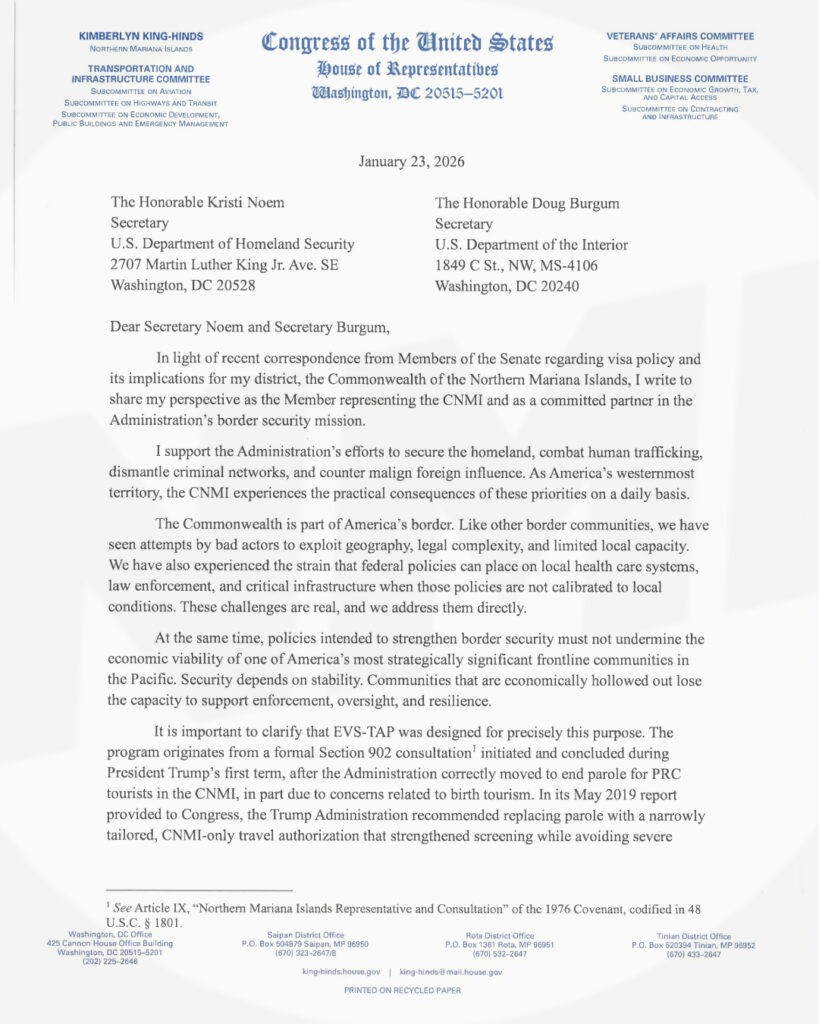
WASHINGTON, D.C. — CNMI Delegate Kimberlyn King-Hinds is urging the Trump administration’s top homeland security and interior officials to treat the Northern Marianas as both a border community and a frontline economic outpost, warning that border-security policy changes that ignore local conditions could weaken the Commonwealth’s stability and, by extension, its ability to support enforcement and resilience.
In her letter addressed to Homeland Security Secretary Kristi Noem and Interior Secretary Doug Burgum, King-Hinds wrote in response to recent Senate correspondence about CNMI visa policy, saying she supports efforts to secure the homeland, combat trafficking, dismantle criminal networks, and counter malign foreign influence. She said the CNMI experiences the practical consequences of these priorities daily and has seen attempts by bad actors to exploit geography, legal complexity, and limited local capacity.
But King-Hinds argued security “depends on stability,” and said policies intended to strengthen border security should not undermine the economic viability of one of America’s most strategically significant frontline communities in the Pacific.
A major section of the letter focuses on the CNMI Economic Vitality & Security Travel Authorization Program, better known as EVS-TA, which King-Hinds described as a security-and-stability tool that grew out of the formal Section 902 consultation process during President Trump’s first term. She wrote that after the administration moved to end discretionary parole for PRC tourists due to birth tourism concerns, a May 2019 report recommended replacing parole with a narrowly tailored, CNMI-only travel authorization that strengthened screening while avoiding severe economic disruption. King-Hinds said EVS-TAP reflects that recommendation and the idea that border security and economic stability can be advanced together.
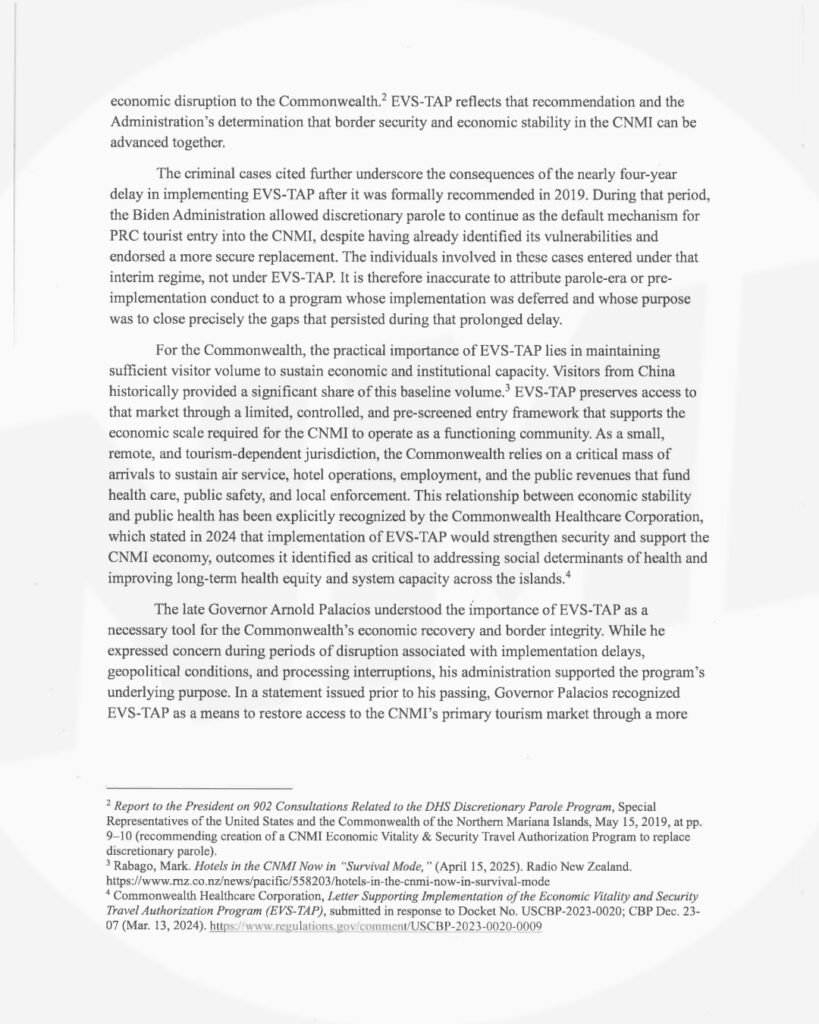
She also pushed back on linking certain criminal cases to EVS-TAP itself, arguing the cases cited highlight the consequences of a nearly four-year delay in implementing EVS-TAP after it was recommended in 2019. During that period, she wrote, discretionary parole remained the default mechanism for PRC tourist entry, and she said it is inaccurate to attribute parole-era problems to a program whose implementation was deferred and whose purpose was to close those gaps.
King-Hinds wrote that EVS-TAP’s practical importance is maintaining enough visitor volume to sustain the CNMI’s economic and institutional capacity, noting that visitors from China historically made up a significant share of baseline visitor volume. She said EVS-TAP preserves access through a limited, controlled, and pre-screened framework that supports the economic scale needed for the CNMI to function, including arrivals that help sustain air service, hotel operations, employment, and public revenues tied to health care and public safety.
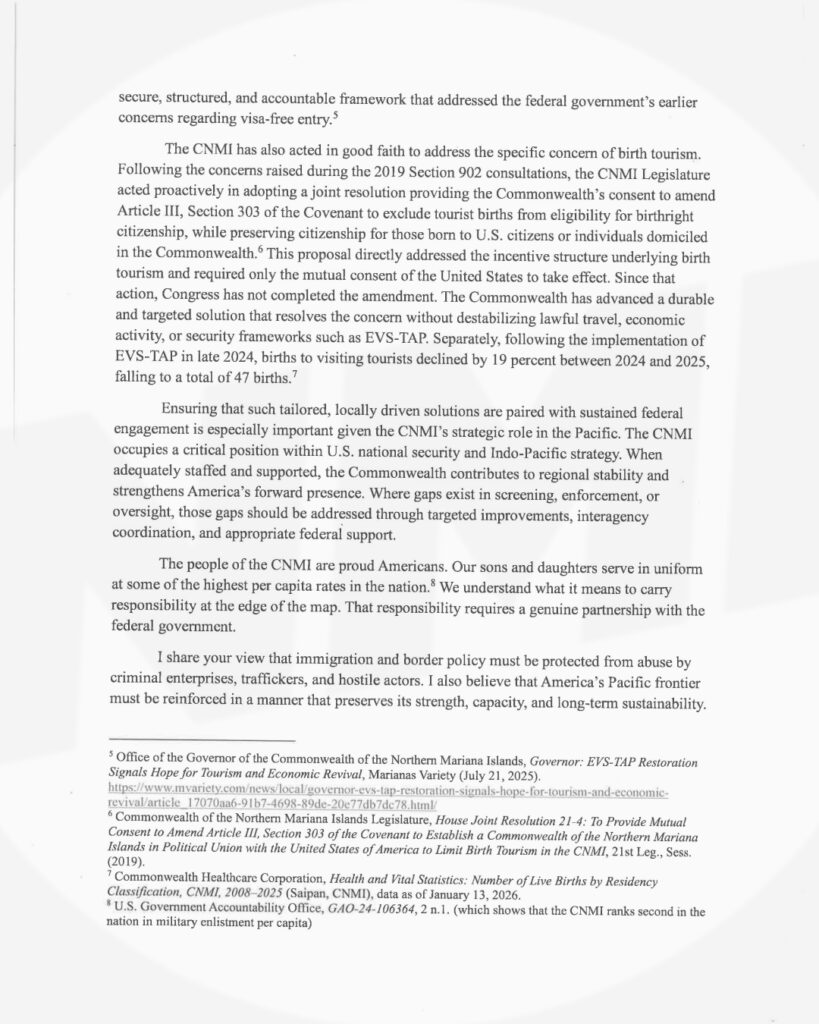
She cited the Commonwealth Healthcare Corporation as recognizing the relationship between economic stability and public health, and referenced prior statements by the late Gov. Arnold Palacios supporting EVS-TAP’s underlying purpose as a more secure and accountable framework.
King-Hinds wrote that the CNMI has acted in good faith to address birth tourism, pointing to a CNMI Legislature joint resolution consenting to amend the Covenant to exclude tourist births from eligibility for birthright citizenship, while preserving citizenship for children born to U.S. citizens or individuals domiciled in the Commonwealth. She noted the amendment requires mutual consent and said Congress has not completed it.
Separately, she wrote that after EVS-TAP was implemented in late 2024, births to visiting tourists declined by 19% between 2024 and 2025, falling to 47 births.
King-Hinds emphasized the CNMI’s place in U.S. national security and Indo-Pacific strategy and called for targeted improvements rather than destabilizing lawful travel and the economy. She also pointed to CNMI military service, citing a GAO reference indicating the Commonwealth ranks among the highest per-capita enlistment rates nationally.
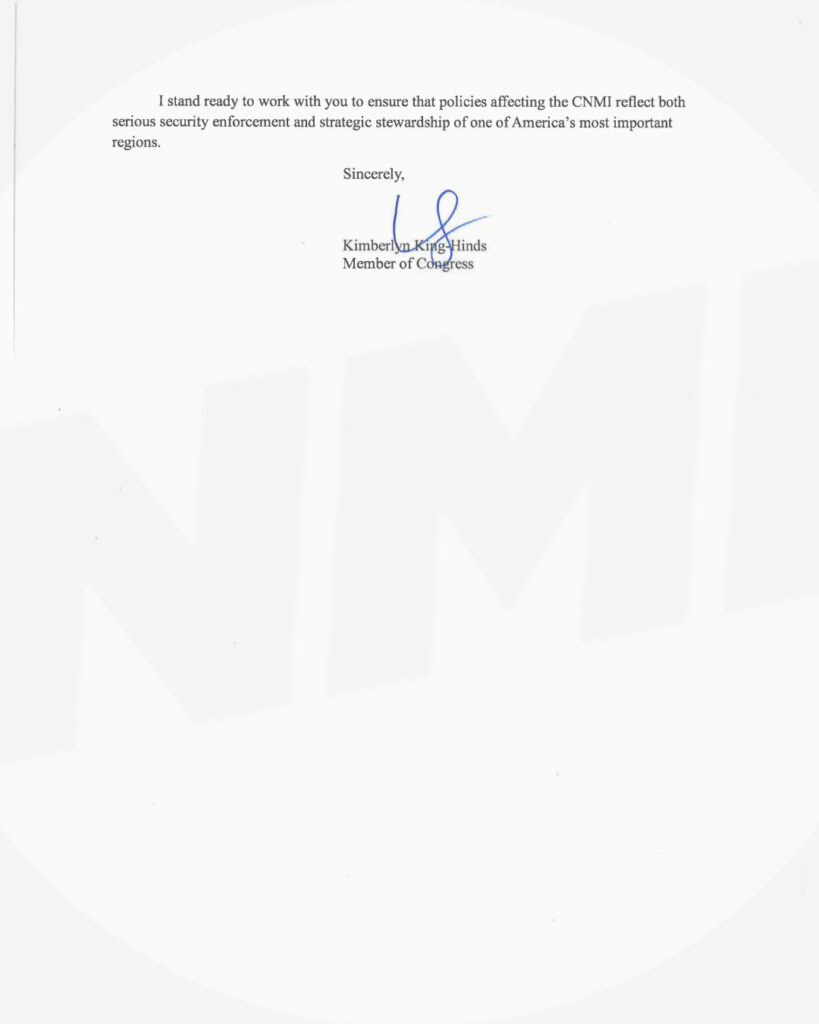
She closed by telling Noem and Burgum she is ready to work with the administration to ensure policies affecting the CNMI reflect serious security enforcement and strategic stewardship of a region she described as critical to America’s forward presence.