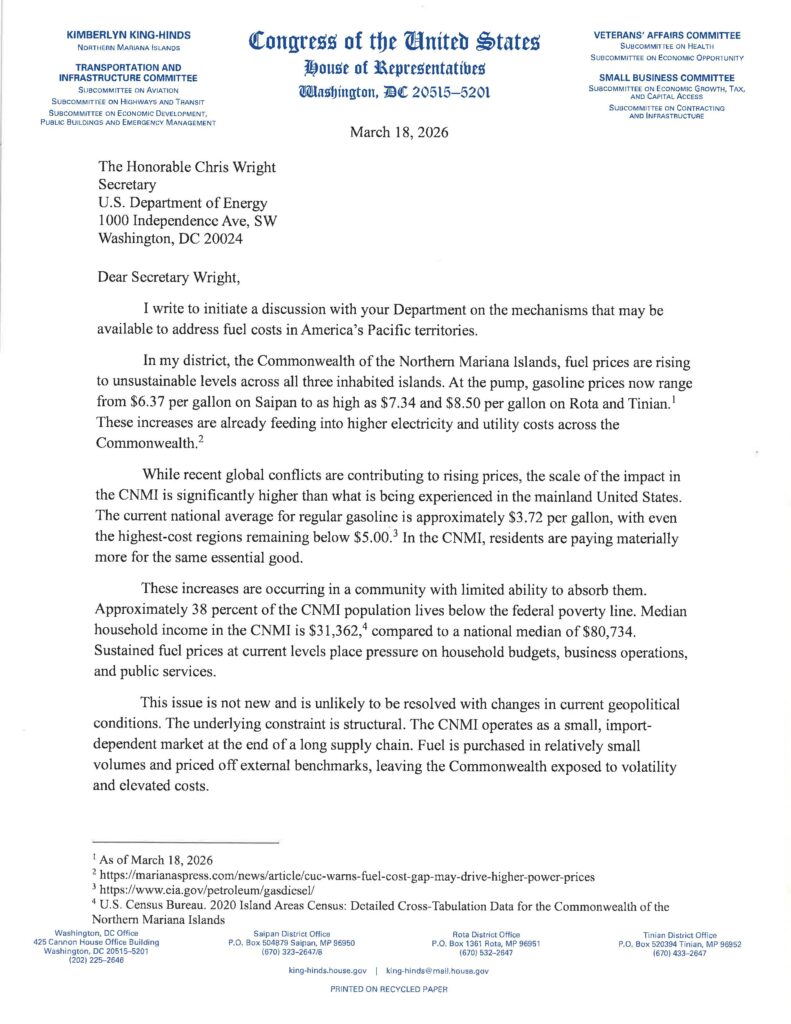
WASHINGTON — Congresswoman Kimberlyn King-Hinds has written to U.S. Energy Secretary Chris Wright asking the Department of Energy to work with her on solutions to fuel costs in the Commonwealth of the Northern Mariana Islands, where gasoline prices now range from $6.37 per gallon on Saipan to $7.34 and $8.50 per gallon on Rota and Tinian.
The March 18 letter points out that while global conflict is contributing to rising prices, the gap between CNMI fuel costs and the national average reflects structural problems that predate the current crisis. The national average for regular gasoline is approximately $3.72 per gallon, with even the highest-cost regions on the mainland staying below $5.00. CNMI residents are paying materially more for the same essential good.
“For communities like ours, fuel costs come down to how fuel is procured and delivered,” King-Hinds said. “We operate at a scale that leaves us exposed to higher costs and volatility, and that is something we should be addressing directly.”
King-Hinds described the CNMI as a small, import-dependent market at the end of a long supply chain, where fuel is purchased in relatively small volumes and priced off external benchmarks. She noted that approximately 38 percent of the CNMI population lives below the federal poverty line and that median household income in the Commonwealth is $31,362, compared to a national median of $80,734.
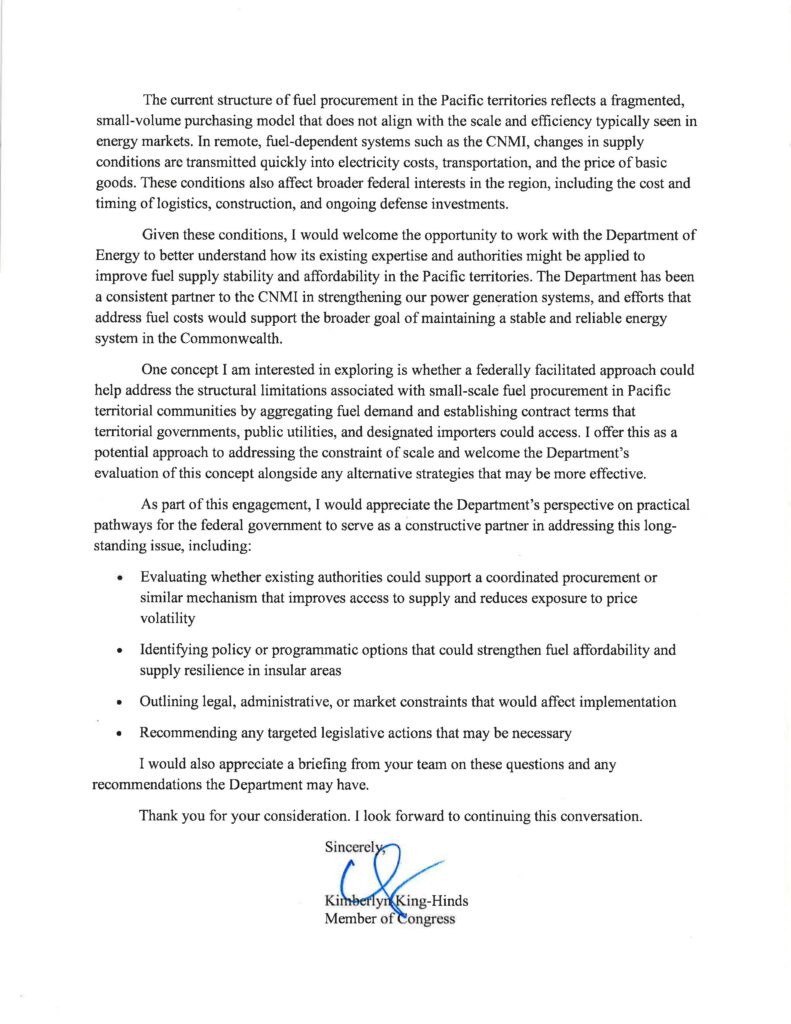
The congresswoman outlined a possible federal approach centered on aggregating fuel demand across Pacific territorial communities to establish more favorable procurement contract terms for territorial governments, public utilities and designated importers. She asked the Department of Energy to evaluate whether existing authorities could support such a coordinated procurement mechanism, what policy or programmatic options could strengthen fuel affordability and supply resilience in insular areas, what legal or administrative constraints might affect implementation, and whether targeted legislative action would be necessary.
King-Hinds also noted that elevated fuel costs affect broader federal interests in the region, including the cost and timing of logistics, construction and ongoing defense investments. She requested a briefing from the Department on its recommendations.
“This is a long-standing issue that requires a more coordinated approach,” King-Hinds said. “The objective is straightforward: to bring down fuel costs and reduce the pressure these prices are placing on families, businesses, and our economy.”