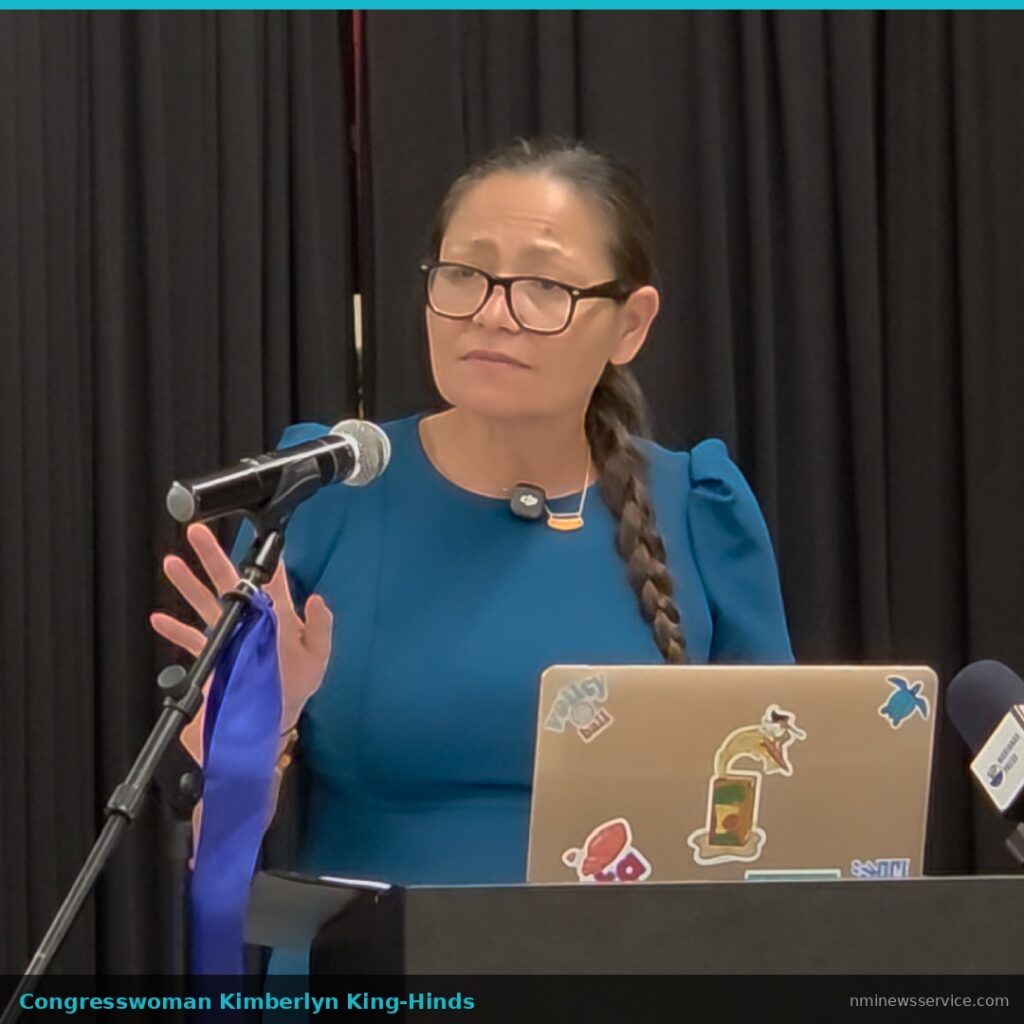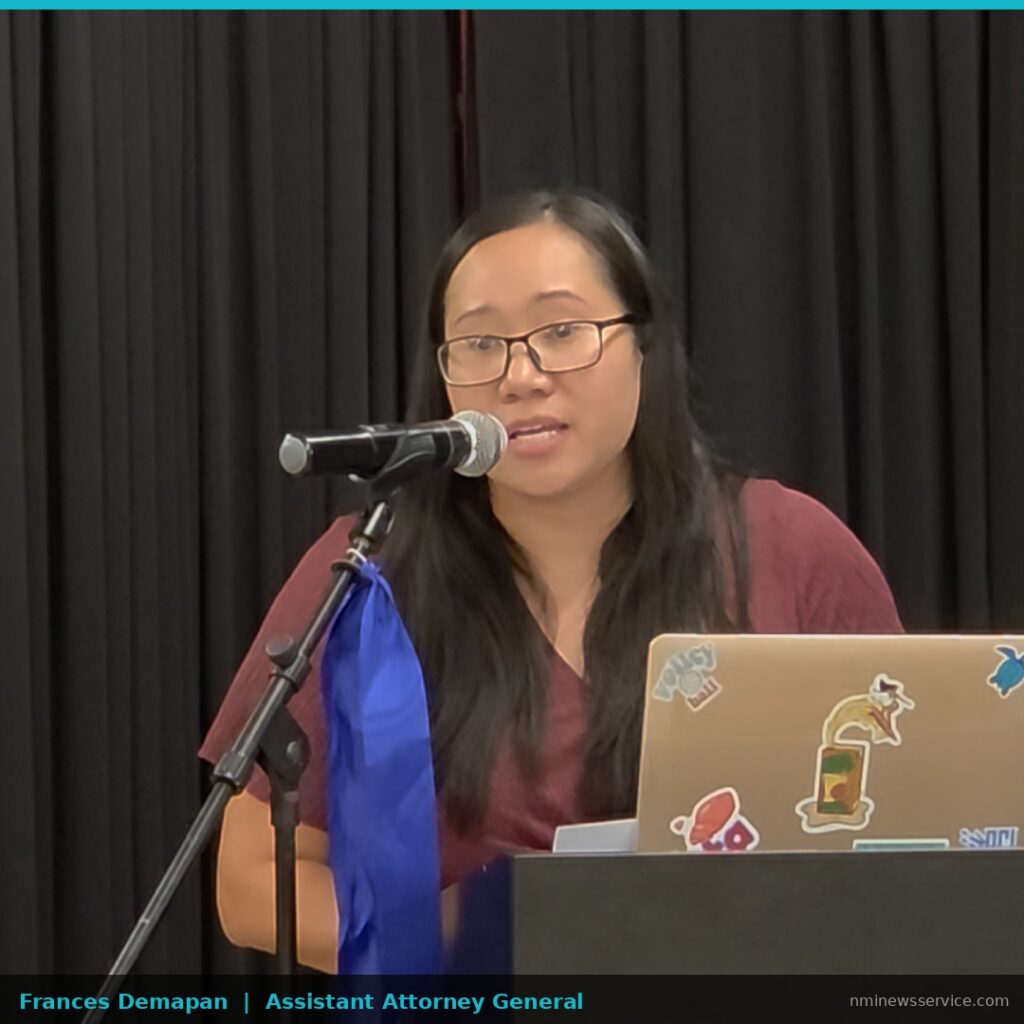
SAIPAN — Governor David M. Apatang signed a proclamation Tuesday declaring April Child Abuse and Neglect Prevention Awareness Month at a ceremony hosted by the Division of Youth Services at Marianas High School. But it was the remarks delivered by Congresswoman Kimberlyn King-Hinds and Assistant Attorney General Frances Demapan that left the room still.
Neither woman came with talking points. Both came with truth.
King-Hinds: “The cycle may not have started with me, but it will end with me.”
King-Hinds opened not with statistics or policy, but with a memory. She was watching Days of Our Lives with her sister when her grandmother called her to the kitchen. She rushed. She closed a cabinet door too hard. Her grandmother hit her.
It was, she said, the last time.
But the last time was a long time coming. There were rice cooker lines from being hit because she had not cooked the rice right. Belt lashes because the ironing creases were not straight enough. She went to school with marks on her body. Other kids could see them. Some days she could not contain herself in class.
She was careful to frame her grandmother not as a villain but as a woman carrying her own inherited pain, shaped by war, by trauma, by violence she herself had survived.
“My grandmother loved me. She raised me. She sacrificed for me,” King-Hinds said. “But what I didn’t understand then, what I only came to understand later, was that she was carrying her own pain.”
The physical abuse, King-Hinds said, planted a seed of fear that kept her silent in other circumstances. Silent when her uncle sexually abused her, repeatedly, beginning before she was even in Head Start. After each act, he would give her five dollars.
“To him, after that moment, that was my value,” she said. “And if I had let that define me, I would have a very different life.”
She did not let it define her. Today she is a mother, a wife, a lawyer, a marathon runner, a person of faith and community, and the delegate representing the CNMI in the U.S. Congress.
She spoke directly to young people in the room she knew were living what she had lived.
“I know what you’re going through. It’s not just pain, anger, or shame. I know the confusion you live with every day,” she said. “What has been done to you does not define you.”
And she spoke to everyone about the choice each generation faces.
“Our children don’t inherit our intentions. They inherit our actions. They feel it, they carry it. And if we don’t change it, they repeat it,” King-Hinds said. “We don’t break cycles with words. We break them with choices.”
Demapan: “Something has to change.”
If King-Hinds spoke from the inside of the experience, Assistant Attorney General Frances Demapan spoke from inside the system charged with responding to it, and she did not spare that system from scrutiny.
She opened with a courtroom memory from early in her career, a bail modification hearing for a juvenile who had cycled through the system multiple times. The boy’s uncle was approved as a third-party custodian. Before the hearing ended, the uncle raised his hand and asked the judge for permission to discipline his nephew. The judge, likely not reading the moment, said yes.
That afternoon, the uncle beat the child severely, reasoning the judge had authorized it.
“I was speechless,” Demapan said. “Even though I felt like I was doing all the right things, running through the correct protocol, asking all the right questions, and choosing to believe the answers given to me, it wasn’t enough.”
She noted that the juvenile was not even her client. She was prosecuting him. But she felt for him deeply, wondering whether he had ever been truly seen at home.
Then she delivered a number that stopped the room.
In 2025, the CNMI’s child welfare system received reports of more than 2,000 child abuse and neglect cases. The Attorney General’s office received 25. Of those, only 15 or 16 were charged.
“That’s less than one percent,” Demapan said. “And that should scare all of us.”
She said the cases that actually move forward are the ones where someone fought for them like a non-offending parent, a school counselor, a friend who asked the right questions and stayed with the answer.
Demapan then turned inward, speaking as a mother of three young boys and reflecting on how even well-intentioned parents can transmit what they never intended to pass on. She referenced trauma and childhood development expert Dr. Gabor Maté, whose observation she said has stayed with her.
“He said the way we gift future generations is by actually working on ourselves. Not by trying to be better parents, but by actually dealing with our own stuff,” she said. “In ways we don’t even realize, we pass our trauma onto our children. In our tone, in our reactions, in the way we respond when we’re overwhelmed, stressed, or triggered.”
She closed with a direct charge.
“Prevention of child abuse and neglect doesn’t start in the courtroom next door,” Demapan said. “It starts at home.”
If you or someone you know has experienced child abuse or needs support, contact the CNMI Division of Youth Services or call the Child Abuse Hotline. Help is available.