Congresswoman tells Saipan Chamber forum that Washington’s rules and restrictions gutted the outside spending the islands need to survive
SAIPAN — In a blistering speech that pulled no punches, Congresswoman Kimberlyn King-Hinds told the CNMI business community Wednesday that the federal government is responsible for the Commonwealth’s economic crisis, arguing that rules, restrictions and policy decisions out of Washington have gutted the outside spending the islands depend on to survive.
Speaking at the close of the 4th Annual Saipan Chamber of Commerce Economic Forum, King-Hinds said the collapse of visitor spending, not government mismanagement or a lack of economic diversification, is the root cause of the hardship residents and businesses are experiencing across the islands.
“The CNMI economy runs on outside spending,” she said. “When that spending disappears, everything else begins to fall apart.”
King-Hinds was pointed in assigning responsibility. She said she was not singling out any president, cabinet official or political party but rather the broader federal apparatus, the rules, restrictions and decisions that come out of Washington, including Congress itself.
“We are Americans living in an American community asking our federal government to get out of the way,” she said.
Before the pandemic, she said, visitors accounted for 54 percent of all customers in the CNMI and spent roughly $1.9 billion annually. That figure paid the wages of thousands of private-sector workers and generated the tax revenue that funded thousands more government jobs. As that customer base collapsed, businesses with no direct connection to tourism began to struggle as well.
She said the CNMI’s unified position, presented across the private sector and local government in recent months, centers on three requests: remove the barriers keeping tourists from coming, fix arrangements that divert visitors to other destinations, and stop eliminating the legal tools the Commonwealth depends on. If Washington acts, she said, recovery could begin by the end of this year. If it does not, the federal government will find itself spending far more to prevent the Commonwealth from collapsing entirely.
King-Hinds also pushed back against arguments that economic diversification can fill the gap left by lost tourism in any near-term timeframe. She said she supports the pharmaceutical, auto manufacturing and other emerging industries the CNMI is pursuing, but cautioned that those projects are years away from generating meaningful economic activity. Anyone suggesting otherwise, she said, “is either selling you something, running for office, or simply just doesn’t understand.”
To illustrate the scale of the tourism revenue gap, she pointed to agricultural data showing total vegetable sales in the CNMI at approximately $1.2 million annually across roughly 207 acres. Reaching $1.9 billion at that rate of output, she said, would require more land than exists on Saipan and Guam combined.
She also directed pointed criticism at voices within the CNMI that she said have undermined the push for federal action by arguing in Washington against the programs and policies the islands rely on.
“When someone from our own community tells them not to help, to do nothing, or to take away the tools we rely on, that makes their decision very easy,” she said. “They do not have to deal with the consequences. We do.”
King-Hinds closed by warning that the current crisis, while slower-moving than a natural disaster, is equally serious and that the window to respond is closing.
“The house is on fire,” she said. “And putting out that fire will require a unified voice from this community.”
READ THE FULL TEXT BELOW:
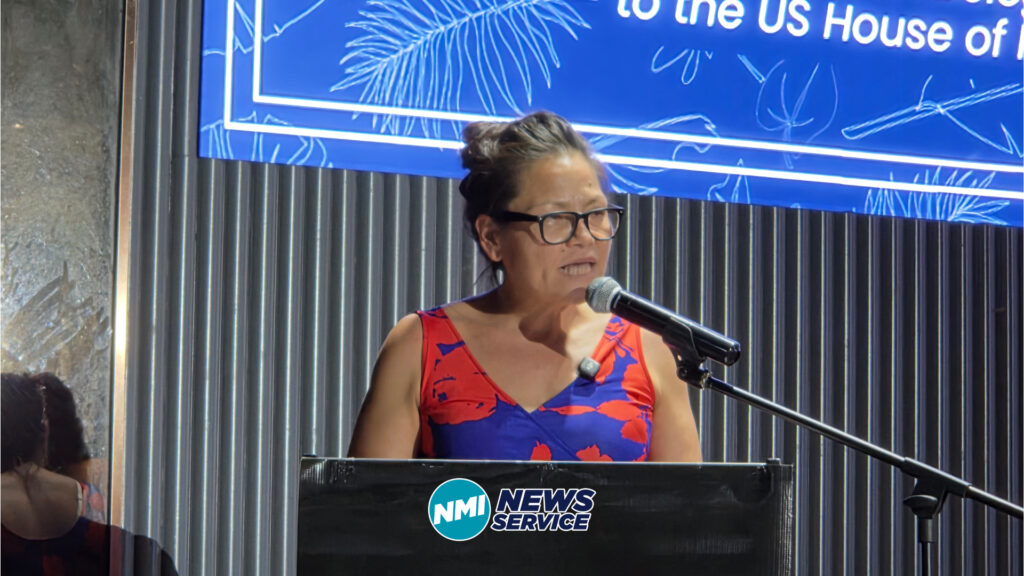
Full Text: Closing Remarks by Congresswoman Kimberlyn King-Hinds 4th Annual Saipan Chamber of Commerce Economic Forum, March 11, 2026
Good afternoon everyone, and thank you for being here all the way through to the end of this year’s summit. For those who were not able to stay for the full event, I also want to thank you for your interest and participation. These are important conversations. Not because the business community alone needs to hear them, but because the entire community should understand the magnitude and the causes of the issues affecting everyone’s lives.
There are conversations happening across our community today. Conversations just as significant as the ones we had during this summit. Conversations about how to survive, what to do next, how to live in this new reality of declining opportunity. And those conversations often lead to the same place. Who to blame.
Many people in this room already know the answer to that question, because you are in the trenches of this economy. Fighting for every opportunity that reaches our shores. But for those who may not see it as clearly, I want to talk to you specifically and begin by talking about how our economy actually works by addressing a few widely held myths.
First, the government is not the economy. What government spends, or mis-spends, is not the reason our economy succeeds or fails. If you believe the government has misused public money, that is a legitimate political question. But it is not the reason we are here today. The truth is much simpler. The government can only mis-spend money that the economy first produces. Without a functioning economy, there are no tax dollars to spend.
Second, the economy will not rebound on its own. Our islands have experienced dramatic ups and downs over the generations. That history has made our businesses resilient and our people adaptable. But it has also taught us the wrong lesson. Sometimes people look back and believe the economy simply corrected itself. It did not. Each time our economy recovered, it happened because people in this community recognized what was needed and fought to make it happen. Many of those people worked quietly. They did not seek recognition. They simply did the hard work that had to be done. Because of that, many in the community assumed things fixed themselves. They did not. Many of those individuals are no longer with us. But a few still are. They are still doing what they have always done, in the private sector and in government, working quietly every day to keep opportunity alive.
But the challenges we face today are deeper than those we faced before. And that brings me to another myth. That simply shifting away from tourism will solve the problem. Listen. We should grow more of our own food. We should diversify our economy. We should manufacture. We should innovate. But anyone telling you those things will meaningfully improve life in the next decade is either selling you something, running for office, or simply just doesn’t understand.
I am excited about the opportunities the CNMI is pursuing with pharmaceuticals, auto manufacturing, and the development of new products. These are important efforts, and we should support them as they move through the long process of development. That includes selecting sites in the CNMI, developing plans, applying for permits, hiring and recruiting workers, and beginning the start-up process. If you are eager to support these projects, the good news is they will not take up too much of your time this year. These early steps will take years to complete, and years beyond that before they reach the level of economic activity provided by the industry we already have today.
People sometimes say that I am too focused on tourism. Let me tell you why. Before the pandemic, tourists represented 54 percent of all customers in the CNMI. When you see a store or a restaurant close and wonder why, this is the reason. If your paycheck were cut by 54 percent, would you stay in that job? No, you wouldn’t. That 54 percent of our customer base paid the wages of thousands of residents across our islands. It also contributed to the taxes that paid for thousands more government employees.
We do not print money in the CNMI. The money that circulates in our economy has to come from somewhere. For decades, the majority came from tourists. More than residents, more than the government. Tourists. As that money disappears, businesses that have nothing to do with tourism begin to struggle. They start to face difficult decisions. Every one of you works to earn a paycheck. Businesses operate the same way. We all want businesses to serve the community. We want them to contribute to the life of these islands. But the reality is simple. Everyone needs to eat. Small business owners included.
Before the pandemic, visitors spent about $1.9 billion a year in the CNMI. Think about that number for a moment. Billions are hard to visualize, so let me break it down. Let’s imagine we tried to replace tourism with vegetable farming. The most recent agricultural data shows total vegetable sales in the CNMI were about $1.2 million for the entire year, across roughly 207 acres of farmland. To produce $1.9 billion at that same level of output, we would need farmland far beyond what exists in the Northern Marianas. In fact, to reach that level we would need land larger than every inch of earth on Saipan and Guam combined. Not just every inch of farmland. Every inch of land. Homes, stores, schools, baseball fields, hotels all taken down and we still wouldn’t have enough.
So will these ideas keep you employed this year? No. Ideas are good. We should share them. But the ideas that help people are the ones grounded in reality. I am not talking about tourism because I like it. I am talking about it because I want to keep you employed, earning an income, and staying here in the CNMI.
Look around you. We have hotels waiting to be filled. Restaurants ready to serve. An airport waiting for planes. We do not have to reinvent the wheel. And we do not need to bulldoze the island to keep people earning a living.
But if we want to understand who is responsible for the situation we are in, we first have to understand the problem. You feel uncertain about your ability to earn an income. You worry about losing your job. You worry that your paycheck will shrink because the government has cut hours. Your boss cuts shifts because payments from the government are late. You want to eat at your favorite restaurant. But it is closed. These are not separate problems. They all come from the same place.
Many of you in this room already understand this. But most conversations in the community are missing one key piece of information. Once you see it, the whole situation starts to make sense. The CNMI economy relies on spending from outside our islands to sustain economic activity. Those inflows have fallen to levels that can no longer support our private sector or our government finances. Without action to restore that outside demand, the Commonwealth will collapse economically and fiscally.
So who is responsible for the drop in outside money coming into the CNMI? The answer is clearly the federal government. I am not talking about the President, cabinet officials, or party politics. I am talking about the larger federal system. The rules, restrictions, and decisions that come out of Washington. The apparatus that includes Congress.
When people hear that, the response is often the same. The federal government gives us money. Money for roads. Money for food assistance. Money for programs. As if that is a reasonable trade for you not having a job. I do not believe that is a trade any community should accept. It is not sustainable, and it is not in our national interest. I do not go to work in Washington thinking about how many more people I can place on food assistance. And if I were not in this position, I would not vote for anyone who made that their priority either.
Our goal should be different. I want roads. I want people to have the nutrition they need to survive. I believe government programs have a role. But I also want us to be able to afford these things ourselves. We should be able to make our own bread. Build our own economy. Earn our own living. Our future cannot depend on the shifting decisions of a federal system thousands of miles away.
Do you think the federal government wants to send money here forever? No. They do not. Sending more money without building an economy that can sustain itself only guarantees that cycle continues. At a time when the federal budget and spending are under greater scrutiny than ever, telling ourselves to stay quiet and let Washington pay our bills is not a plan. It is not even smart.
I am grateful that the CNMI has come together in recent months, presenting a unified position across the private sector and local government to make clear requests. Remove the barriers that keep tourists from coming to the CNMI. Fix broken arrangements that pull our visitors to other destinations. Stop stripping away the legal tools we rely on to survive. If Washington agrees to these requests, and I hope they do, we can begin moving toward recovery by the end of this year. If they do not, more people will end up on food assistance, and the federal government will end up spending millions to keep the Commonwealth from collapsing.
We are Americans living in an American community asking our federal government to get out of the way.
But whenever you point a finger, three point back at you. We all understand natural disasters. When a typhoon hits, our community comes together quickly to respond. Make no mistake. What we are experiencing now is just as serious, and in some ways worse. The difference is that this disaster does not arrive all at once. It unfolds slowly. And by the time everyone realizes how serious it is, it will already be too late to respond. Which means we should have been acting yesterday.
Yet getting people in Washington to understand the severity of this situation becomes much harder when voices from our own community are working to tear this place down. We have all seen it. People presenting themselves as national security experts, telling Washington that the CNMI should be stripped of the very tools that allow our economy to function. Thankfully many have moved past those arguments and are focused on what the Commonwealth actually needs. But the damage from those narratives has already been done.
When you see people in Washington arguing against the CNMI, trying to remove what few lifelines we have left, they often justify those decisions by quoting our own people. Let me simplify this. No one in Washington wakes up hoping to take on more responsibility for the CNMI than they have to. When someone from our own community tells them not to help, to do nothing, or to take away the tools we rely on, that makes their decision very easy. They do not have to deal with the consequences. We do.
For too long we have stepped back from the responsibility of standing up for ourselves. And when we do that, we leave the conversation to conspiracy theorists and dilettantes who end up shaping policy in our place. So I am placing my trust in the members of this community who can see the bigger picture. The picture of a viable Commonwealth. The picture of real jobs, not ones propped up by federal spending that can disappear overnight. The goal of standing on our own feet again.
When you have conversations in the community and hear someone blaming the wrong thing, tell them the truth about how the economy actually works. This is a crisis. The house is on fire. And putting out that fire will require a unified voice from this community.
This is not about politics or which President you prefer. That is not the conversation we are having. You may not agree with the solutions we are presenting, and that is fine. In fact, I want to hear other ideas. But this moment calls for real solutions and honest conversations about the problem in front of us.
If you remember nothing else from today, remember this: the CNMI economy runs on outside spending. When that spending disappears, everything else begins to fall apart. The CNMI needs customers. And we need them this year. So let’s stay focused on how we bring them here.