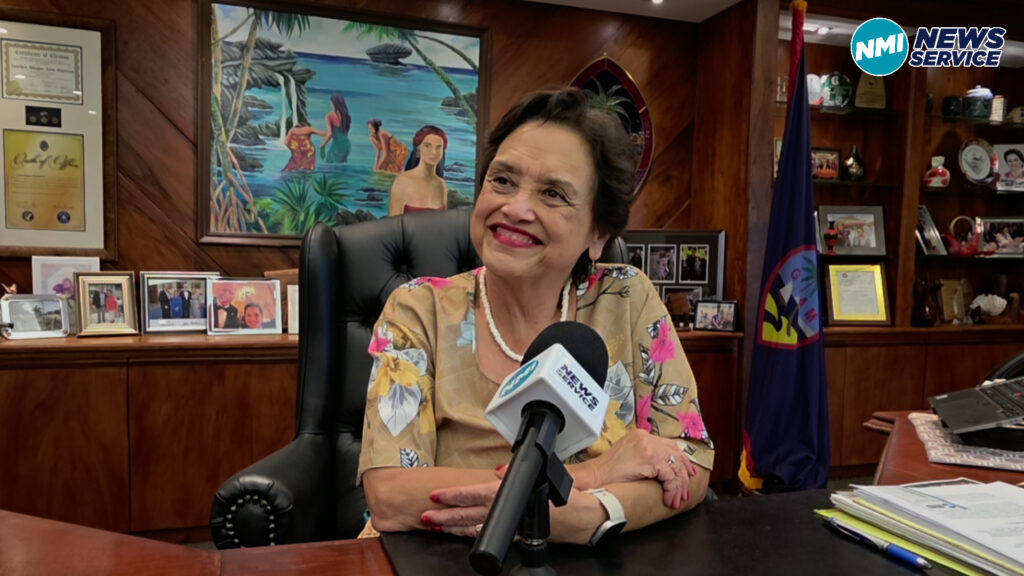
Hagåtña, Guam — Governor Lourdes Leon Guerrero is calling for revenue sharing equality with mainland coastal states as federal plans advance for deep sea mining in Marianas waters, warning that a voluntary one percent profit commitment from mining companies is “an insult” to Pacific territories.
In an exclusive interview with NMI News Service, Leon Guerrero revealed that Guam, the Commonwealth of the Northern Mariana Islands, and American Samoa stand united in opposition to deep sea mining plans targeting waters near their islands—plans they learned about with minimal notice and no guaranteed revenue sharing.
“If they’re going to come into our waters and harvest the wealth of our waters, then I think the people of Guam, CNMI, and American Samoa should be right up there in terms of the revenue outcome,” Leon Guerrero said. “And 1% is nothing. It’s a great insult to the people that live in the waters that depend on the lives of this marine life for their sustenance.”
Territories Face Unequal Treatment
The Trump administration’s Bureau of Ocean Energy Management (BOEM) issued a Request for Information (RFI) specifically targeting waters near the CNMI for deep sea mining operations by companies like Impossible Metals. The RFI period ran from November 12 through mid-December—a 30-day window that caught territorial leaders off guard.
“When I first found out about it was through public media,” Leon Guerrero explained. “When we found out about it, it was already two weeks into that November, and I immediately called Governor (Apatang), and he also did not know till just that morning.”
Under existing federal law, mainland coastal states like Alaska, California, and Texas automatically receive revenue sharing from offshore resource extraction. U.S. territories receive no such automatic benefits.
“If this was Alaska or California’s offshore waters, those states would automatically get revenue sharing under existing federal law,” Leon Guerrero noted. “Why shouldn’t Guam and the CNMI receive the same revenue sharing arrangement?”
United Pacific Opposition
The governor brought the deep sea mining issue to the recent Micronesian Islands Forum, where leaders from Palau, the Federated States of Micronesia, the Republic of the Marshall Islands, and Nauru expressed clear opposition to moving forward with such projects.
“It was very, very clear from the leaders that they didn’t want to move forward with any kind of deep sea mining projects or programs because they don’t know a lot about how this is going to impact our waters,” she said.
Leon Guerrero, American Samoa Governor Pulaali’i Nikolao Pula, and CNMI Governor David Apatang have united in their stance against deep sea mining until comprehensive environmental studies are completed.
Environmental Concerns Trump Economic Promise
As a former CEO of the Bank of Guam, Leon Guerrero understands economic opportunity, but she says the science isn’t settled on deep sea mining’s environmental impact.
“Deep sea mining is not very well studied,” she said. “Science is not as wealth like other kinds of industries, and deep sea mining is a bit, for me, scary.”
The governor cited concerns about marine ecosystem disruption, fishing environment impacts, and destruction of seabed life. “As I read more, there are hundreds of species on the seabed that will be interrupted or killed and won’t be able to come back for many, many, many, many, many years.”
She’s inviting experts like Dr. Jeff Drazen from the University of Hawaii to conduct community outreach and education. The mining operations would create sediment plumes that travel through the water column, potentially affecting fisheries including Palau’s tuna industry.
Federal Control Over Territorial Waters
Leon Guerrero highlighted a fundamental power imbalance: while Guam should control waters up to 200 miles from its coast under standard Exclusive Economic Zone (EEZ) principles, the territory only controls three miles.
“After that, up to 200 miles is the US, the federal government,” she explained. “So yeah, they can come in and do deep sea mining, even without our consent. But I hope in these days of partnership and relationship that that doesn’t happen.”
The governor called on federal officials to respect territorial concerns and allow Guam, the CNMI, and American Samoa to conduct due diligence before any mining operations begin.
“I am asking the powers in the federal government to respect that, and to allow the people of Guam, CNMI, and American Samoa to do their due diligence, and to have very frank discussions and comments about how this is going to affect our livelihood here in this part of the world,” Leon Guerrero said.
Despite American Samoa producing more than 76,000 public comments, with most in opposition, BOEM continues to move forward with the deep sea mining proposal.
Editor’s Note: This is the first in a series of stories from NMI News Service’s exclusive interview with Governor Lourdes Leon Guerrero conducted this afternoon in her office in Hagåtña. Additional coverage will address the governor’s reflections on her historic tenure as Guam’s first female governor, the ongoing hospital relocation debate, and her perspective on decolonization and self-determination issues.