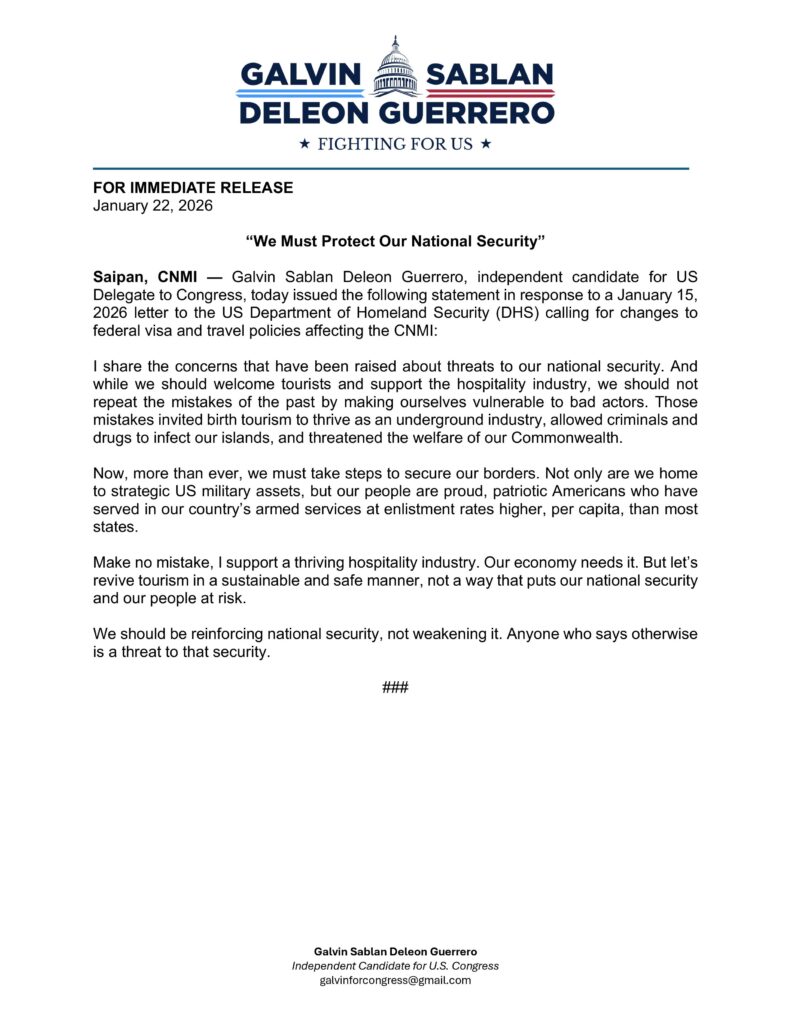
SAIPAN — Congressional candidate Galvin Deleon Guerrero weighed in this week on the growing debate over the CNMI’s visa waiver framework, saying he shares concerns about national security threats and warning the Commonwealth should avoid policies that “make ourselves vulnerable to bad actors.”
Deleon Guerrero’s statement follows a Jan. 15, 2026 letter from U.S. Sens. Rick Scott, Jim Banks, and Markwayne Mullin urging federal officials to revoke the CNMI’s Economic Vitality & Security Travel Authorization Program (EVS-TAP) and require standard tourist visas for Chinese nationals visiting the CNMI. The senators also urged ending Hong Kong’s participation in the Guam-CNMI Visa Waiver Program, citing birth tourism and security concerns.
In his statement, Deleon Guerrero said the Commonwealth can welcome visitors and support the hospitality industry, but argued the CNMI should not “repeat the mistakes of the past.” He said those past mistakes “invited birth tourism to thrive,” and “allowed criminals and drugs to infect our islands,” while threatening the welfare of the Commonwealth.
He said border security should be a priority, citing the CNMI’s strategic role and its ties to U.S. military assets. He also pointed to the Commonwealth’s military service record, describing local residents as “proud, patriotic Americans” who have served at high enlistment rates.
Deleon Guerrero said he supports a thriving hospitality industry and acknowledged the economy depends on it, but said tourism should be revived “in a sustainable and safe manner” that does not put national security or residents at risk. He closed by calling for reinforcing national security and criticized those who argue otherwise.
The issue has drawn multiple local responses since the senators’ letter. CNMI Delegate Kimberlyn King-Hinds has said changes to EVS-TAP or the visa waiver framework are not warranted at this time based on current conditions in the CNMI and warned of economic impacts. HANMI and the Marianas Visitors Authority have also urged federal policymakers to consider local conditions, stakeholder input, and the economic consequences of abrupt program changes while continuing to strengthen safeguards.