SAIPAN — As the Commonwealth of the Northern Mariana Islands marks the 50th anniversary of the Covenant this year, it is worth revisiting the document that defines the islands’ unique relationship with the United States and continues to shape nearly every major policy debate in the region.
The Covenant to Establish a Commonwealth of the Northern Mariana Islands in Political Union with the United States of America is not just a historical artifact. It is a living framework that determines how the CNMI is governed, who can own land, what federal laws apply, and how the islands engage with Washington on everything from military training ranges to deep-sea mining.
From Trust Territory to Commonwealth
The story of the Covenant begins after World War II. Following Japan’s defeat, the United States assumed administrative control of the Mariana Islands, Caroline Islands and Marshall Islands under a United Nations Trusteeship Agreement in 1947. The region was designated the Trust Territory of the Pacific Islands, with the U.S. serving as the administering authority.
For the people of the Northern Mariana Islands, the postwar period brought a fundamental question: what would the political future look like? Unlike other districts of the Trust Territory, which eventually became independent nations or freely associated states, the people of the Marianas chose a different path.
Negotiations between Mariana Islands leaders and the United States began in earnest in the early 1970s. The Marianas Political Status Commission engaged in multiple rounds of talks with federal negotiators. The goal was to achieve a form of self-governance while maintaining the protections and benefits of U.S. citizenship.
The Covenant is Signed
The Covenant was signed on February 15, 1975, on the island of Saipan. President Gerald Ford signed the legislation approving the Covenant into U.S. law on March 24, 1976. The people of the Northern Mariana Islands approved the Covenant in a plebiscite with an overwhelming majority in favor.
Under the Covenant, the CNMI became a self-governing commonwealth in political union with the United States. Residents of the CNMI became U.S. citizens. The islands would have a locally elected governor, legislature and judiciary, operating under a locally drafted constitution.
The CNMI Constitution took effect on January 9, 1978, establishing the three-branch government that exists today.
What the Covenant Says
The Covenant is divided into articles covering government structure, citizenship, federal relations, land, finances and transitional matters. Several provisions remain of particular importance today.
On citizenship, Section 301 granted U.S. citizenship to persons born in the CNMI who were citizens of the Trust Territory as of the Covenant’s effective date, as well as to those born in the CNMI thereafter.
On land, the Covenant includes some of its most distinctive and durable protections. Article XII restricts the acquisition of permanent or long-term interests in land to persons of Northern Marianas descent, preserving the land base for Chamorro and Carolinian families. This provision has been a source of ongoing legal debate but has been consistently upheld as a core element of the Covenant relationship.
On federal law, the Covenant specifies which federal laws apply to the CNMI and which do not. Many federal statutes apply automatically. Others required specific action. Notably, the CNMI was initially granted local control over immigration and minimum wage, recognizing the islands’ unique economic circumstances and geographic isolation.
On representation, the Covenant established that the CNMI would send a nonvoting delegate to the U.S. House of Representatives, giving the islands a voice in Washington without a vote on final passage of legislation. The CNMI has no U.S. senators and no votes in the Electoral College.
Transition to Full Commonwealth Status
The Covenant’s Transition Period ended and full commonwealth status took effect on November 4, 1986, when President Ronald Reagan issued Presidential Proclamation 5564 terminating the Trusteeship Agreement for the Northern Mariana Islands. On that date, the CNMI became a full U.S. commonwealth and all CNMI residents became U.S. nationals entitled to U.S. citizenship.
The Federalization of Immigration and Labor
One of the most consequential changes to the CNMI’s post-Covenant landscape came in 2008, when Congress passed the Consolidated Natural Resources Act, which extended federal immigration law to the CNMI and established a transition period for the large foreign worker population. The law ended the CNMI’s local control over immigration, one of the key economic tools the islands had relied on to build its tourism and garment manufacturing industries.
Federal minimum wage law was also phased in over the same period, replacing the CNMI’s locally set wage floors.
The 902 Consultation Process
The Covenant created a formal mechanism for the CNMI and the federal government to address issues affecting the relationship. Section 902 requires periodic consultations between representatives of the U.S. and CNMI governments to review the Covenant and consider proposed changes. These consultations have addressed a wide range of issues over the years, from federal program funding to immigration to military land use.
Most recently, 902 consultation working groups convened in early 2026 to address several outstanding issues, with a 30-day reporting deadline set from February 18, 2026.
The Covenant Today
Fifty years on, the Covenant remains both a foundation and a fault line. Its provisions continue to define what the CNMI can and cannot do, what the federal government owes the islands, and how disputes between local and federal authority are resolved.
Current debates over deep-sea mining in Marianas waters, military training range expansion, federal energy assistance, fuel costs and immigration policy all trace directly back to the framework the Covenant established. The islands’ nonvoting status in Congress means that even as federal decisions reshape the CNMI’s ocean, land and economy, residents have no vote on those decisions.
This year’s 50th anniversary is an occasion to reflect on what the Covenant promised, what it has delivered and what work remains. As Congresswoman Kimberlyn King-Hinds has noted in her advocacy on issues from fuel costs to pharmaceutical investment, the islands’ relationship with Washington is still very much a work in progress.
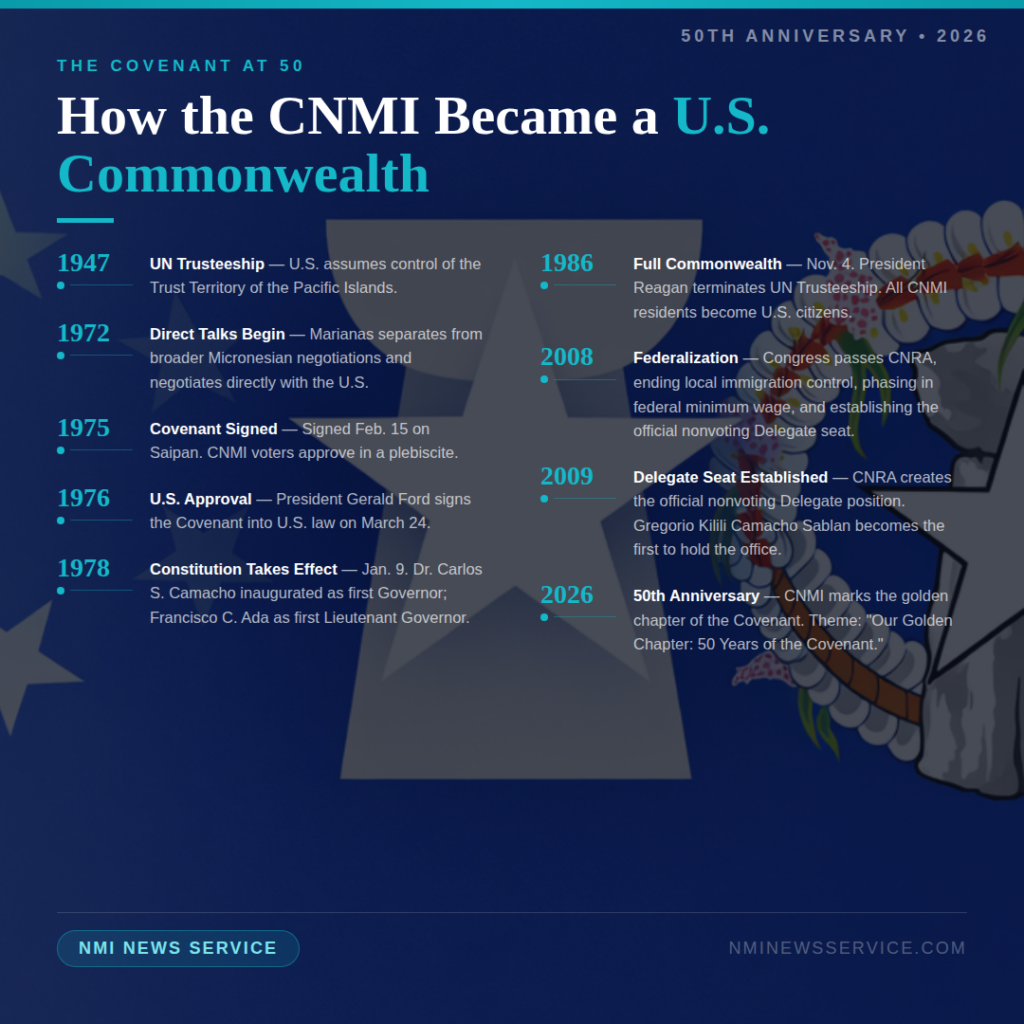
COVENANT TIMELINE
1947 — United Nations Trusteeship Agreement takes effect. U.S. assumes administrative control of the Trust Territory of the Pacific Islands, including the Mariana Islands.
1969 — Congress of Micronesia establishes the Future Political Status Commission to explore options for the region.
1972 — The Mariana Islands separates from broader Micronesian status negotiations and begins direct talks with the United States.
1975 — The Covenant is signed on February 15 on Saipan. CNMI voters approve the Covenant in a plebiscite.
1976 — President Gerald Ford signs legislation approving the Covenant into U.S. law on March 24.
1978 — The CNMI Constitution takes effect on January 9. The first locally elected governor and legislature are inaugurated.
1982 — CNMI voters choose in a plebiscite to seek closer ties with the United States, including potential statehood, though no action is taken.
1986 — Full commonwealth status takes effect on November 4. President Reagan terminates the UN Trusteeship. All CNMI residents become U.S. citizens.
2008 — Congress passes the Consolidated Natural Resources Act, federalizing immigration and phasing in federal minimum wage in the CNMI.
2009 — Federal immigration transition period begins for the CNMI’s foreign worker population.
2019 — CNMI gains its first nonvoting delegate seat in the U.S. House of Representatives under the Consolidated Natural Resources Act provisions.
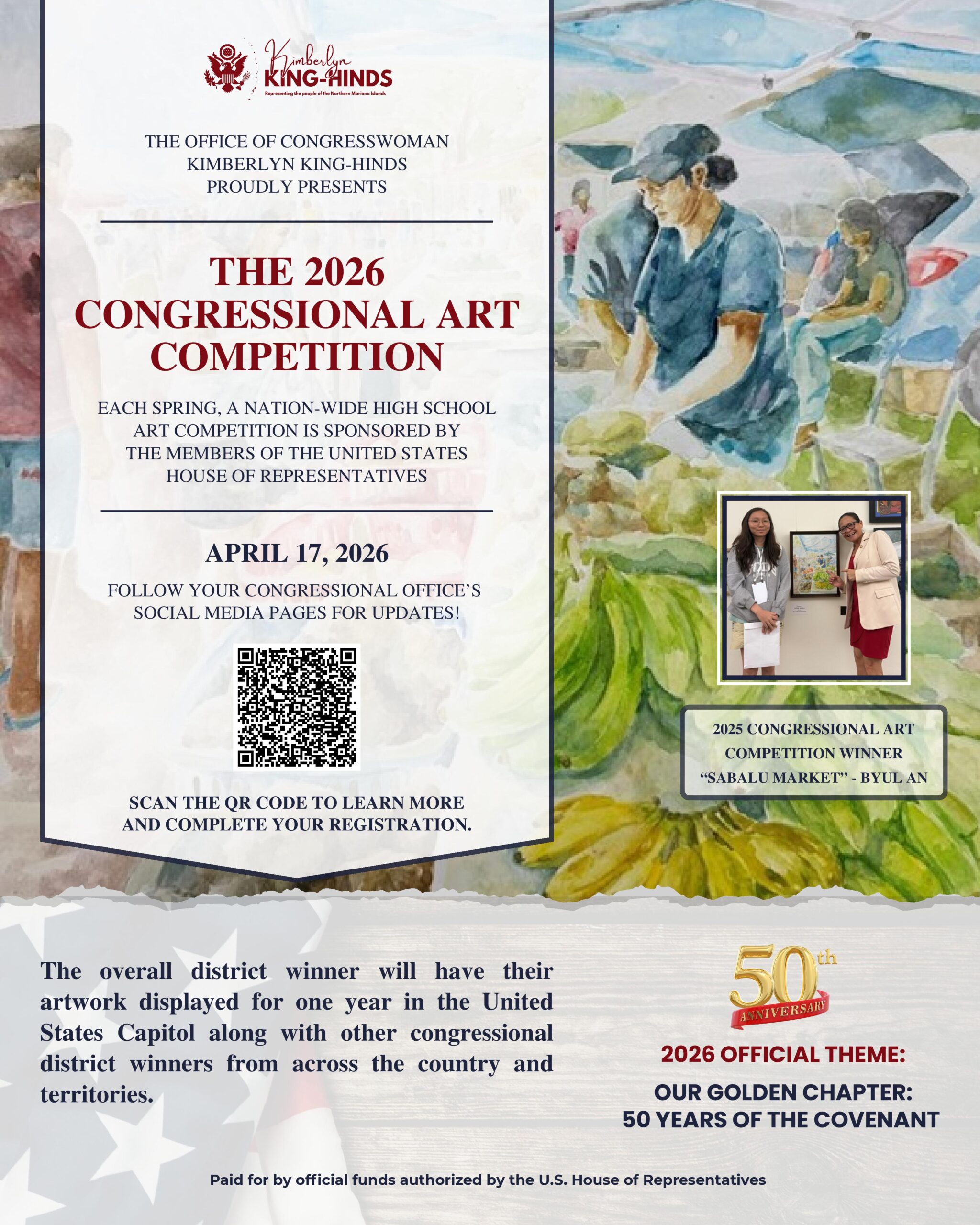
2026 — The CNMI marks the 50th anniversary of the Covenant’s approval by Congress. This year’s theme for the Congressional Art Competition: “Our Golden Chapter: 50 Years of the Covenant.”