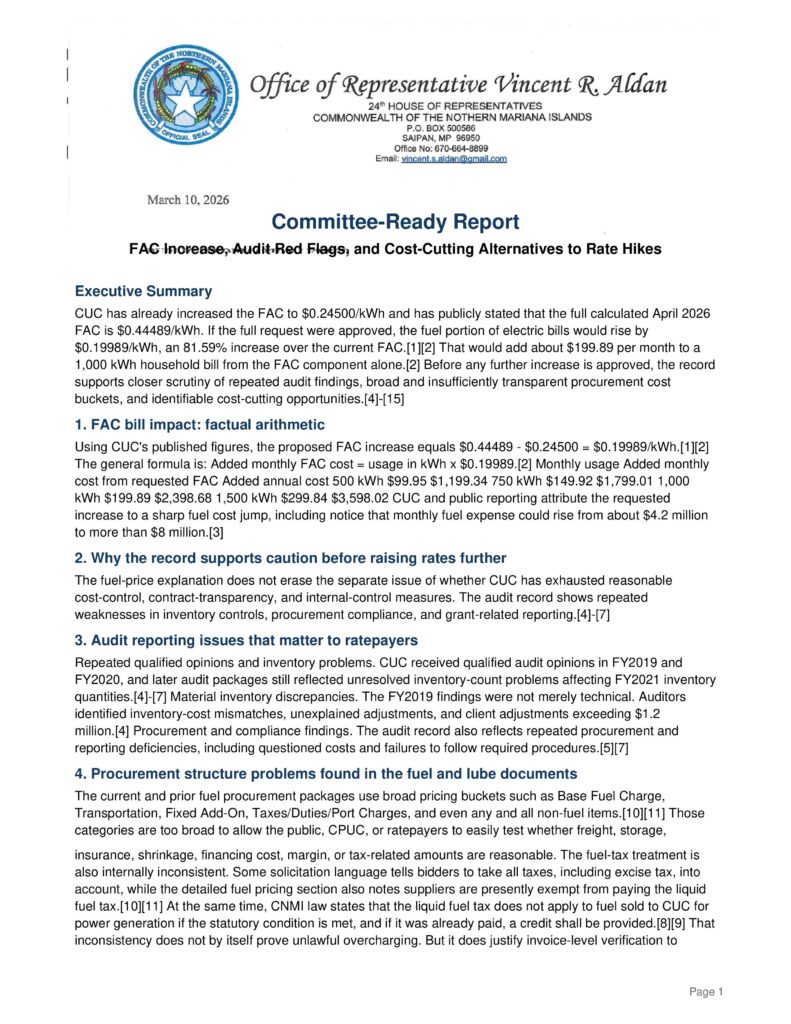
SAIPAN — Rep. Vincent R. Aldan has released a formal committee report documenting audit failures, procurement transparency problems and available cost-cutting measures at the Commonwealth Utilities Corporation, calling on the Legislature to demand accountability before approving any further increase to the Fuel Adjustment Charge.
The report, prepared by Aldan’s House Committee on Transportation and Infrastructure, concludes that CUC’s proposed FAC jump from $0.24500 per kilowatt-hour to $0.44489 per kilowatt-hour — an 81.59% increase — would add roughly $199.89 per month to a household using 1,000 kilowatt-hours, or about $2,398.68 per year from the fuel charge alone.
Aldan said the fuel cost explanation does not resolve a separate question: whether CUC has exhausted every reasonable cost-control measure before asking ratepayers to absorb the increase.
The report cites a pattern of qualified audit opinions at CUC in fiscal years 2019 and 2020, with unresolved inventory-count problems persisting into FY2021 and FY2022 audits. Auditors in FY2019 identified inventory-cost mismatches and unexplained client adjustments exceeding $1.2 million. The report also flags repeated procurement and compliance deficiencies across multiple audit cycles.
On procurement structure, the report finds that CUC’s fuel contracts use broad pricing categories — including base fuel charge, transportation, fixed add-on, taxes and duties, and “any and all non-fuel items” — that make it difficult for the public, the Commonwealth Ports and Utilities Commission or ratepayers to test whether individual charges are reasonable.
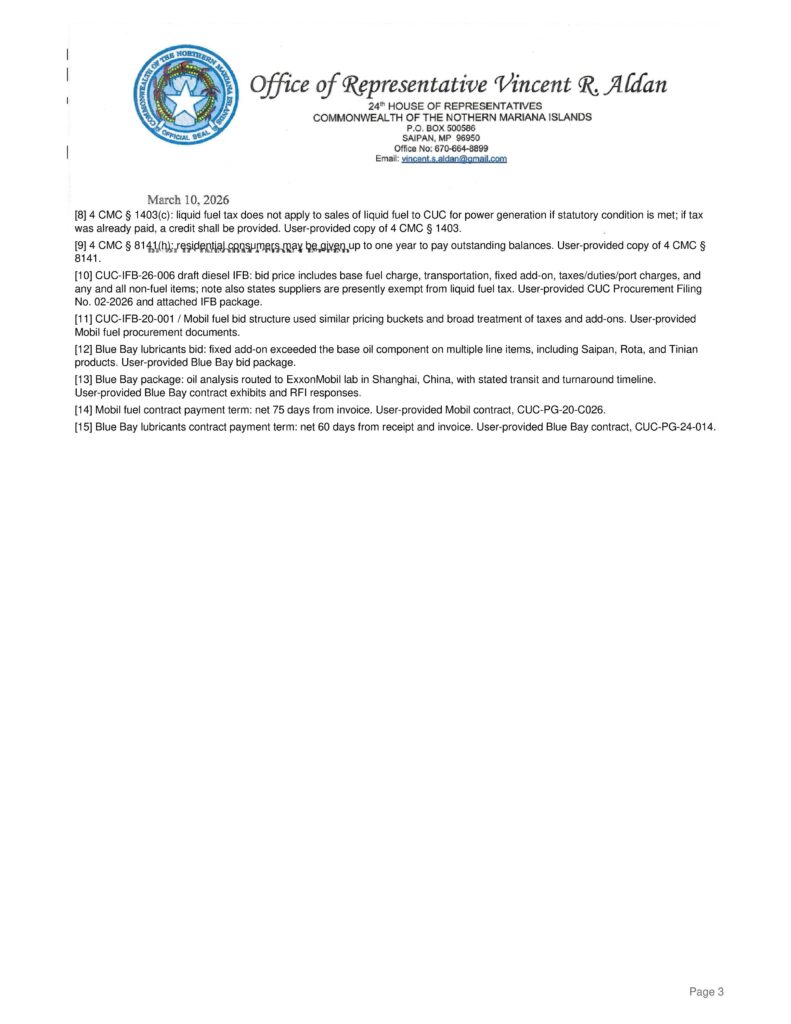
The report also raises concern about the fuel-tax treatment in CUC’s procurement documents, noting an internal inconsistency: some solicitation language requires bidders to account for excise taxes while other sections note suppliers are exempt from the liquid fuel tax. Under 4 CMC Sec. 1403(c), fuel sold to CUC for power generation is exempt from the liquid fuel tax, and if the tax was already paid, a credit must be provided. Aldan said that inconsistency warrants invoice-level verification.
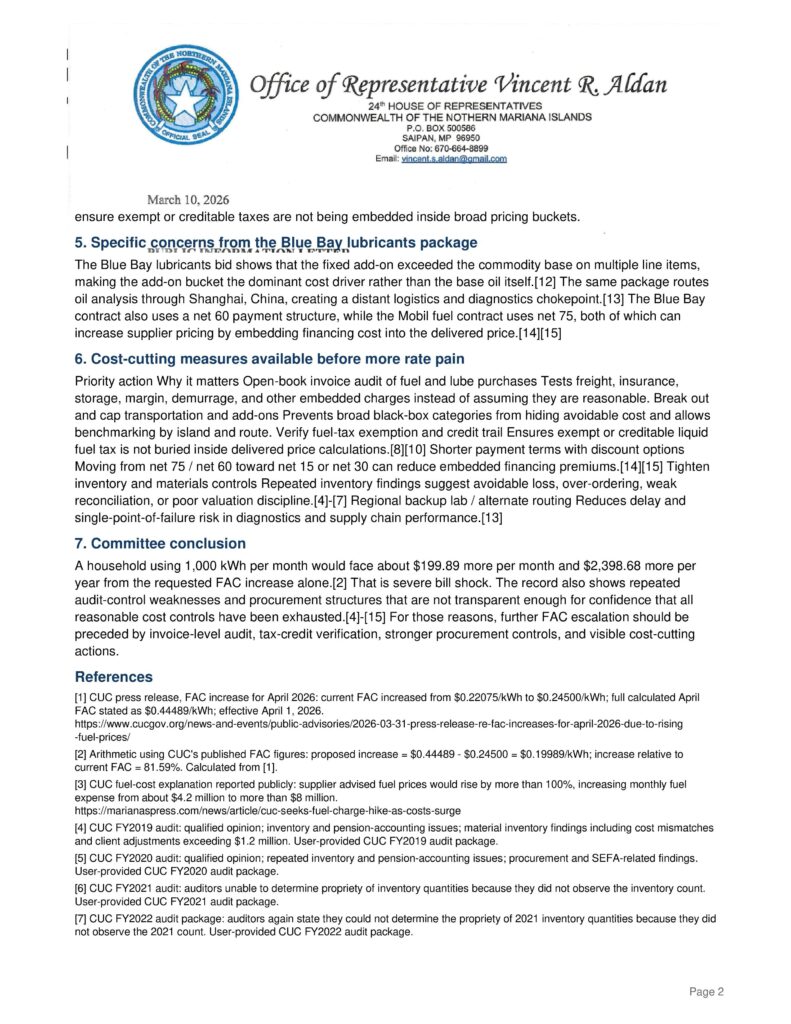
The report identifies additional concerns in the Blue Bay lubricants contract, where the fixed add-on exceeded the commodity base price on multiple line items across Saipan, Rota and Tinian. It also notes that oil analysis under that contract is routed through an ExxonMobil laboratory in Shanghai, China, and that CUC’s contracts carry payment terms of net 60 and net 75 days, which can embed financing costs into delivered prices.
Among the cost-cutting measures the report recommends before any further rate increase: an open-book invoice audit of all fuel and lubricant purchases, itemized disclosure of transportation and add-on charges, verification of fuel-tax exemption and credit trails, shorter payment terms, tighter inventory controls and development of regional backup lab options to reduce supply chain risk.
“Further FAC escalation should be preceded by invoice-level audit, tax-credit verification, stronger procurement controls, and visible cost-cutting actions,” the report concludes.