Recent reporting highlighted by Angelo Villagomez of the Center for American Progress and published in the Guam Daily Post should concern everyone in the Commonwealth of the Northern Mariana Islands.
The report explains that the Bureau of Ocean Energy Management is proposing changes that would shorten the review timeline for deep sea mineral lease applications and remove the requirement that governors and territorial governments be notified when environmental concerns arise during those leases.
For island communities like ours, where the ocean is central to culture, livelihoods, and food security, reducing transparency and consultation in decisions affecting the deep ocean should raise serious concerns.
Over the past several months I have been urging the Commonwealth government to establish a CNMI Deep Sea Mining Task Force. Earlier this year I wrote directly to House Speaker Edmund Villagomez requesting leadership on organizing a task force that could coordinate scientific review, policy analysis, and community engagement on this issue. To date I have not received a response.
At the same time, I have been corresponding with Department of Lands and Natural Resources Secretary Sylvan Igisomar through personal email exchanges. Director Igisomar recently shared that his office met with representatives from the Bureau of Ocean Energy Management and raised the possibility of forming a federal territorial task force focused on deep sea mining policy affecting the Marianas.
According to Director Igisomar, his department has recommended to the Governor that the CNMI formally request such a task force through the Department of the Interior. That step is encouraging and deserves public support.
But developments in Washington show how quickly the policy landscape can change.
During the recent Section 902 consultations in Washington, Governor David Apatang met with Homeland Security Secretary Kristi Noem to discuss matters affecting the Northern Mariana Islands. Shortly after those meetings, the administration announced that Noem had been removed from her position. Leadership changes at the federal level can occur rapidly, sometimes within days of meetings with territorial leaders. When this happens, island governments must be prepared to continue advocating for their interests regardless of who holds federal office.
This reality highlights why the Commonwealth must build its own coordinated structure to examine emerging issues such as deep sea mining.
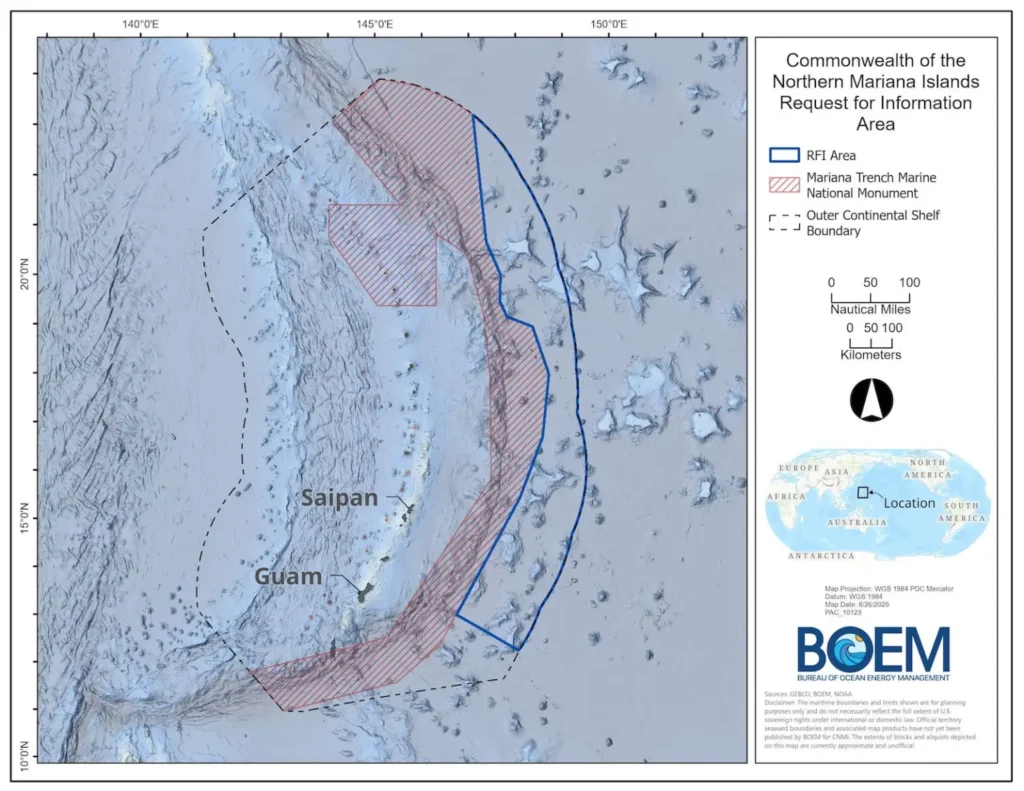
The federal government has already been evaluating a large offshore region east of the Mariana Trench for potential mineral leasing. The area under consideration spans millions of acres of deep ocean connected to the waters surrounding the Mariana Islands.
These waters contain ecosystems that scientists are still working to understand. For the people of the Marianas, the ocean is not simply a distant resource. It supports fisheries, sustains local economies, and carries deep cultural meaning rooted in generations of ocean stewardship and navigation traditions.
Across the Pacific, governments have already begun organizing themselves to address seabed mineral development. Countries including the Cook Islands, Tonga, Fiji, and Papua New Guinea have established regulatory frameworks or advisory bodies to guide national decisions regarding seabed minerals.
The CNMI should be doing the same.
A Commonwealth task force would not override federal jurisdiction over offshore mineral resources. Instead it would bring together scientists, policymakers, fishermen, cultural leaders, and community representatives to evaluate the issue carefully and ensure that the Marianas have a unified voice in federal discussions.
Island communities have learned many times that decisions made far away can have lasting impacts locally.
If federal policy is moving faster while consultation with island governments is being reduced, then the responsibility falls on us to organize our expertise and leadership now.
Creating a CNMI Deep Sea Mining Task Force would be a responsible and proactive step toward protecting the ocean that sustains our islands.
Gregorie Michael Towai (Eipéráng)
Gregorie Michael Towai is a cultural advocate, independent researcher on Oceanic indigeneity, and community leader who grew up in Garapan, Saipan. He is a vocal opponent of seabed mining and advocate for the Ocean Rights movement in the Marianas.
Editor’s note: The views and opinions expressed in this op-ed are those of the author and do not necessarily reflect the views of NMI News Service or its staff. All assertions are the sole responsibility of the writer.
To submit an op-ed for consideration, email your piece to brad.ruszala@nminewsservice.com