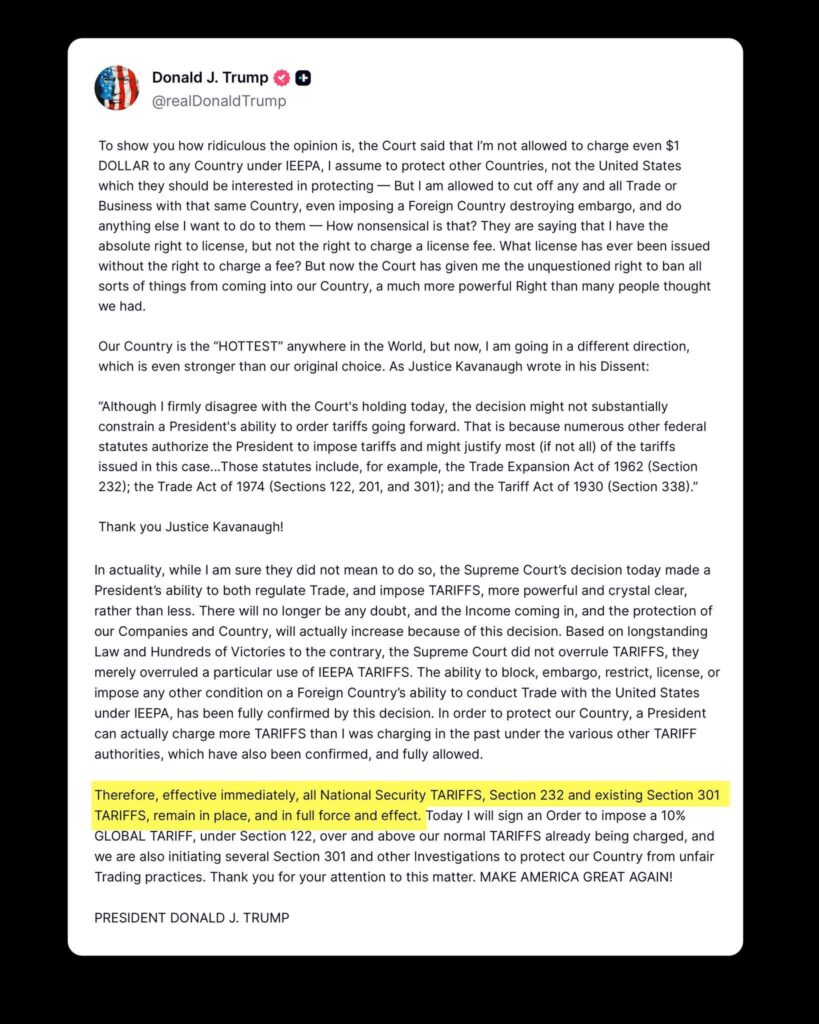
Saipan — President Donald Trump said he will impose a temporary 10% “global tariff” under Section 122 of the Trade Act of 1974 after the U.S. Supreme Court ruled that the International Emergency Economic Powers Act does not authorize a president to impose tariffs.
In a statement circulated online, Trump criticized the Court’s ruling and argued it was illogical to bar what he described as even a minimal fee tied to licensing under IEEPA while still allowing broad restrictions on trade. The message also said existing Section 232 national security tariffs and Section 301 tariffs would remain in effect.
The Supreme Court’s decision came in Learning Resources, Inc. v. Trump, a 6–3 ruling that found IEEPA does not grant the president authority to levy tariffs. Reporting and analysis on the ruling indicated the majority treated tariffs as a form of taxation that requires clearer congressional authorization than IEEPA provides.
Trump’s statement praised language from Justice Brett Kavanaugh’s dissent pointing to other statutes that can support tariff actions, including Section 232 of the Trade Expansion Act of 1962 and provisions of the Trade Act of 1974. Trump said the Court’s decision left those other tariff pathways intact, and he framed the ruling as clarifying presidential authority to regulate trade through other means.
Reuters reported the Section 122 tariff would apply for up to 150 days and begin within days, and that the administration also plans to initiate new Section 301 unfair-trade investigations that could lead to additional, more targeted tariffs later