SAIPAN — Governor. David M. Apatang is urging the Trump administration’s top homeland security and interior officials to treat the CNMI as a frontline U.S. border community where economic stability and border security are closely linked, warning that disrupting lawful travel programs could undercut the Commonwealth’s ability to support federal enforcement and oversight.
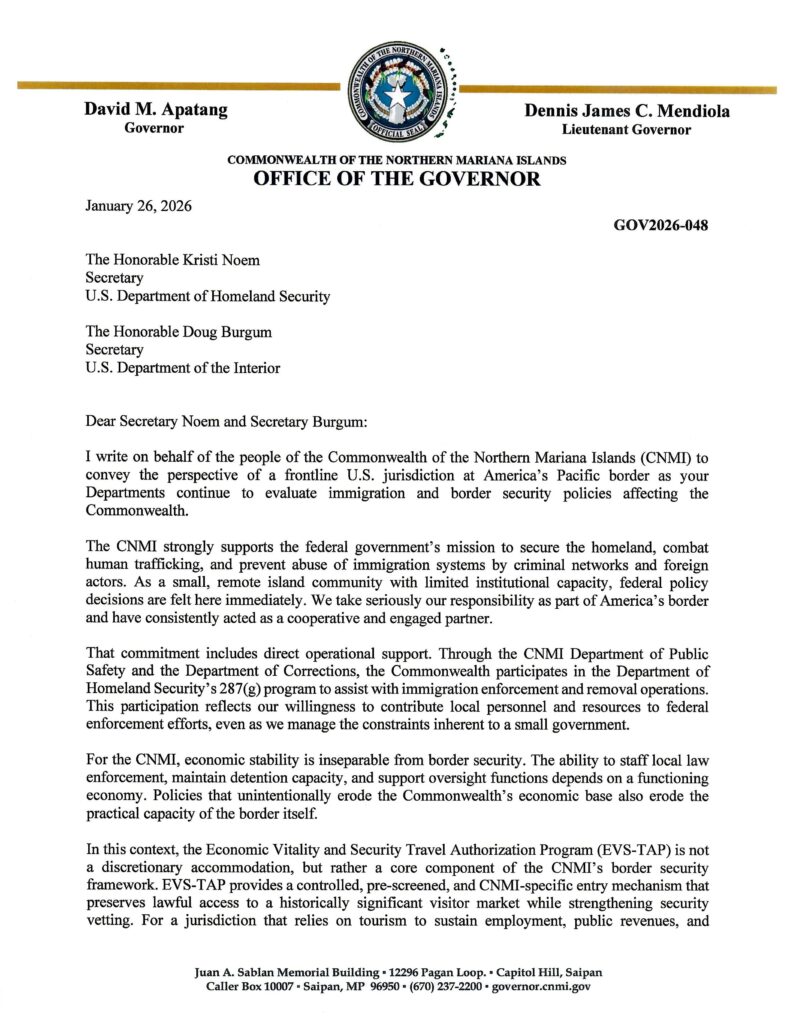
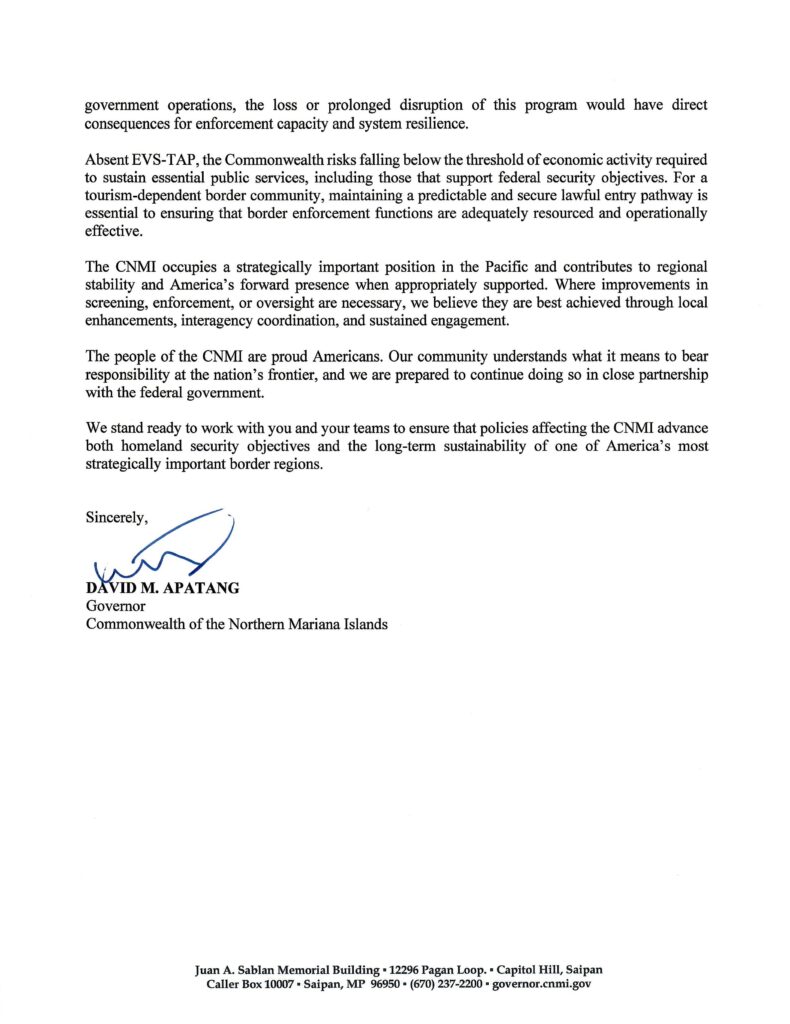
Following responses from Congresswoman Kimberlyn King-Hinds, the Hotel Association of the Northern Mariana Islands, the Saipan Chamber of Commerce, and the Marianas Visitors Authority, the Apatang administration today penned a letter to Homeland Security Secretary Kristi Noem and Interior Secretary Doug Burgum, that said the CNMI supports the federal mission to secure the homeland, combat trafficking, and prevent abuse of immigration systems by criminal networks and foreign actors, but stressed that policy shifts can hit small, remote island communities immediately because of limited institutional capacity.
Apatang pointed to what he described as the CNMI’s direct operational support for federal efforts, including work through the CNMI Department of Public Safety and Department of Corrections and participation in DHS’s 287(g) program connected to immigration enforcement and removal operations.
The governor also defended the CNMI Economic Vitality & Security Travel Authorization Program (EVS-TAP) as a controlled, pre-screened entry mechanism and described it as a core part of the Commonwealth’s border security framework rather than a discretionary accommodation. He warned that losing or significantly disrupting EVS-TAP would have direct consequences for enforcement capacity and system resilience, arguing that a sharp economic hit would threaten the public services and institutional footing the CNMI relies on to support security objectives.
The letter comes amid growing scrutiny of CNMI travel programs. In a Jan. 15, 2026 letter, U.S. Sens. Rick Scott, Jim Banks, and Markwayne Mullin urged DHS to revoke EVS-TAP and require Chinese nationals to obtain standard tourist visas to visit the CNMI, and also urged changes involving Hong Kong’s participation in the Guam-CNMI Visa Waiver Program.
Apatang said the CNMI occupies a strategically important position in the Pacific and contributes to regional stability and America’s forward presence when appropriately supported. Where improvements in screening, enforcement, or oversight are needed, he said they are best achieved through local enhancements, interagency coordination, and sustained engagement — not economic destabilization.