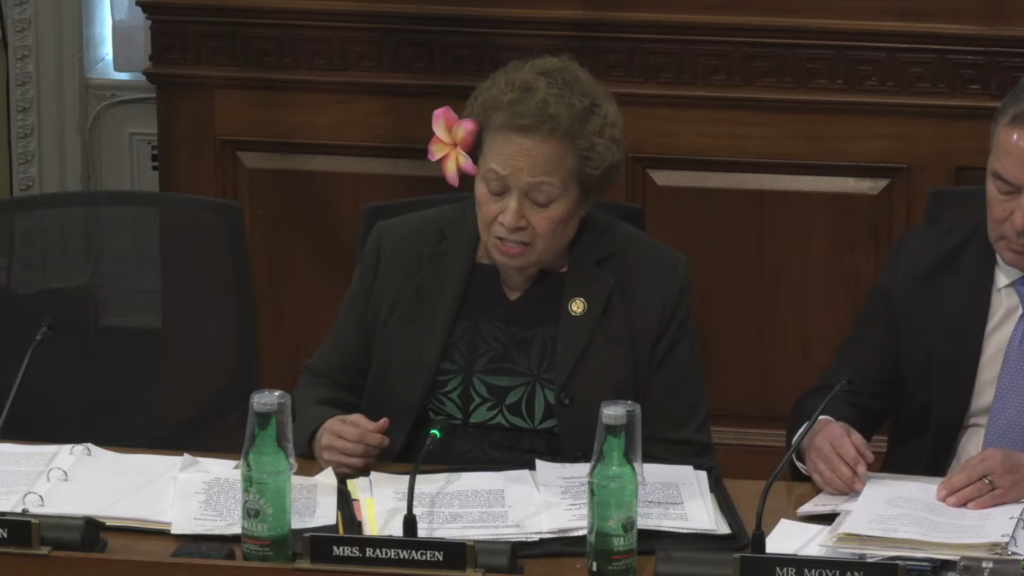
WASHINGTON, D.C. —Representative Aumua Amata Coleman Radewagen, who represents American Samoa, used her time in a House Natural Resources subcommittee hearing to underline strong local opposition to deep-sea mining near the territory and to press Impossible Metals on when its “green” technology could realistically be ready and what benefits would flow back to the people living closest to any offshore activity.
Amata told the committee that while critical minerals are being framed as a national security issue, especially in the context of growing Chinese influence in the Pacific, territories like American Samoa also face the cultural and economic consequences of decisions made in federally controlled waters. She said the ocean is “sacred” to Indigenous people in American Samoa and that residents remain unconvinced that benefits would outweigh costs if deep-sea mining occurs near the islands.
Amata said any federal move toward deep-sea mining must keep territorial communities in mind, starting with protecting fishing stocks and the seafloor ecosystem. “Fishing is our lifeblood,” she said, adding that if the technology is not ready or if it will disrupt the ecosystem “we simply can’t proceed.”
She also urged that if the federal government proceeds, policymakers should prioritize plans that directly bolster local economies closest to the activity raising ideas such as a trust fund for residents or investing in local infrastructure. Amata said that kind of approach has been used as a tactic to counter Chinese influence, and she urged colleagues to remember what and who the U.S. is trying to protect in the Pacific.
Amata asked to enter into the record her comments submitted to BOEM’s request for information on commercial leasing for Outer Continental Shelf minerals offshore American Samoa. She said her submission echoes the governor, local leaders, and the public’s opposition to mining in and around the territory, and calls for a minimum buffer distance of at least 50 miles, preferably more.
Turning to Impossible Metals representative Oliver Gunasekara, Amata asked what timeline he sees for adopting “green tech” versus legacy methods, and how technologies like his could limit irreversible ecosystem damage. Gunasekara said the company has spent the last five years developing its technology but is not yet at production scale, estimating it will take about three more years before it is ready for commercial deployments. He also said Impossible Metals is committed to an environmental impact assessment and mining test with independent scientists to monitor impacts, and said the company has an agreement with the German government to do that next year.
Amata then referenced Gunasekara’s statement that if Impossible Metals receives a contract to extract minerals near American Samoa, the company would voluntarily dedicate 1% of profits to the territory. She asked whether that offer would change if the federal government provided its own subsidy to the territory based on the lease. Gunasekara responded that it would not change, and said he encourages the federal government to share revenues and lease fees with coastal communities, adding that Impossible Metals would still voluntarily commit 1% of profits regardless.
Watch the full committee meeting on the NMI News Service Facebook page or YouTube channel.