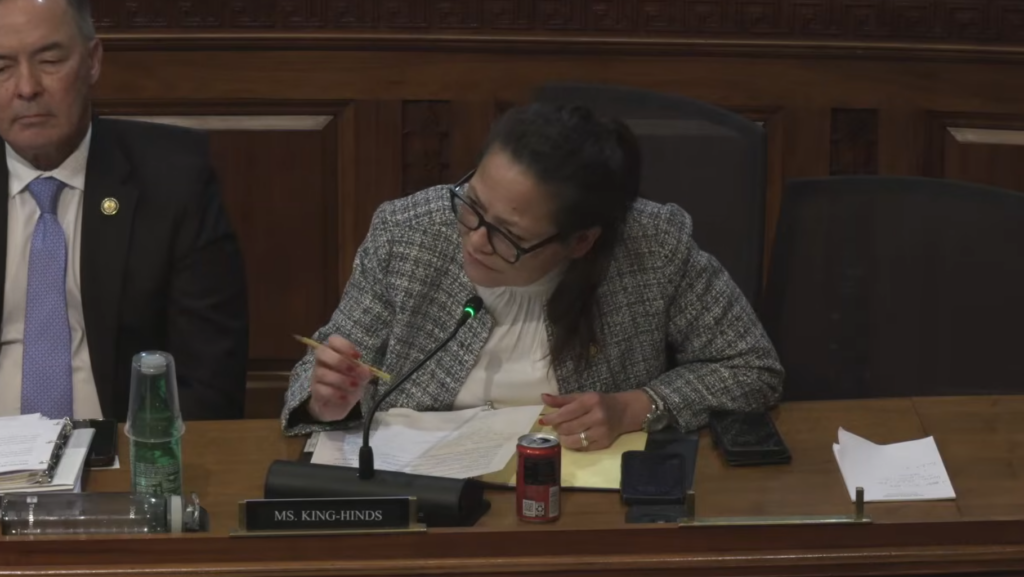
WASHINGTON, D.C. — CNMI Delegate Kimberlyn King-Hinds and Guam Delegate James C. Moylan used their time in a House Natural Resources Committee hearing segment to challenge deep-sea mining companies on environmental safeguards, permitting, and what meaningful consultation with island communities would actually look like.
King-Hinds opened by saying she supports innovation, stronger domestic supply chains, and a regulatory system that works but stressed that in the Marianas, Guam, and American Samoa, communities “don’t get the luxury of being wrong” because any decision affecting the ocean is permanent. She described the ocean as tied to identity and culture and also as “a refrigerator” for many families.
Speaking directly to Oliver Gunasekara of Impossible Metals, King-Hinds said public opposition in the region has been fueled in part by concerns that mining companies may be trying to avoid a full federal environmental process. She asked him to clarify on the record whether Impossible Metals supports going through NEPA and a full environmental impact statement-style review.
Gunasekara responded that the company is committed to a NEPA environmental review, including collecting baseline information and conducting an environmental impact assessment combined with a mining test to evaluate impacts. He said “we’re right at the beginning” and that it would take “many years” before the company would potentially be mining.
King-Hinds then pressed for specifics on what industry is asking the federal government to speed up. She asked what exactly companies want to shorten, remove, or combine, and which environmental or community protections they would leave untouched. She said communities want engagement, but “high-quality” engagement, and asked what that means in practice. Gunasekara said it means having real, shareable environmental data that can show what the impacts of collecting will be, rather than engagement without new data.
King-Hinds also asked about measurable commitments to ensure that plume-related turbidity or the operational footprint would not be damaging. Gunasekara said minimizing disturbance is the point of their design, describing a collection system that does not create a sediment plume, does not land, and does not use a riser system or create a mid-water plume. He also said the system can selectively collect and avoid “all visible life.”
Moylan followed by saying the delegates from the CNMI, Guam, and American Samoa were united to protect their homelands. He told the committee that the ocean is not theoretical for Guam, it is how people live, how families are fed, and how history is carried forward, and that decisions made in Washington about mining near the islands feel immediate back home.
Moylan asked to enter multiple Guam actions into the record, including Guam Legislature Resolution 132-38 calling for a moratorium and objecting to BOEM’s RFI and proposed leasing offshore the Marianas, a Mayor’s Council of Guam resolution opposing deep-sea mining activity near Guam until credible evidence shows it will not cause harm, a letter signed by Guam’s top elected officials opposing BOEM’s proposed commercial leasing in the Marianas, and a coalition letter signed by more than 5,000 individuals calling for a halt and for consultation with island communities.
Turning to Gerard Barron of The Metals Company, Moylan cited statements from environmental scientists that seabed collection can create sediment plumes, disrupt the water column, and pose risks to fisheries and ecosystems, impacts he said would deeply affect Pacific communities and local economies. He asked whether The Metals Company’s claim that its collectors create less disruption than other collectors has been reviewed by independent scientists. After Barron described the company’s investment in environmental research, Moylan repeated the question, and Barron answered yes.
Moylan also asked why The Metals Company is not pursuing AUV-based technologies that may result in even less disruption. Barron said the company has to pursue what is commercially viable now, described alternative designs as many years away, and said the company is looking at commercial production next year.
Moylan closed by saying his constituents have been frustrated and angered by what he described as a lack of territorial consultation and lack of information. He invited subcommittee members to come to Guam and speak directly with residents. He said Guam is not against progress, but is against actions taken without consultation or consent, and wants Washington to not only hear island communities, but listen, even when it is not the answer the federal government is looking for.
Watch the full committee meeting on the NMI News Service Facebook page or YouTube channel.