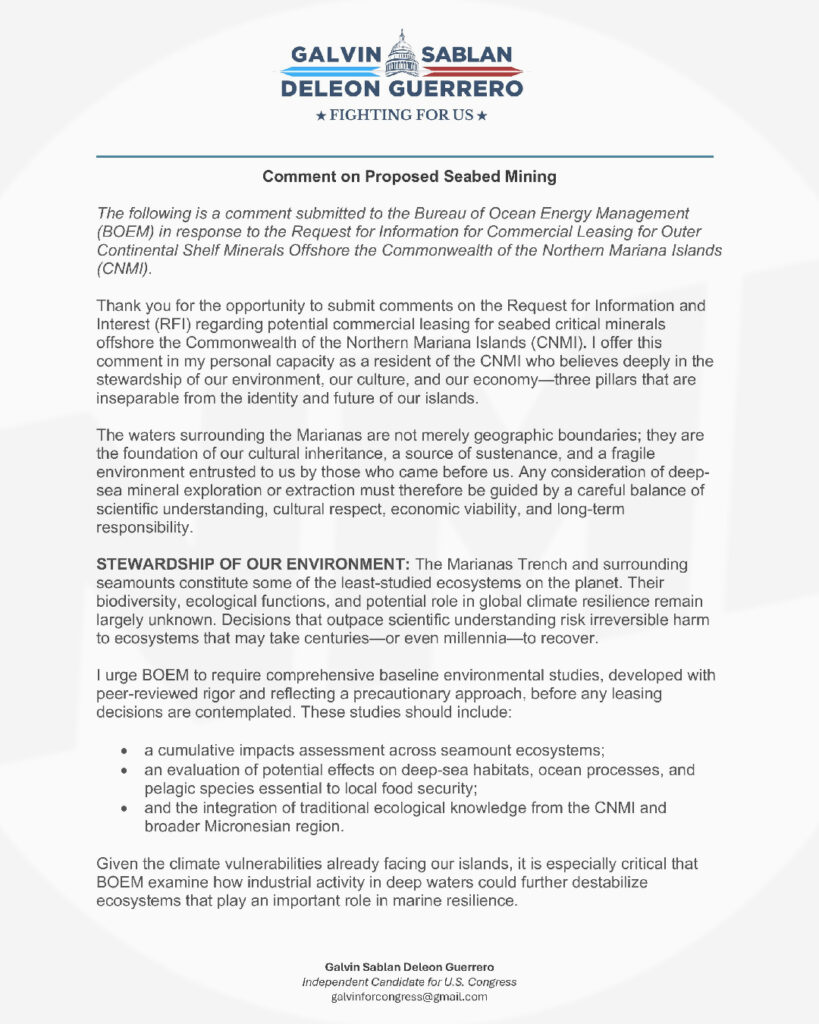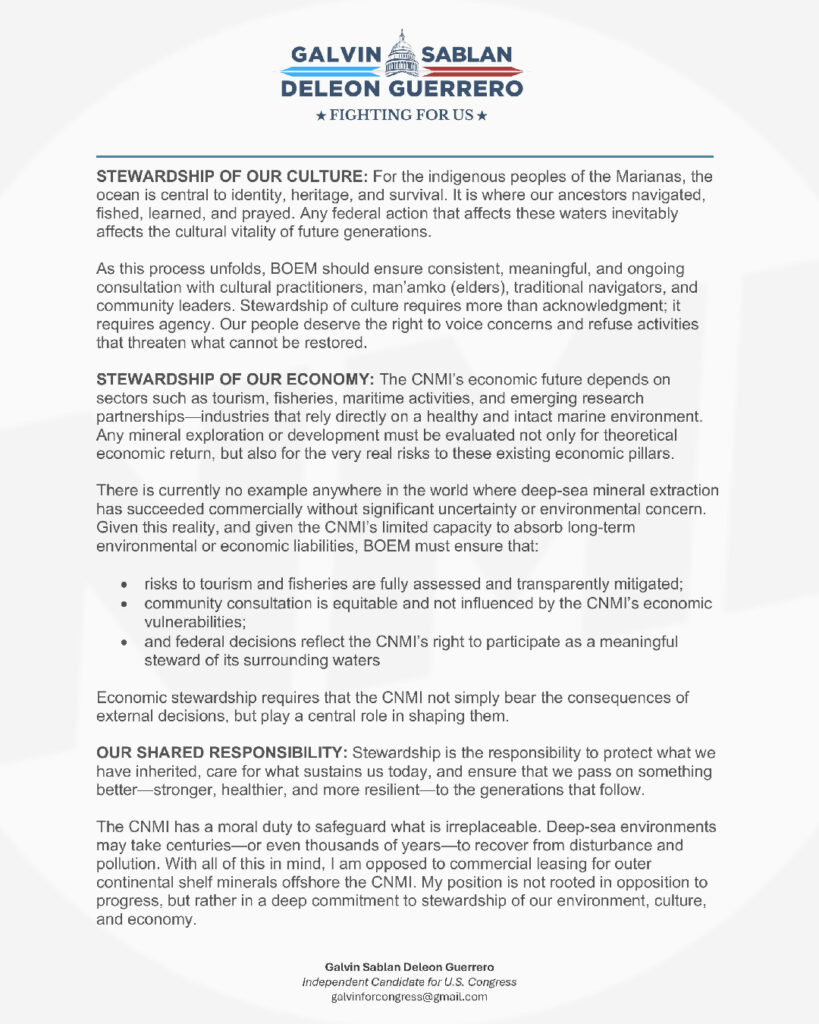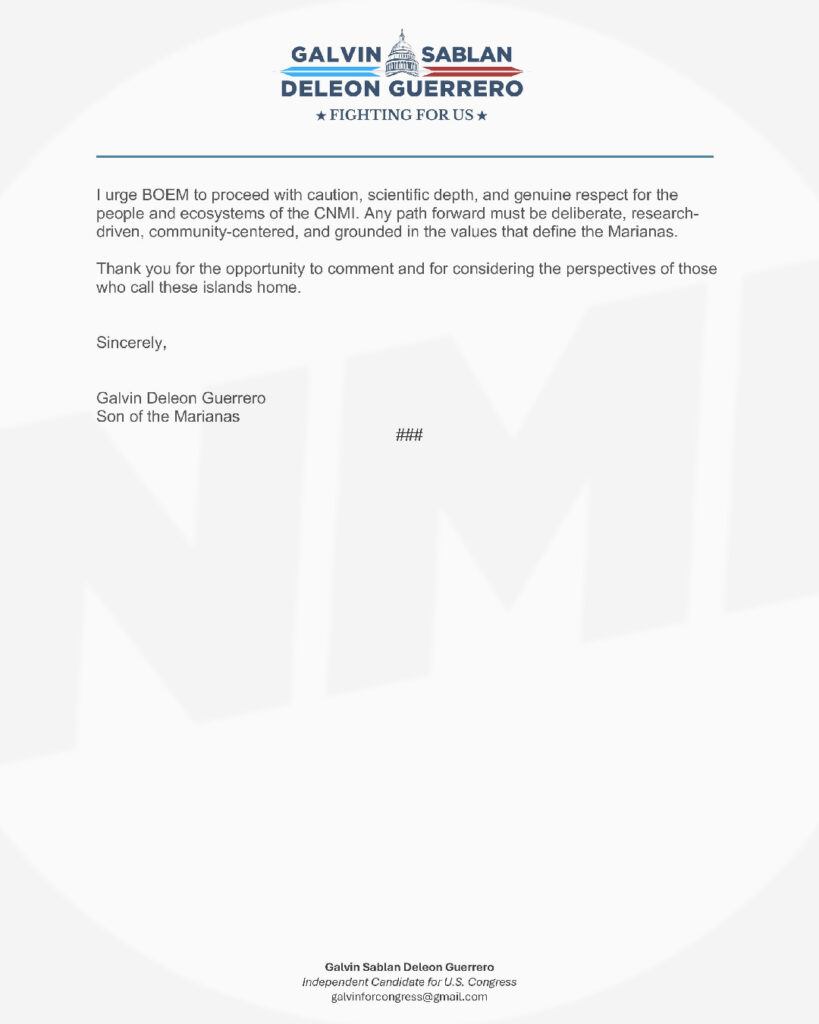
Galvin Sablan Deleon Guerrero, Independent candidate for U.S. Congress, has formally submitted comments to the Bureau of Ocean Energy Management (BOEM) opposing commercial leasing for seabed mineral extraction in waters offshore the Commonwealth of the Northern Mariana Islands.
In his detailed response to BOEM’s Request for Information regarding potential deep-sea mining operations, Deleon Guerrero outlined concerns centered on three interconnected pillars: environmental protection, cultural preservation, and economic sustainability.
Deleon Guerrero emphasized that the Marianas Trench and surrounding seamounts represent some of the least-studied ecosystems on Earth, with their biodiversity and ecological functions remaining largely unknown. “Decisions that outpace scientific understanding risk irreversible harm to ecosystems that may take centuries—or even millennia—to recover,” he stated in his comment to the federal agency.
The congressional candidate is urging BOEM to require comprehensive baseline environmental studies before any leasing decisions move forward. His recommendations include cumulative impact assessments across seamount ecosystems, evaluations of potential effects on deep-sea habitats and pelagic species essential to local food security, and integration of traditional ecological knowledge from the CNMI and broader Micronesian region.
Deleon Guerrero highlighted the ocean’s central role in the identity and heritage of the Marianas’ indigenous peoples, noting that federal actions affecting these waters inevitably impact the cultural vitality of future generations. “For the indigenous peoples of the Marianas, the ocean is central to identity, heritage, and survival. It is where our ancestors navigated, fished, learned, and prayed,” he wrote in his submission.
He called for consistent, meaningful consultation with cultural practitioners, man’amko (elders), traditional navigators, and community leaders throughout the process, emphasizing that stewardship of culture requires more than acknowledgment—it requires agency.
The candidate also raised concerns about potential impacts on the CNMI’s existing economic pillars, including tourism, fisheries, maritime activities, and emerging research partnerships, all of which depend on a healthy marine environment. Deleon Guerrero noted that no example exists worldwide where deep-sea mineral extraction has succeeded commercially without significant uncertainty or environmental concern. Given the CNMI’s limited capacity to absorb long-term environmental or economic liabilities, he argued that risks to existing industries must be fully assessed and transparently mitigated.
“Economic stewardship requires that the CNMI not simply bear the consequences of external decisions, but play a central role in shaping them,” he stated.
Deleon Guerrero made clear that his opposition to commercial leasing stems not from resistance to progress, but from commitment to responsible stewardship. “Stewardship is the responsibility to protect what we have inherited, care for what sustains us today, and ensure that we pass on something better—stronger, healthier, and more resilient—to the generations that follow,” he wrote.
The candidate concluded his comment by urging BOEM to proceed with caution, scientific depth, and genuine respect for the people and ecosystems of the CNMI, calling for any path forward to be deliberate, research-driven, community-centered, and grounded in the values that define the Marianas. Deleon Guerrero signed his submission identifying himself as “Son of the Marianas.”