SAIPAN – Governor David M. Apatang has signed the Commonwealth of the Northern Mariana Islands’ Fiscal Year 2026 Appropriations Act into law as Public Law 24-20, while exercising his line-item veto authority on multiple provisions he deemed unconstitutional or financially imprudent.
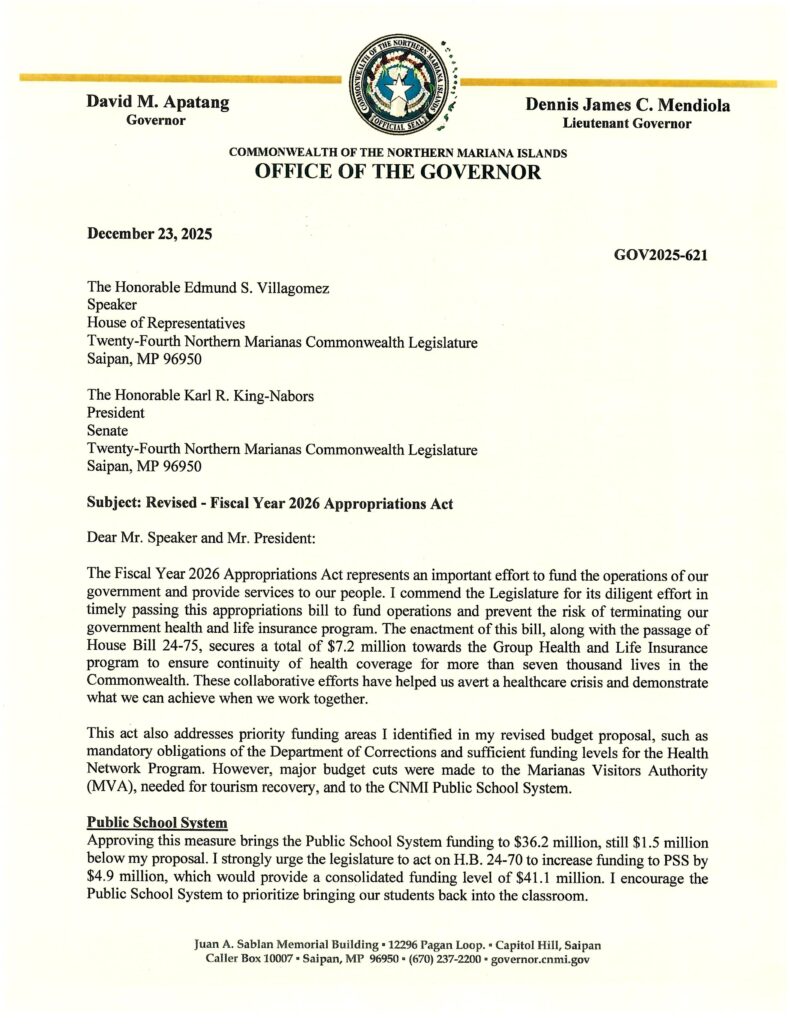
In a detailed letter to House Speaker Edmund S. Villagomez and Senate President Karl R. King-Nabors, Governor Apatang explained his vetoes were necessary to ensure lawful and sustainable appropriations, preserve constitutional integrity, uphold fiscal discipline, and protect the Commonwealth’s financial stability.
The governor commended the Legislature for passing the appropriations bill in time to fund government operations and prevent risks to the Group Health and Life Insurance program. The act, combined with House Bill 24-75, secures $7.2 million toward health coverage for more than seven thousand CNMI residents.
However, Apatang expressed significant concerns about cuts to key programs. The Public School System received $36.2 million in the final budget, which the governor noted is $1.5 million below his proposal. He strongly urged the legislature to act on H.B. 24-70 to increase PSS funding by $4.9 million, bringing it to a consolidated level of $41.1 million.
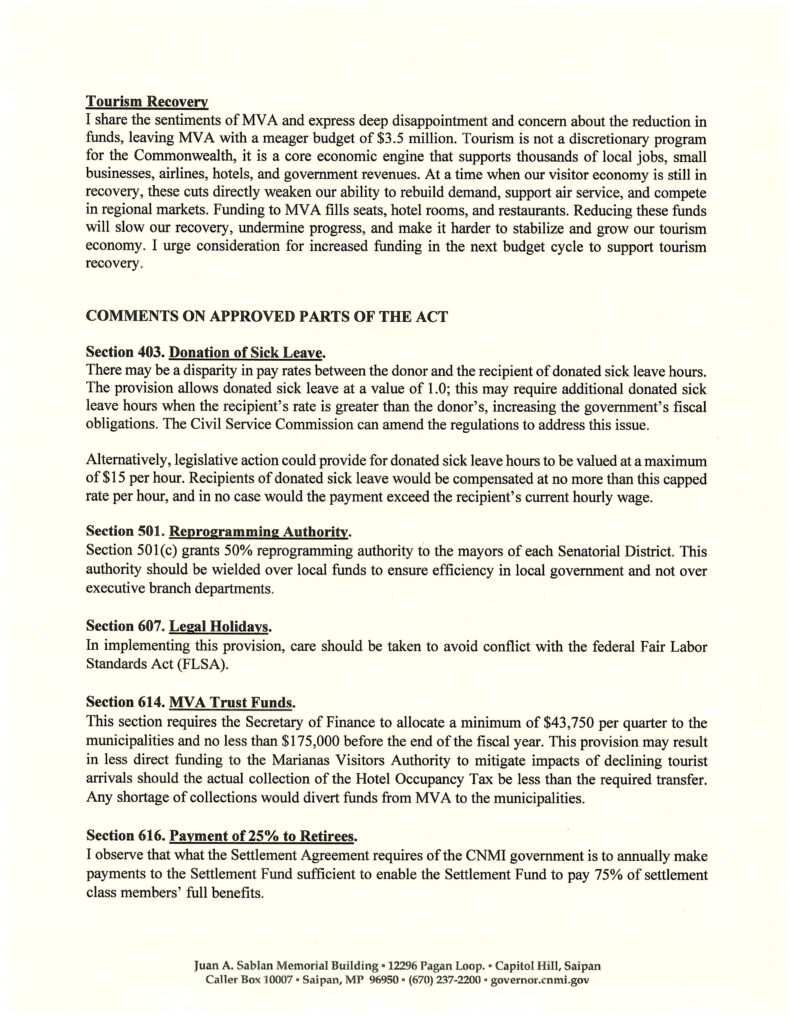
The governor voiced deep disappointment over reductions to the Marianas Visitors Authority, which was left with a budget of just $3.5 million. Calling tourism a core economic engine that supports thousands of local jobs and generates revenue for businesses, airlines, hotels, and government, Apatang warned that the cuts would slow recovery and make it harder to stabilize and grow the tourism economy. He urged consideration for increased funding in the next budget cycle to support tourism recovery.
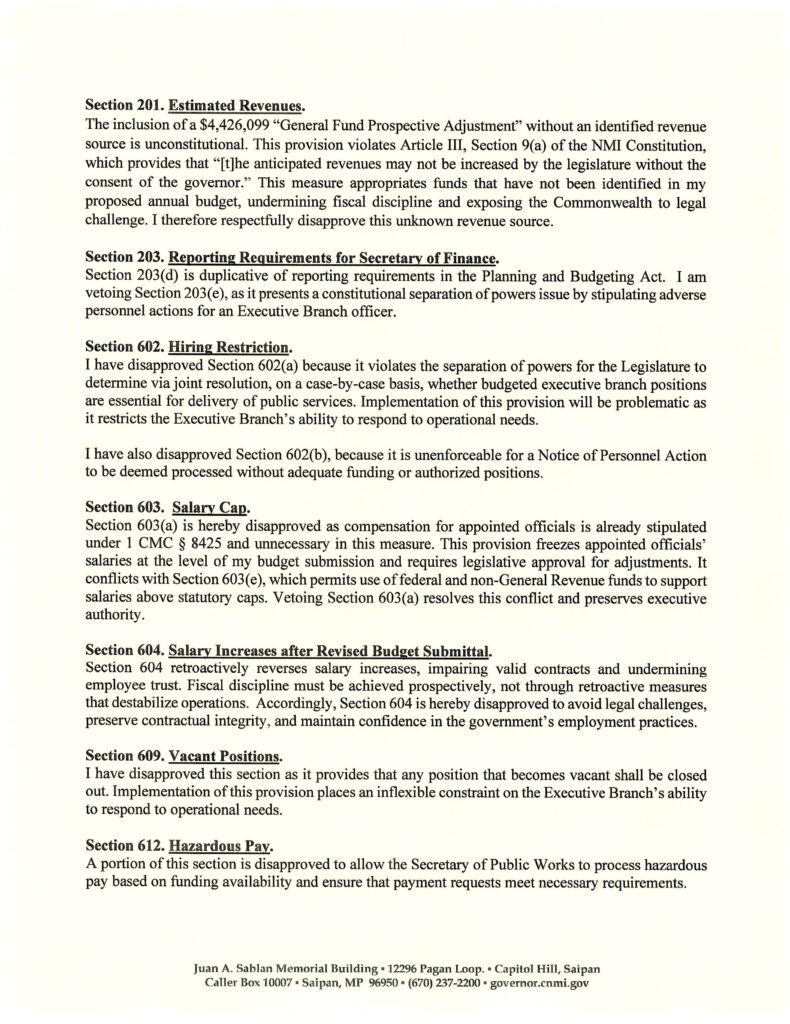
Among the vetoed provisions, several stood out for constitutional concerns. The governor disapproved Section 201, which included a $4.426 million “General Fund Prospective Adjustment” without an identified revenue source, calling it unconstitutional under Article III, Section 9(a) of the NMI Constitution, which prohibits increasing anticipated revenues without the governor’s consent.
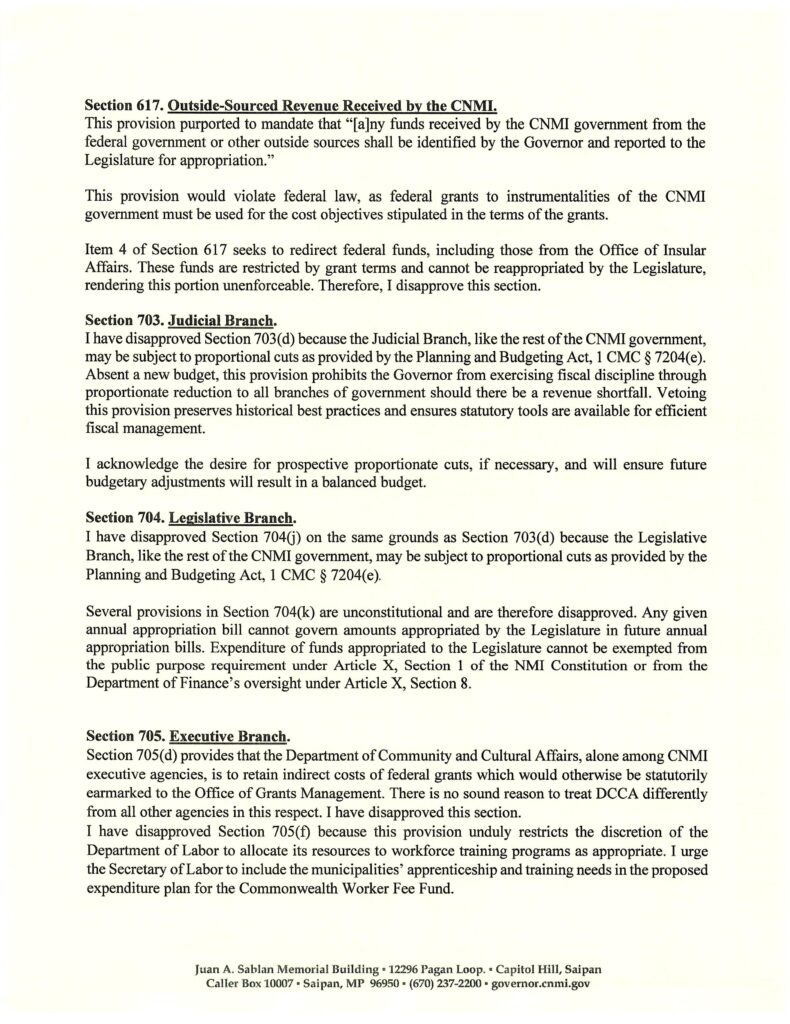
Section 617, which would have mandated that all federal funds received by the CNMI government be identified by the governor and reported to the Legislature for appropriation, was also vetoed. Apatang noted this would violate federal law, as federal grants must be used according to grant terms and cannot be reappropriated by the Legislature.
The governor vetoed provisions in Sections 703 and 704 that would have prohibited him from exercising fiscal discipline through proportionate reductions to branches of government during revenue shortfalls, arguing this preserves historical best practices under the Planning and Budgeting Act.
Multiple personnel-related sections were vetoed as well. Section 602(a) was disapproved because it violates separation of powers by requiring the Legislature to determine via joint resolution whether budgeted executive branch positions are essential for public service delivery. Section 603 was vetoed as unnecessary since compensation for appointed officials is already stipulated under 1 CMC § 8425. Section 604 was disapproved for retroactively reversing salary increases and impairing valid contracts, while Section 609 was vetoed because it would require closing out any vacant position, placing an inflexible constraint on the Executive Branch’s operational needs.
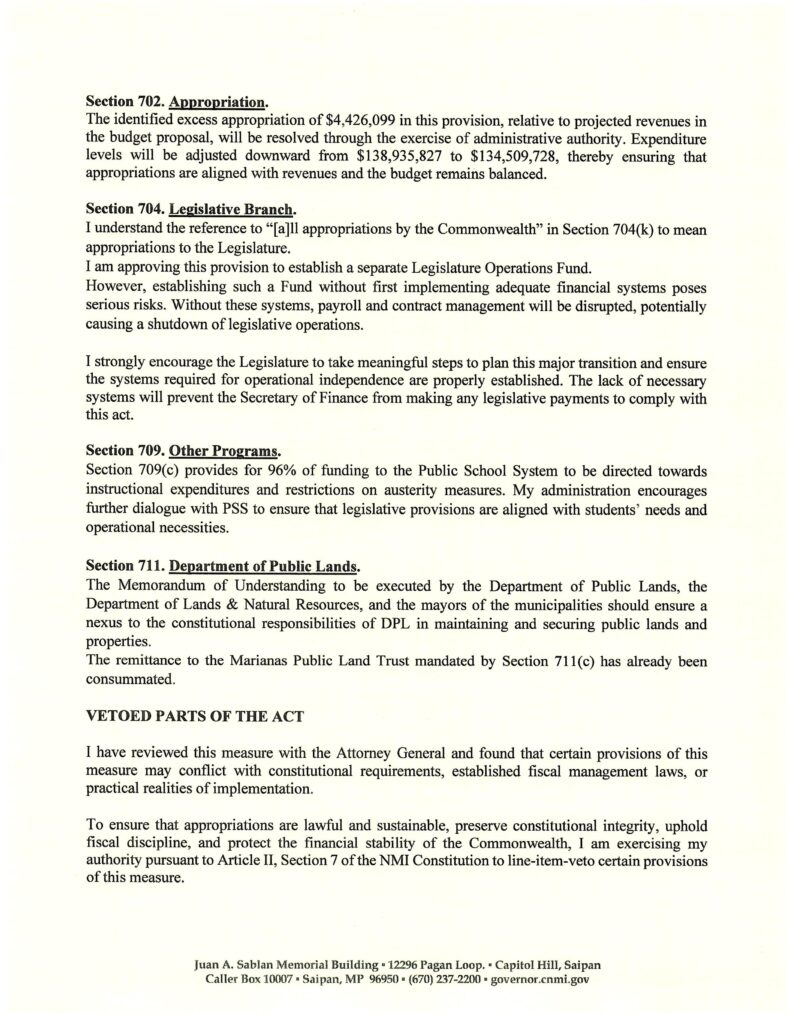
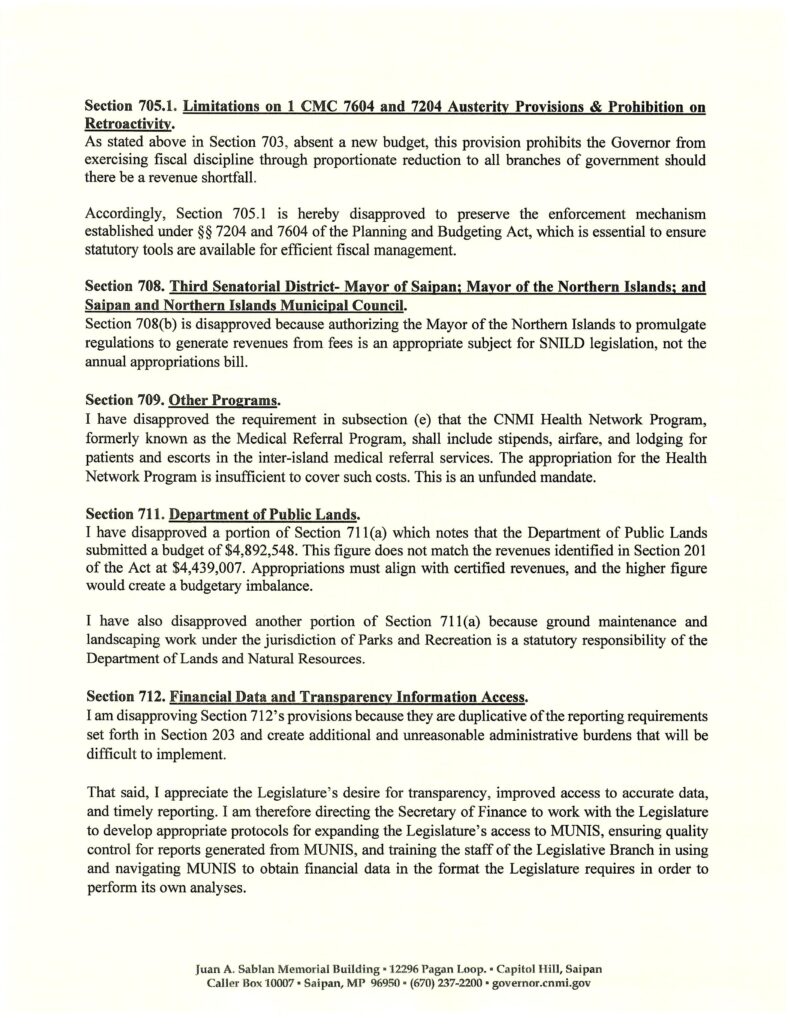
Regarding the Department of Public Lands, the governor disapproved portions of Section 711(a) noting that the department’s submitted budget of $4.892 million doesn’t match identified revenues of $4.439 million in the act, creating a budgetary imbalance. He also vetoed language assigning ground maintenance and landscaping work to Public Lands, stating this is a statutory responsibility of the Department of Lands and Natural Resources.
Section 709(e) regarding the CNMI Health Network Program was disapproved because it mandated that the program include stipends, airfare, and lodging for patients and escorts in inter-island medical referral services without sufficient appropriation to cover such costs.
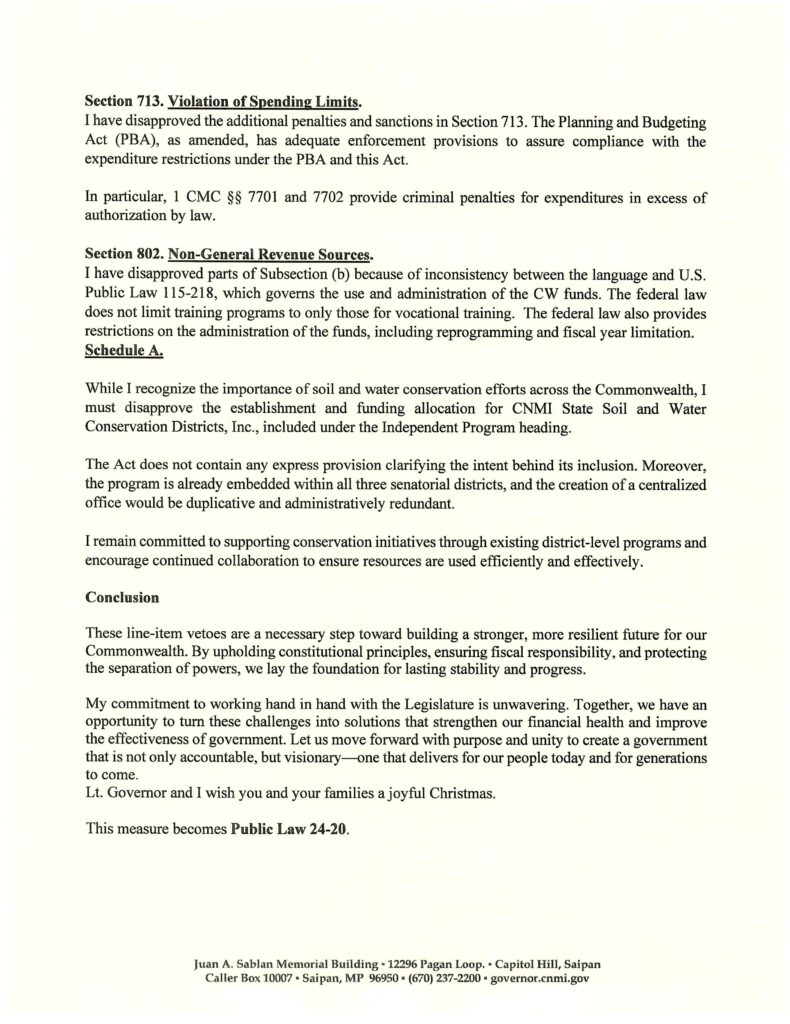
While recognizing the importance of conservation efforts, the governor disapproved establishment and funding for CNMI State Soil and Water Conservation Districts under Schedule A, citing lack of express legislative intent and noting the program already exists within all three senatorial districts.
The governor disapproved Section 712’s financial data and transparency provisions, calling them duplicative of existing reporting requirements in Section 203 that would create unreasonable administrative burdens. However, he directed the Secretary of Finance to work with the Legislature on developing protocols for expanding legislative access to the MUNIS financial system and training legislative staff to use it effectively.
Regarding the Legislature’s operational independence, Apatang approved establishing a separate Legislature Operations Fund under Section 704, but warned that without adequate financial systems in place first, payroll and contract management could be disrupted, potentially causing a shutdown of legislative operations. He strongly encouraged the Legislature to plan this major transition carefully.
The governor provided comments on several approved sections, including requirements for quarterly MVA Trust Fund allocations, the Settlement Fund payment structure, reprogramming authority for mayors, and provisions regarding donated sick leave and legal holidays.
In his conclusion, Governor Apatang emphasized his unwavering commitment to working with the Legislature, stating that together they have an opportunity to turn challenges into solutions that strengthen the Commonwealth’s financial health and improve government effectiveness. He wished the Legislature and their families a joyful Christmas as the measure became Public Law 24-20.