SAIPAN — A U.S. seabed-mining startup has formally told federal regulators it wants to mine polymetallic nodules in waters east of the Northern Mariana Islands and is offering a profit share for the CNMI if leasing moves forward. In a letter to the Bureau of Ocean Energy Management (BOEM), Impossible Metals CEO Oliver Gunasekara said the San Jose-based, Delaware-incorporated company is “affirm[ing] our commercial interest in a lease in this area” under BOEM’s Request for Information and Interest for offshore minerals in the CNMI exclusive economic zone, docket BOEM-2025-0351.
The company argues that polymetallic nodules in the eastern CNMI EEZ could be “the single most promising domestic source” of cobalt, nickel, manganese and copper, and urges BOEM to move “expeditiously” from the information-gathering stage to a proposed lease sale, warning that China already holds multiple International Seabed Authority exploration contracts and has a development pact with the Cook Islands.
Impossible Metals says its business model would include a one percent share of profits from mineral sales going directly to “the CNMI community,” in addition to any federal revenue-sharing the U.S. government might provide from lease payments and royalties.
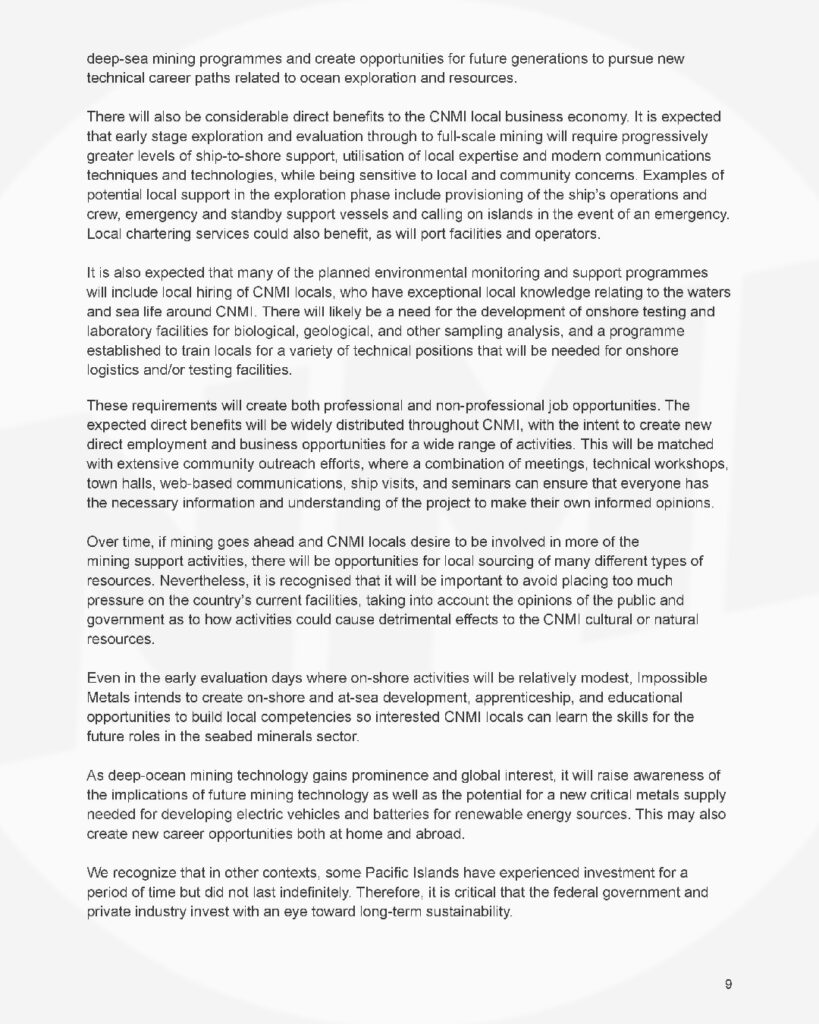
The company also highlights possible local benefits such as jobs and training in a new seabed-mineral sector, on-shore lab and testing facilities hiring CNMI residents, and demand for local port services, provisioning, and support vessels during exploration and operations.
Impossible Metals says it would create “development, apprenticeship, and educational opportunities” so interested residents can learn technical skills for future roles in the industry.
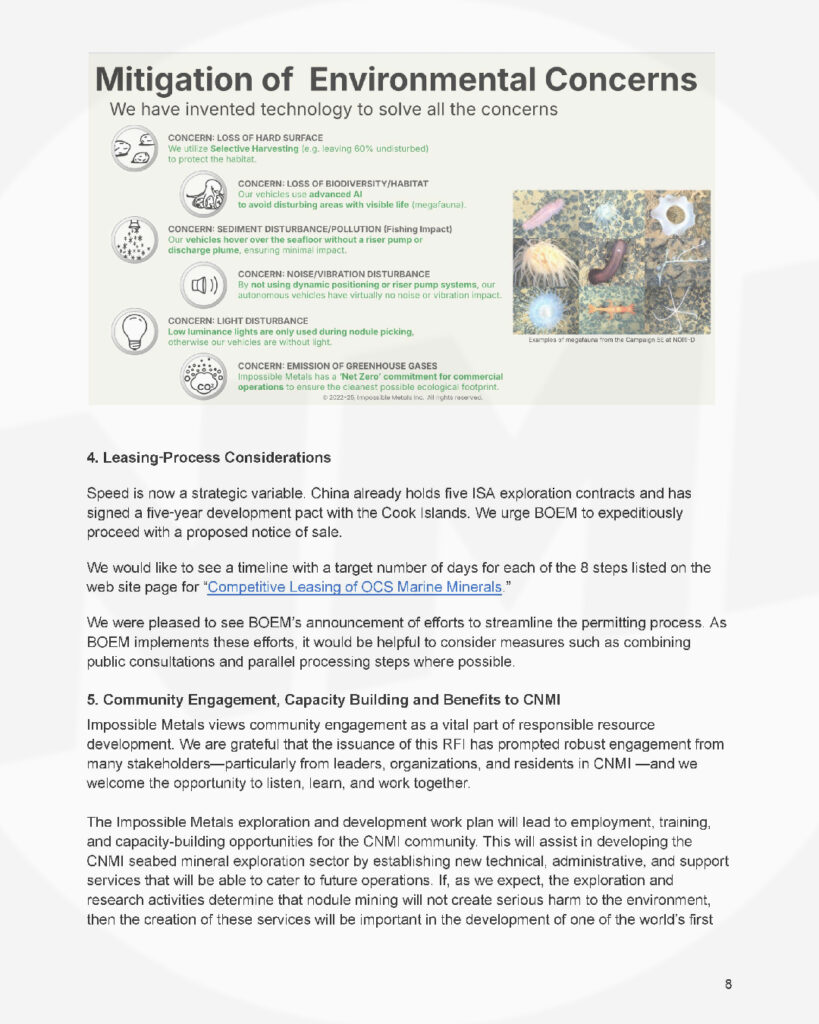
In its 11-page submission, the company describes a “pick-and-place” robotic system that uses autonomous underwater vehicles to hover above the seafloor and lift individual nodules instead of dredging. It says the robots are designed to leave at least 60 percent of nodules in place to help sustain seafloor habitat, avoid “all visually detected megafauna,” and operate without sediment-riser pipes or dynamic-positioning ships, which the firm says eliminates large sediment plumes.
The technology has already been tested at depths of more than a mile, and the company projects it could be ready for full-scale production by 2028. Impossible Metals says it will only proceed to mining if environmental impact statements show “no material, long-lasting impacts on the marine habitat or other uses of the ocean,” including fishing, cables, transportation and recreation. The letter cites life-cycle studies commissioned by another nodule company, The Metals Company, which it says show lower carbon emissions and waste compared to land-based mining, and argues its own system would create even less sediment disturbance than other prototype nodule collectors previously tested in the Pacific.
Impossible Metals urges BOEM to rule out mining of seafloor massive sulfides and cobalt-rich crusts on seamounts, saying those areas support unique vent communities, cold-water corals and key fisheries. It calls nodule mining “less invasive” and notes that no U.S. company is currently developing technology for vent or seamount mining.
The company says it is “exclusively focused” on polymetallic nodules and would be willing to exclude seamounts and guyots from any leased area.
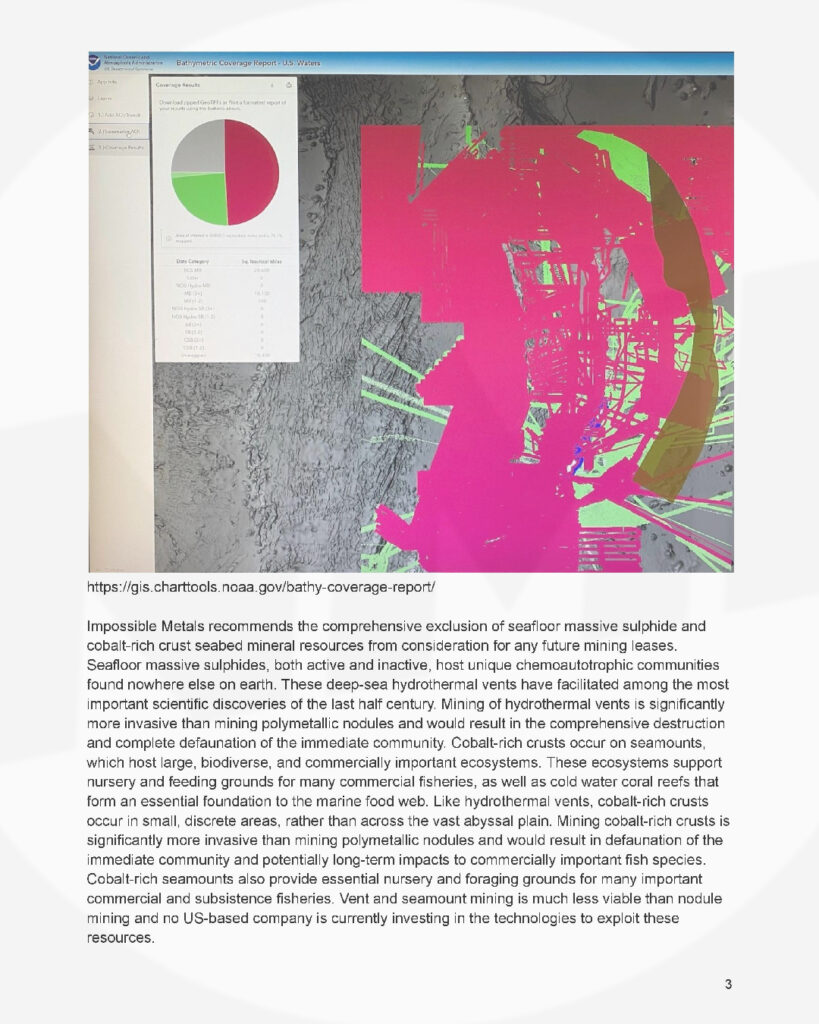
The BOEM Request for Information area east of the Marianas Trench National Monument covers about 143,595 square kilometers and 6,502 potential lease blocks, with the closest point roughly 128 miles east of Saipan.
Impossible Metals suggests an initial exploration tract of about 75,000 km², in line with International Seabed Authority contracts, or at minimum 25,000 km², and an eventual mining footprint of roughly 5 percent of that exploration area, which it calculates as less than one percent of the CNMI EEZ and about 0.05 percent of the overall U.S. exclusive economic zone.
Because seabed mining is a “first-of-its-kind” industry, the company supports BOEM’s idea of charging no rental payments for the first five years, while exploration and environmental studies take place.
Among its suggestions, Impossible Metals hopes to focus more on production royalties than on up-front rentals, set royalties at no more than 3 percent of revenues from processed minerals, with a lower rate such as 1.5-percent in the first five years of production, allow or require partial relinquishment of lease blocks (for example, 50-percent after five years) rather than high rentals, to prevent “land-grabbing,” and use an ascending oral auction with low minimum bids to encourage new entrants.
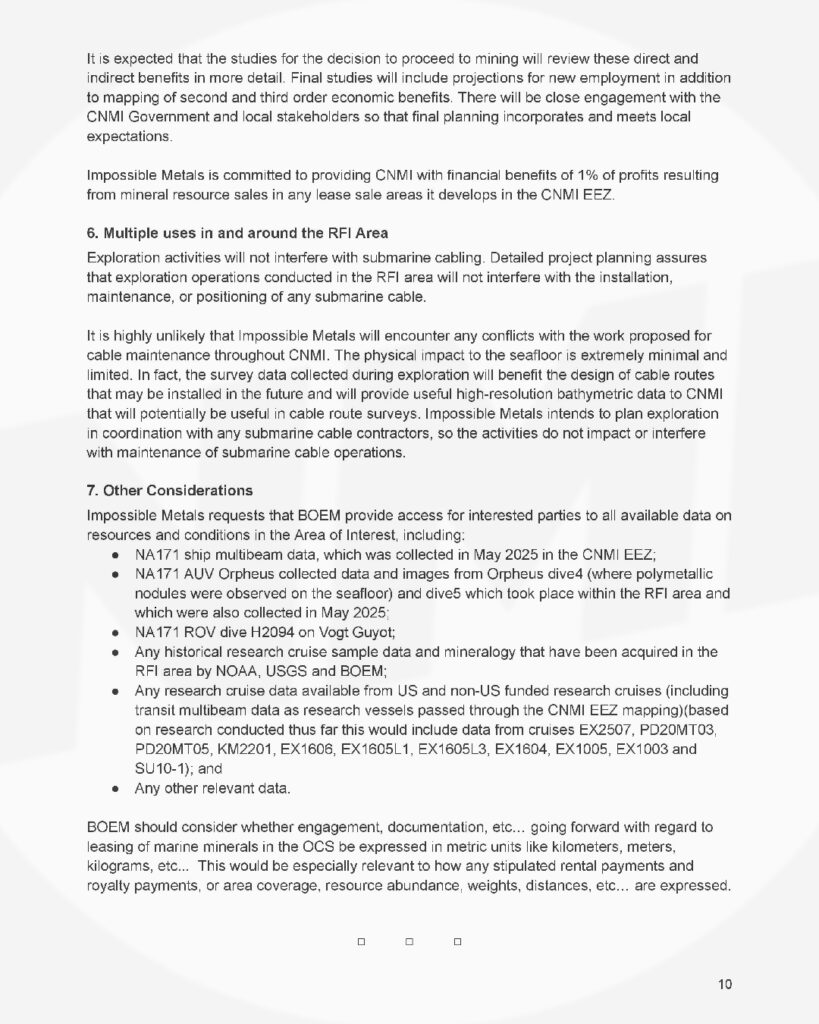
The company also asks BOEM to make existing mapping and research data from the CNMI offshore area publicly available to interested parties.
Impossible Metals frames the CNMI seabed as a strategic test case, saying a well-designed U.S. leasing program could “set the global environmental bar” while reducing dependence on foreign critical-minerals supply chains.
BOEM’s Request for Information is the first step in a longer process that would still require environmental impact statements, public consultation and additional federal decision-making before any commercial mining could be approved.