Congresswoman cites CNMI workforce shortages, hospital staffing crisis
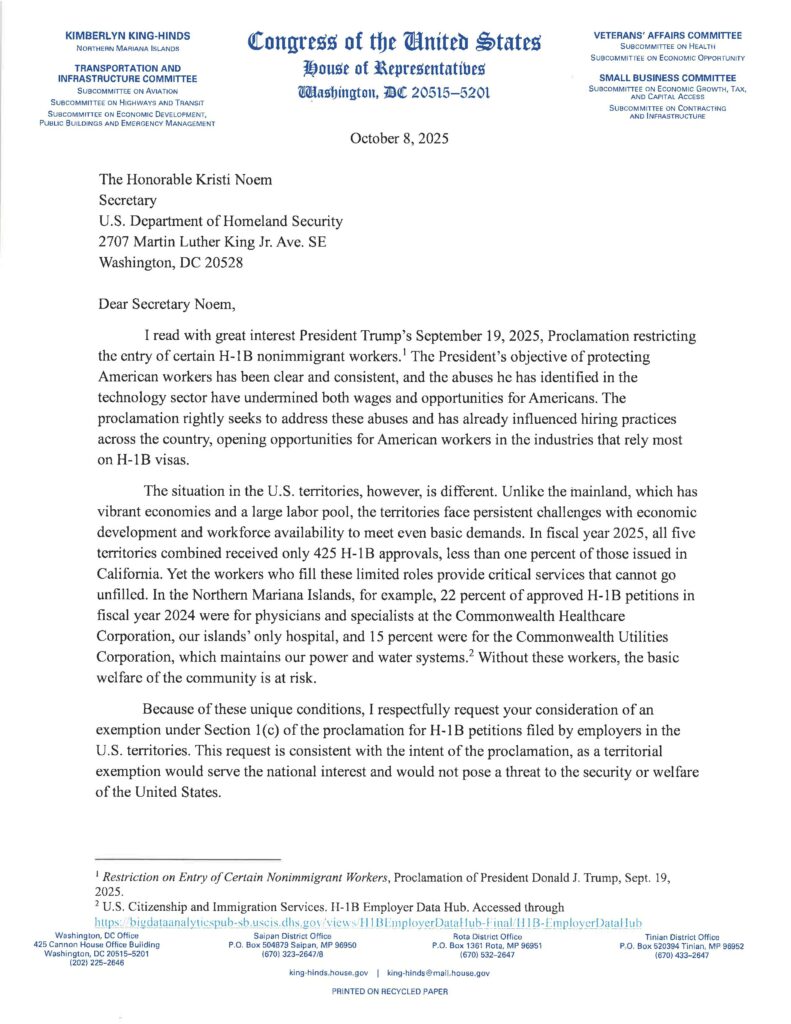
WASHINGTON, DC – Congresswoman Kimberlyn King-Hinds has called on the Department of Homeland Security to grant an exemption from President Trump’s September 19 proclamation restricting the entry of H-1B nonimmigrant workers, arguing that the U.S. territories face distinct economic and workforce challenges that justify special consideration.
In a letter to Homeland Security Secretary Kristi Noem, King-Hinds said that while the President’s order targets abuses of the visa system that harm American workers, the situation in the Northern Mariana Islands and other territories is markedly different.
“Without these workers, the basic welfare of the community is at risk,” she wrote, noting that in the CNMI, 22 percent of approved H-1B petitions in 2024 were for healthcare professionals at the Commonwealth Healthcare Corporation, and another 15 percent for the Commonwealth Utilities Corporation.
King-Hinds said these skilled workers fill essential roles that cannot otherwise be met locally. She emphasized that the CNMI’s limited labor pool and small economy make it difficult to recruit and retain critical staff in healthcare, power, and water operations.
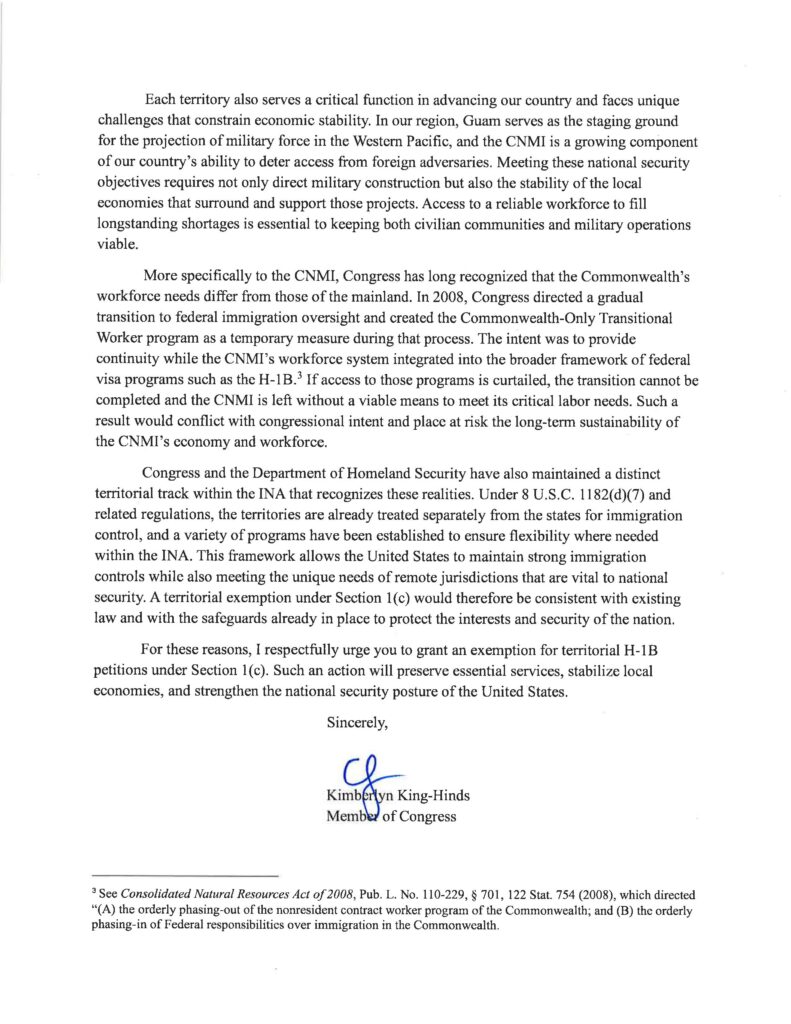
The congresswoman also linked the issue to national security, citing the CNMI’s role in supporting U.S. military readiness in the Western Pacific. She warned that limiting H-1B access would jeopardize the region’s stability and undermine congressional intent established under the Consolidated Natural Resources Act of 2008, which created the Commonwealth-Only Transitional Worker program to bridge the CNMI into the federal system.
King-Hinds urged DHS to use Section 1(c) of the proclamation to approve H-1B petitions from U.S. territorial employers, saying it would be consistent with existing law and in the national interest.
“Granting this exemption will preserve essential services, stabilize local economies, and strengthen the national security posture of the United States,” she concluded.