

SAIPAN — Congresswoman Kimberlyn King-Hinds said Wednesday the Northern Mariana Islands “deserves answers too” about American nuclear testing in the Pacific, welcoming the introduction of federal legislation that would order the first formal government study of whether radioactive fallout reached the CNMI and harmed its people.
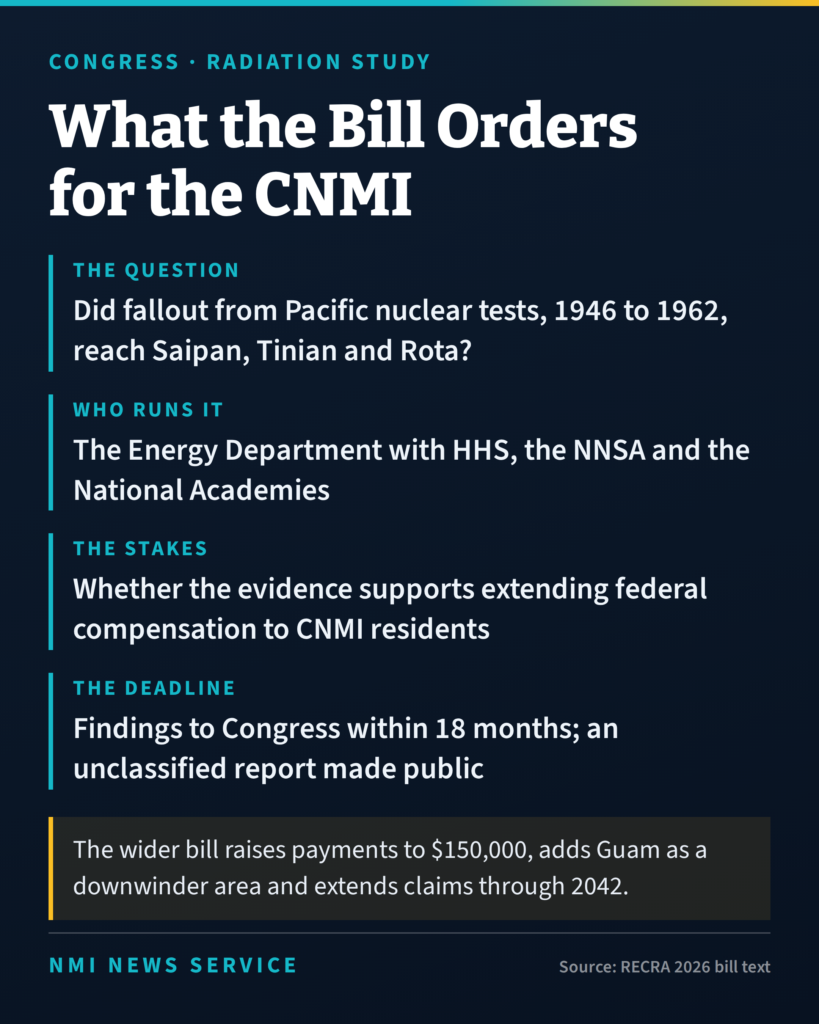
The Radiation Exposure Compensation Reauthorization Act of 2026, introduced by Guam Congressman James Moylan, directs the Department of Energy to determine the extent to which fallout from atmospheric nuclear weapons testing in the Pacific Proving Grounds, including the Marshall Islands, between 1946 and 1962 may have affected residents of the Commonwealth.
The study must be completed within 18 months of the bill becoming law. It would be conducted in consultation with the National Nuclear Security Administration, the Department of Health and Human Services and the National Academies of Sciences, Engineering and Medicine, and would review historical records, meteorological data, environmental monitoring, fallout modeling and declassified documents.
The bill requires the study to assess whether fallout reached inhabited areas of the CNMI, including Saipan, Tinian and Rota, evaluate the radiation doses residents may have received and the health risks associated with them, identify gaps in the historical record and determine whether the evidence supports extending federal radiation-exposure compensation eligibility to CNMI residents. An unclassified version of the findings must be made public on the Energy Department’s website.
King-Hinds said the issue came to her from the community.
“For decades, Pacific communities have lived with unanswered questions about the long-term consequences of America’s nuclear weapons program. The Northern Mariana Islands deserves answers too,” she said. “This issue was recently raised with me by members of our community who asked whether radioactive fallout from nuclear testing in the Pacific may have reached the Northern Mariana Islands and what that exposure could have meant for the health of our people. I want to give them credit for raising an important question that deserves to be examined.”
She said her office brought the CNMI’s concerns to federal partners after examining the issue.
“My responsibility as your Delegate is to listen when concerns are brought to me, look at the facts, and then determine what we can do about them. That is what we did here,” she said.
King-Hinds credited Moylan for the CNMI’s inclusion in the legislation.
“I am grateful to Congressman James Moylan for his partnership and for working with me to ensure the CNMI was included in this legislation. We should not presume what the science will tell us. But our people deserve to have the question asked, the history examined, and the research done,” she said. “This is how representative government should work: our community raises a concern, we listen, and then we get to work finding answers.”
As NMI News Service reported Wednesday, the broader bill would add Guam as a designated downwinder area, raise compensation payments to $150,000, cover documented out-of-pocket medical expenses, expand the list of compensable cancers and extend the program’s claim filing deadline to 2042. It also directs the National Institutes of Health to study cancer and thyroid illness rates among the descendants of people already compensated under the program, and funds a network of radiation screening and education clinics that would include at least one on Guam, with mobile units serving rural areas of eligible states and territories.