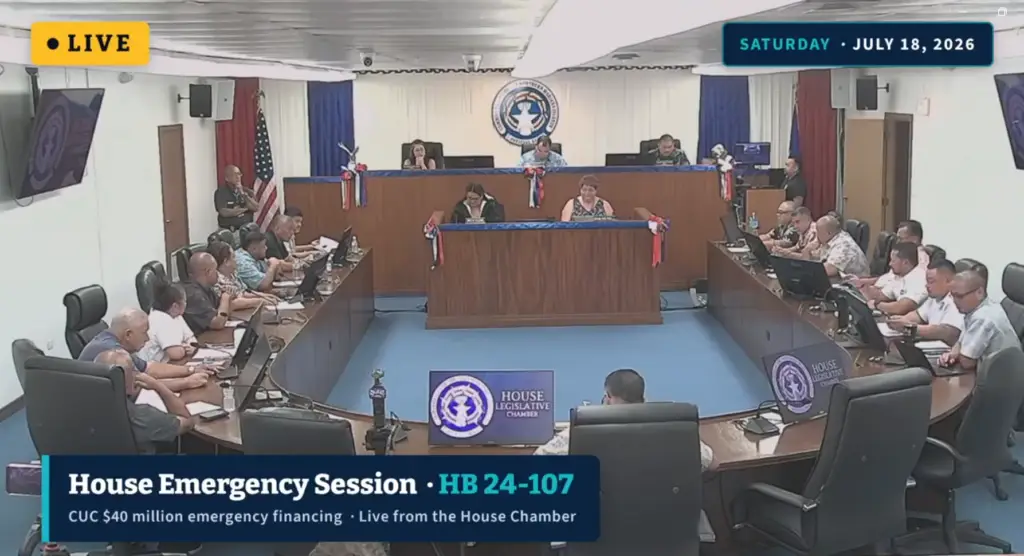




SAIPAN — The House of Representatives voted 20-0 Saturday to authorize the Commonwealth Utilities Corporation to borrow up to $40 million for typhoon recovery, passing House Bill 24-107 on first and final reading in an emergency session with every member signing on as a sponsor.
The bill, which authorizes emergency financing for utility restoration, stabilization and fuel procurement following Super Typhoons Sinlaku and Bavi, now heads to the Senate, which convenes Monday at 3:30 p.m. with the pension appropriation bill already on its final reading calendar. Both of the week’s major money bills will sit in the same Senate session.
Speaker Edmund S. Villagomez called the session, the first day of the Fourth Special Session, with the borrowing bill as the sole item of business. Members first voted 20-0 to declare that an emergency exists, citing the need to prevent disruption to essential utility services after the two storms. The bill was offered on the floor by Representative Ralph Yumul together with Representative Blas Jonathan Attao, Floor Leader Marissa Flores and Villagomez.
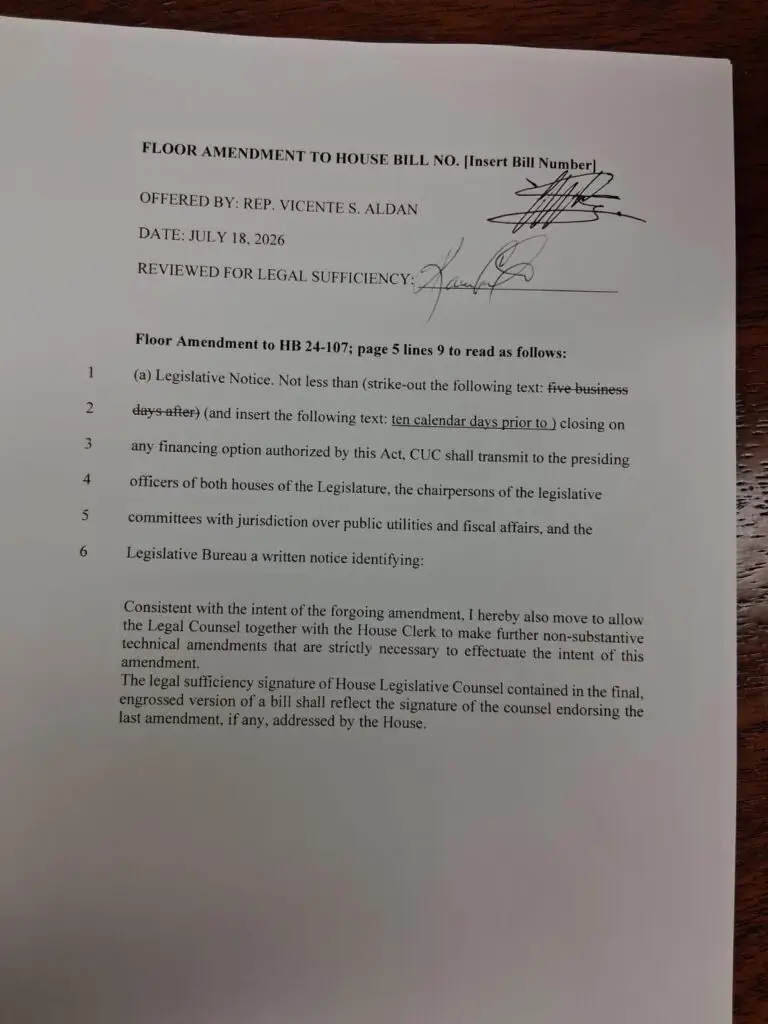
Representative Vincent R. Aldan, who last week demanded 20 sets of amendments and warned he would seek judicial review if the bill moved without ratepayer protections, instead voted yes after the House adopted his floor amendment by voice vote. The amendment requires CUC to transmit written notice to the presiding officers of both houses, the chairs of the committees with jurisdiction over public utilities and fiscal affairs and the Legislative Bureau not less than 10 calendar days before closing any financing authorized by the act.
The provision it replaced told the other side of the story. The introduced bill required notice five business days after closing. Aldan had demanded 20 business days before. The adopted version landed at 10 calendar days, with the direction reversed entirely.
On the floor, Aldan pressed his argument that customer security deposits cannot legally serve as loan collateral, citing the Commonwealth Code requirement that deposits be held in an interest-earning trust fund. He pointed to a 2008-era law that once let CUC borrow against half its deposits. “It was illegal then, and it’s illegal now,” he said. “That money doesn’t belong to the corporation.”
CUC Chief Financial Officer Betty Terlaje, testifying in support, gave the first official island-by-island accounting of the remaining outages. As of Friday night, more than 3,400 customers on Saipan, more than 125 on Tinian and approximately 1,000 on Rota, nearly the entire island, remained without electricity, a combined total of more than 4,500 homes, businesses, government operations and critical facilities. For many, she said, it has been more than 96 days without power.
“Disasters do not wait for reimbursement and neither can restoration,” Terlaje said, telling members that without financing CUC would eventually lack the cash to pay vendors, contractors, mutual aid partners and fuel suppliers, and could be forced to seek a future rate adjustment. She said security deposits would not be spent under the bill and would serve only as lender collateral while remaining in their restricted account, and that FEMA and other disaster reimbursements would generally be applied to pay down the loan.
Terlaje closed with a pointed message to “the chairman of the committee responsible for public utilities” to remember that CUC employees are also constituents. “Misinformation does not install a power pole,” she said. “It does not repair a generator. It does not reconnect a home.”
Executive Director Kevin O. Watson, whose internal memo cutting restoration crews to weekday hours for lack of funds was published by NMI News Service on Friday, urged passage and said he would take the steps necessary to meet the bill’s reporting and accountability obligations.
CUC board member Rebecca White, also testifying in support, cited NMI News Service’s interview with Congresswoman Kimberlyn King-Hinds in which the delegate said CNMI budgets have for years appropriated zero dollars for utility operations. “Stop the 20 year cycle,” White said. Board member Miranda V. Manglona of Rota and Saipan Chamber of Commerce Executive Director Kim Camacho also urged passage.
In debate, Representative Daniel Aquino called the financing a turning point rather than a blank check, then demanded CUC crews stop leaving wires and ceramic insulators behind after pole work. “These projectiles can actually hurt somebody or kill somebody,” he said. Representative Julie Ogo, just back from Rota, told members her island is at zero percent energization. “We’re in the dark,” she said. Flores said she could not sacrifice the residents, hospital and schools of her precinct still waiting for power, and other members spoke at length in support.
Attao, who said the legislation had been negotiated between House and CUC counsel for months, moved that the bill be co-sponsored by the Committee of the Whole, and with no objection the clerk recorded House Bill 24-107, House Draft 1, as sponsored by all 20 members. He said CUC did not challenge the Aldan amendment and told colleagues the corporation “has their fingerprints all over this legislation.”
Yumul said he had wanted to pass the bill unamended but accepted the compromise to bring every member aboard, and said he hoped the Senate acts swiftly Monday.
Under miscellaneous business, Flores raised a separate recovery issue, saying conflicting guidance has emerged over residency declarations supporting FEMA applications and calling on the agency to immediately clarify and standardize its requirements.