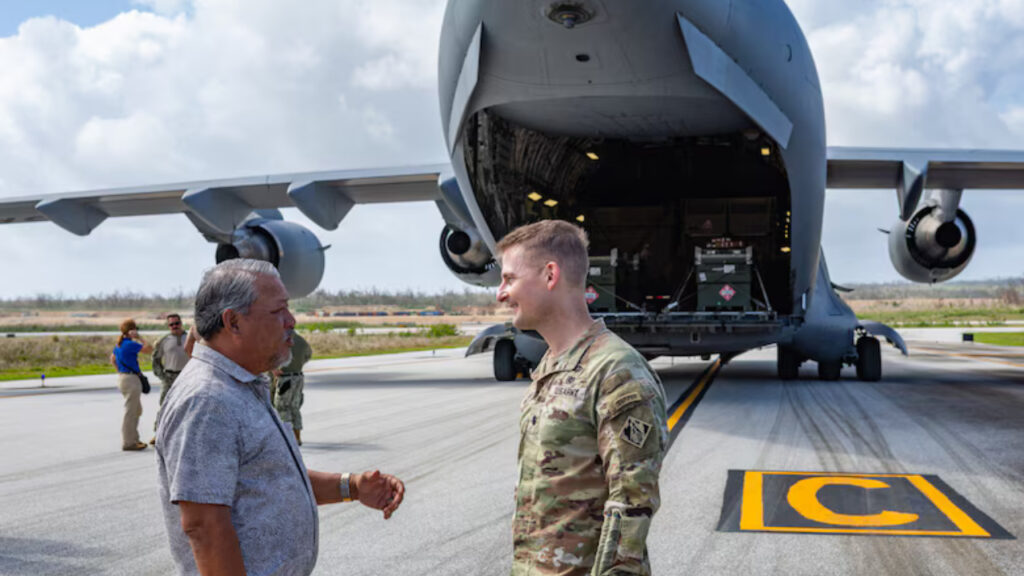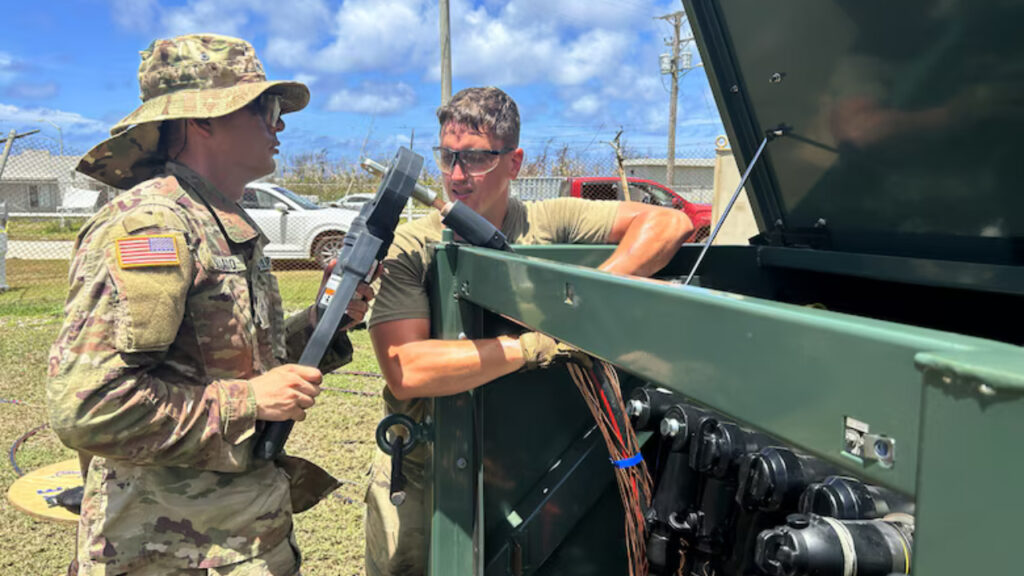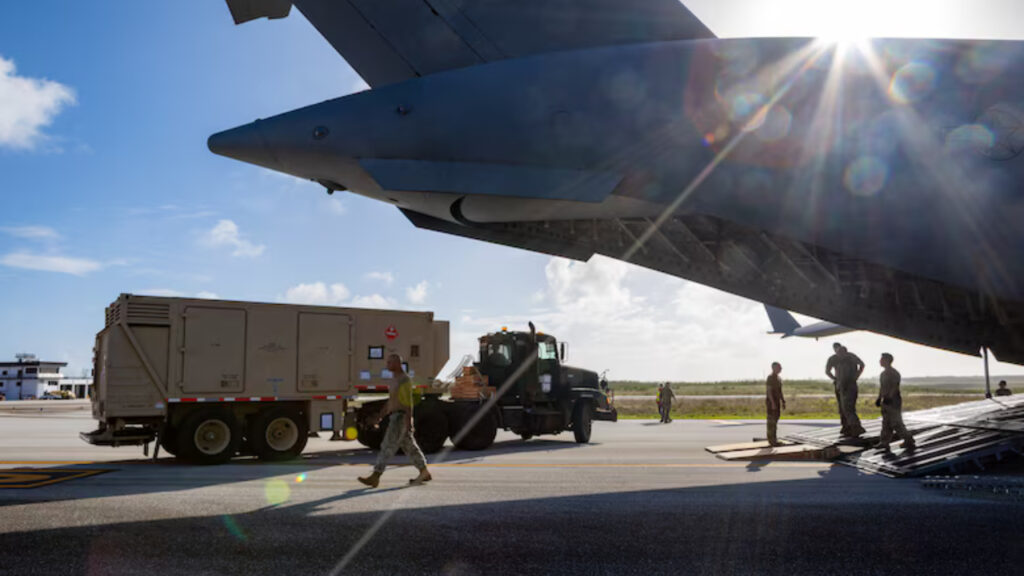
SAIPAN — The U.S. Army Corps of Engineers, Honolulu District, and the Army’s 249th Engineer Battalion (Prime Power) delivered sustained temporary large-scale generator power to the Tinian grid on May 28 at the direction of FEMA, providing interim electricity in the aftermath of Super Typhoon Sinlaku while permanent power is restored.
The storm critically damaged Tinian’s power plant, making generator power necessary to keep electricity flowing to residents and critical facilities. The Mobile Electric Power generators delivered, known as MEP 810D systems, are medium-voltage power systems capable of interfacing directly with Tinian’s electrical grid at about 4,160 volts. Their arrival required extensive coordination to move personnel, generators, heavy equipment and support materials to Tinian through a combination of military airlift and sealift.
Unlike traditional emergency generators that power individual facilities, the 249th Engineer Battalion’s Prime Power systems are designed to support community-scale electrical distribution across portions of the island’s grid. Before Super Typhoon Sinlaku, Tinian’s peak electrical demand was slightly below three megawatts, and the temporary systems are intended to provide enough generation capacity to support current recovery needs while permanent repairs continue.
Governor David M. Apatang said the mission showed what recovery looks like when local, federal and military partners act with urgency. “Restoring reliable electricity is critical to the health, safety, and recovery of the people of Tinian,” he said, expressing gratitude to FEMA, USACE and other partners.
Tinian Mayor Edwin Aldan said the restoration of power meant more than electricity returning to homes. “It represents hope, stability, and an important step toward recovery after the hardships brought by Super Typhoon Sinlaku,” he said. Aldan said power allows families to safely return to daily routines, preserve food and medicine, reconnect with loved ones, and begin rebuilding, while letting businesses reopen and essential services continue.
FEMA Federal Coordinating Officer Andrew Grant said the mission represented a whole-of-government partnership. “Every agency involved is working toward the same goal: helping the community recover as quickly and safely as possible,” he said.
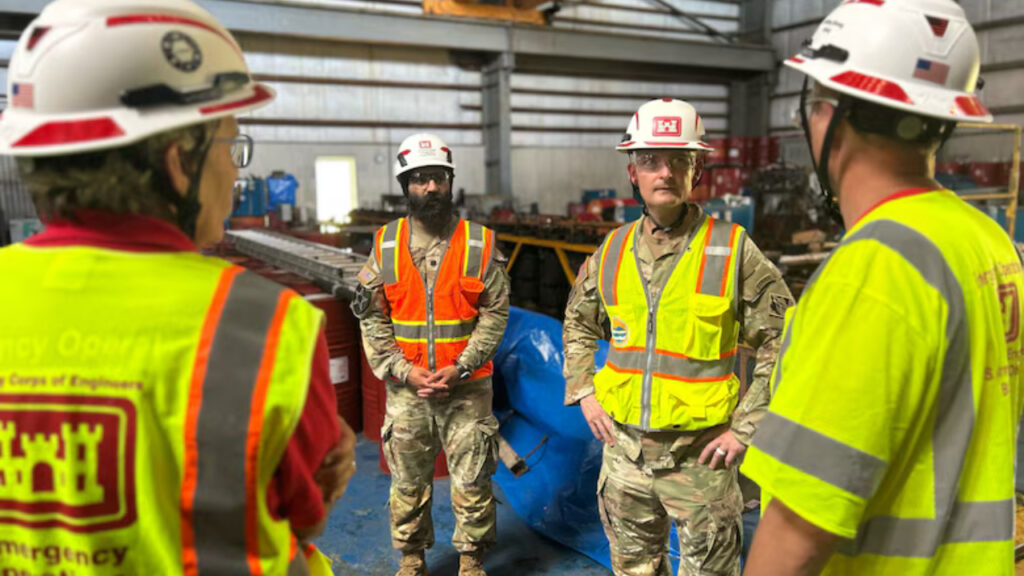
Lt. Col. Simratpal Singh, commander of the USACE Sinlaku Recovery Field Office, called the installation an example of interagency cooperation. He said the mission required partnership with FEMA, the offices of the CNMI governor and Tinian mayor, the Commonwealth Utilities Corporation, and Department of War teams across the Army, Navy and Air Force.
Battalion Commander Lt. Col. Donnie Schmidt said the mission demonstrated what the 249th Engineer Battalion was built to do. “Our Soldiers are delivering expeditionary power generation under complex conditions to help restore electricity to the people of Tinian,” he said.
Before any electricity entered the grid, teams conducted extensive setup, testing and commissioning in coordination with CUC, FEMA and technical experts to ensure the system could safely accept power. Officials emphasized that safety remained the top priority, noting that storm-damaged wiring and electrical faults inside homes and businesses can create fire hazards even when the larger grid is capable of receiving power. Local officials coordinated with residents on safety requirements before reconnecting power.
CUC Executive Director Kevin Watson said the temporary mission gives the utility time to safely assess and repair permanent infrastructure. “Synchronizing temporary generation with an island power grid is a highly technical process,” he said, adding that CUC is working with USACE and FEMA to restore power safely, reliably and sustainably.
USACE is also supporting broader technical coordination involving supplemental generation on Tinian, including evaluations and changes related to standby generators at the former Voice of America facility, in coordination with Naval Facilities Engineering Systems Command and other partners. Adding the NAVFAC generation requires careful synchronization with the MEP systems to maintain grid stability.
Officials said the grid power mission is an interim emergency solution to stabilize the island’s electrical system while long-term repairs move forward, reflecting USACE’s Emergency Support Function #3 role of temporarily supporting critical public works so local governments and utilities can focus on permanent recovery.
“This milestone would not have been possible without the tireless dedication and partnership of so many individuals and organizations working around the clock to support Tinian’s recovery,” Aldan said. On behalf of the people of Tinian and Aguiguan, he extended gratitude to CUC, emergency responders, military personnel, contractors, volunteers, and federal and local partners.
Photos courtesy US Army.