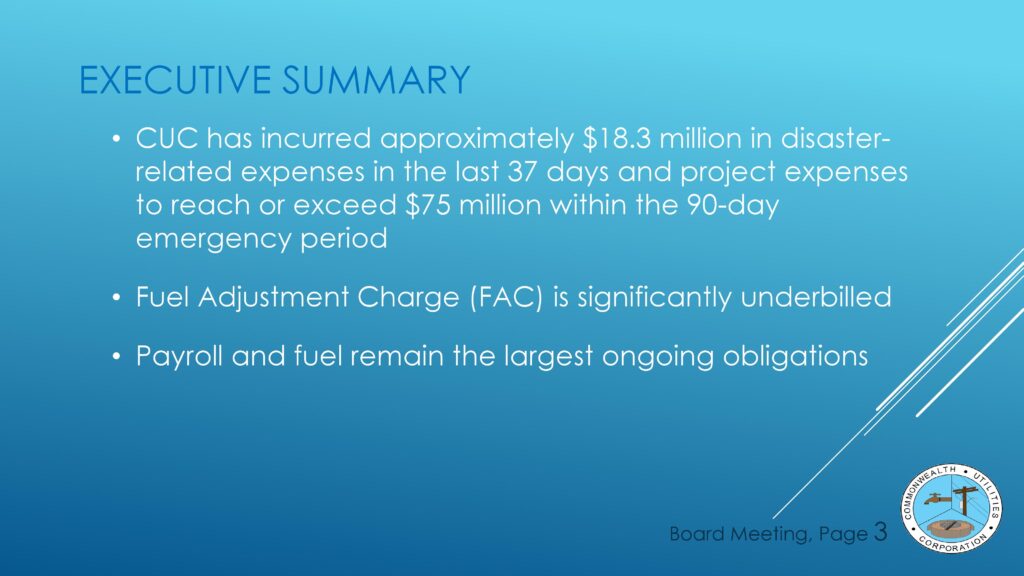
SAIPAN – Commonwealth Utilities Corporation has incurred approximately $18.3 million in disaster-related expenses in the 37 days since Super Typhoon Sinlaku and projects total expenses will reach or exceed $75 million within the 90-day emergency period, according to a financial update presented Thursday by CUC Chief Financial Officer Betty Terlaje.
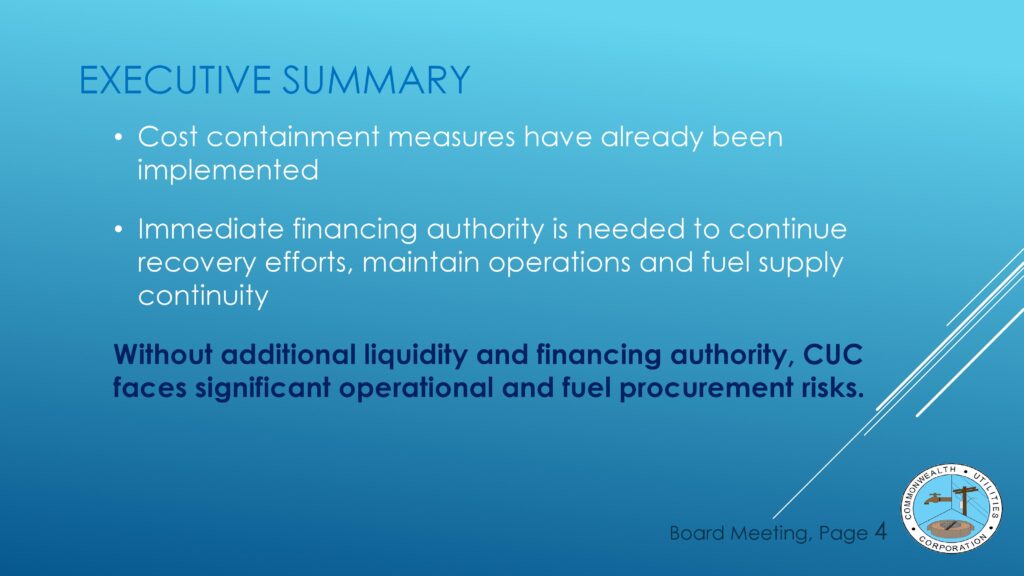
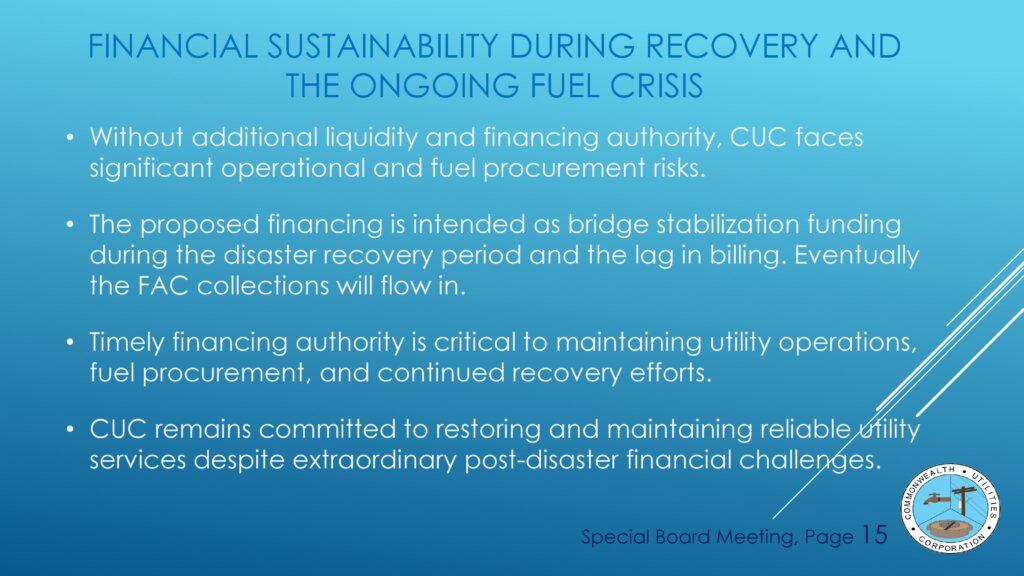
The presentation, delivered to the CUC Board of Directors during a special board meeting, warns that without additional liquidity and financing authority, CUC faces significant operational and fuel procurement risks.
“Every time we energize a customer we are taking a loss,” Terlaje said during the presentation.
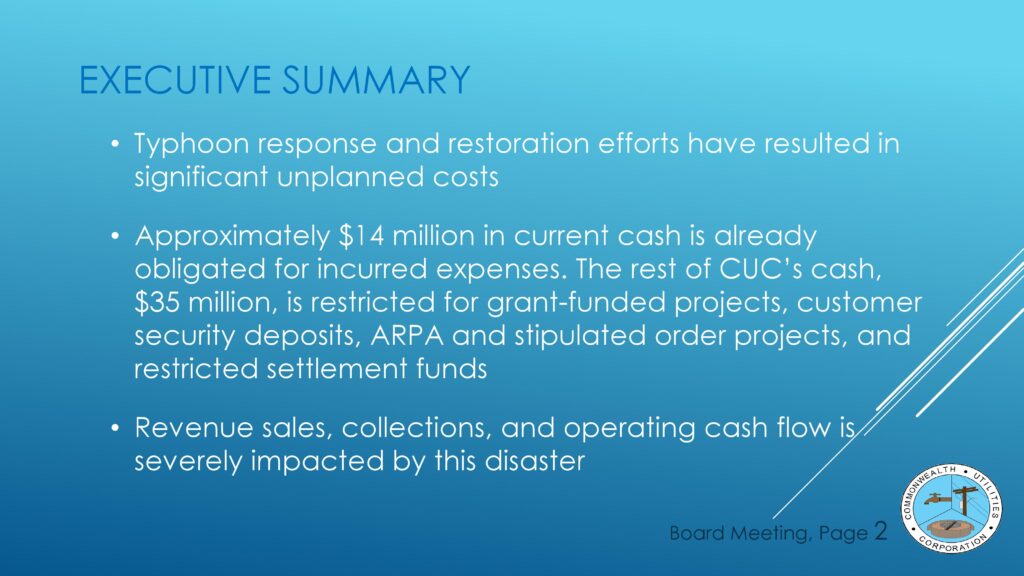
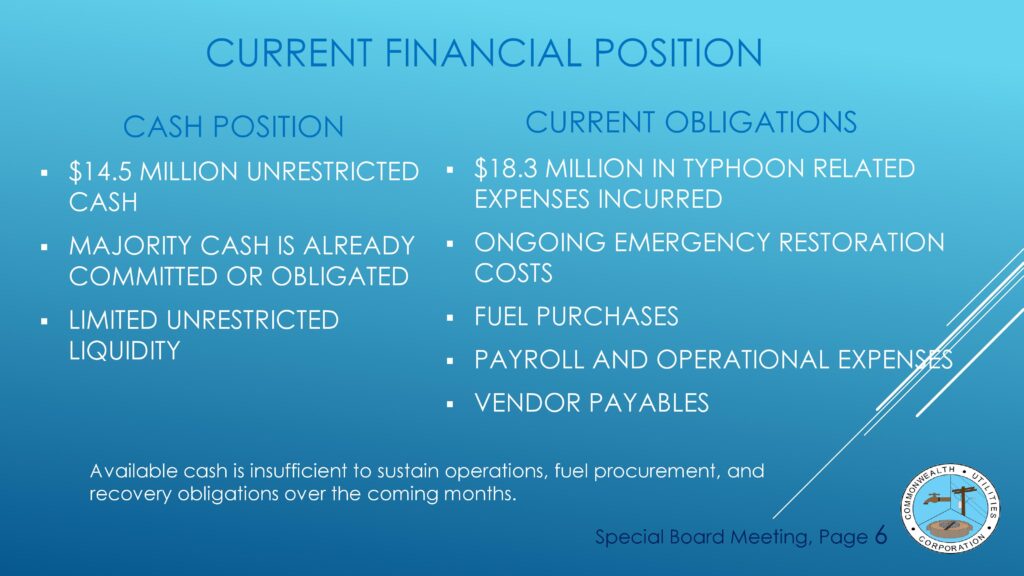
The utility holds approximately $14.5 million in unrestricted cash, the majority of which is already committed or obligated for incurred expenses, according to the presentation. Another $35 million in cash is restricted for grant-funded projects, customer security deposits, American Rescue Plan Act and stipulated order projects, and restricted settlement funds, and cannot be drawn down without authorization, the presentation said.
“Available cash is insufficient to sustain operations, fuel procurement, and recovery obligations over the coming months,” the presentation said.
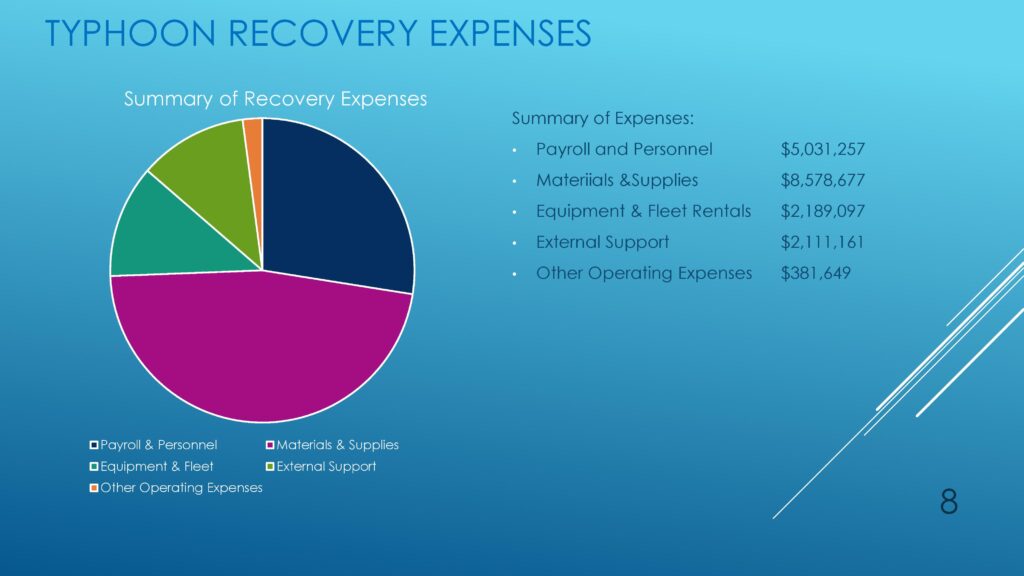
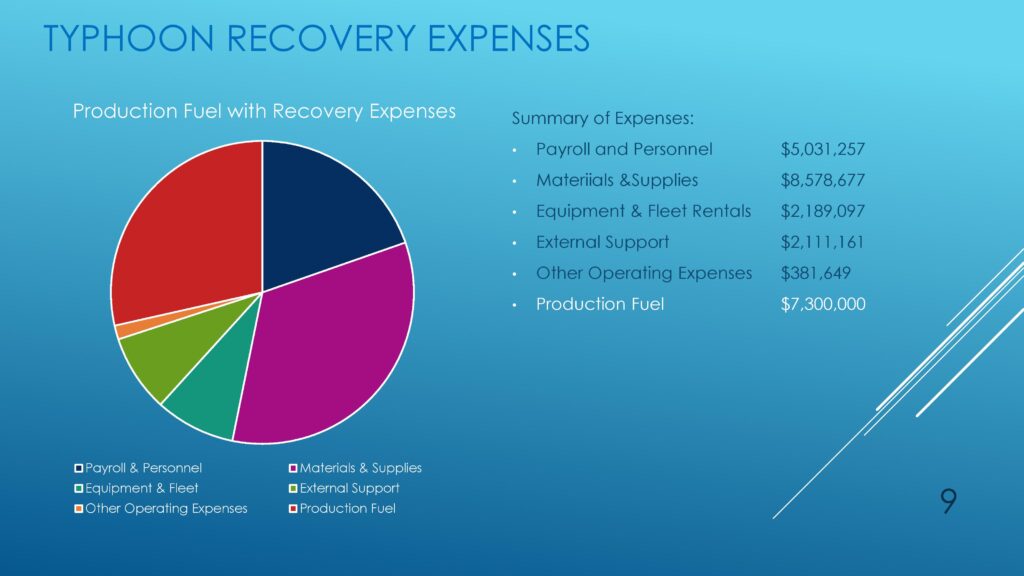
Recovery expenses to date break down as $8.58 million for materials and supplies, $7.3 million for production fuel, $5.03 million for payroll and personnel, $2.19 million for equipment and fleet rentals, $2.11 million for external support, and $381,649 for other operating expenses, according to the presentation.
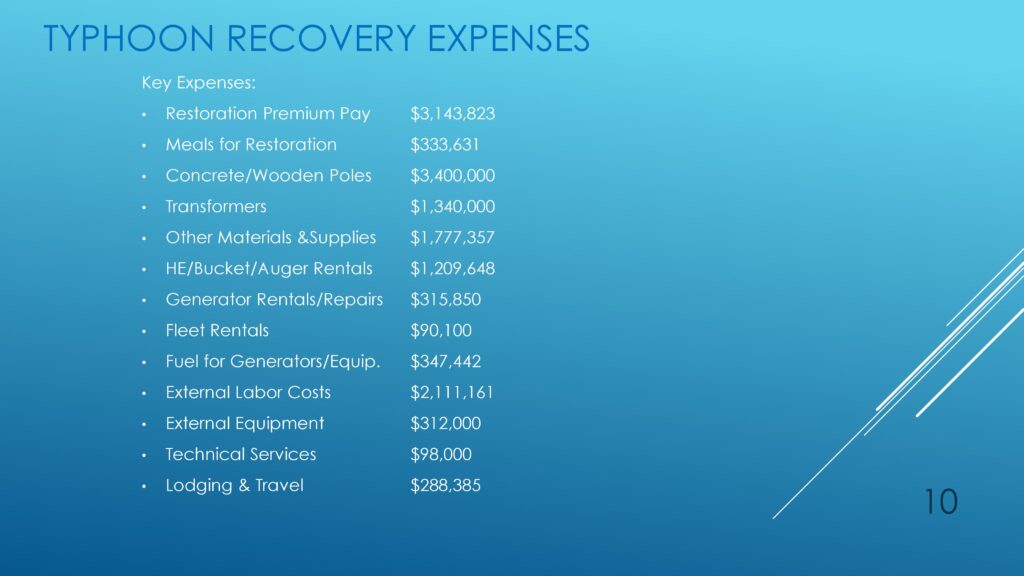
Within those categories, the largest individual line items are $3.4 million for concrete and wooden poles, $3.14 million in restoration premium pay, $2.11 million in external labor costs, $1.78 million in other materials and supplies, $1.34 million for transformers, and $1.21 million in heavy equipment, bucket, and auger rentals.
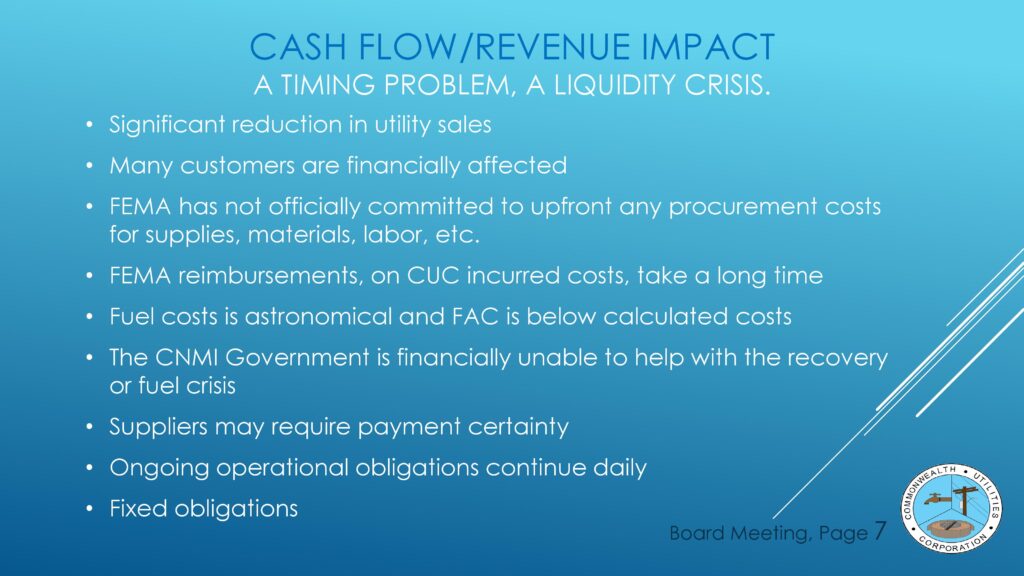
The presentation characterizes CUC’s situation as a timing problem and a liquidity crisis driven by multiple compounding factors. Utility sales have dropped significantly because many customers are without power and many others are financially affected by the storm, the presentation said. The Federal Emergency Management Agency has not officially committed to fronting any procurement costs for supplies, materials, or labor, and reimbursements on costs CUC has already incurred take a long time to arrive, the presentation said. Fuel costs are astronomical and the Fuel Adjustment Charge is below calculated costs, leaving CUC underbilled, the presentation said. The CNMI government is financially unable to help with the recovery or the fuel crisis, the presentation said.
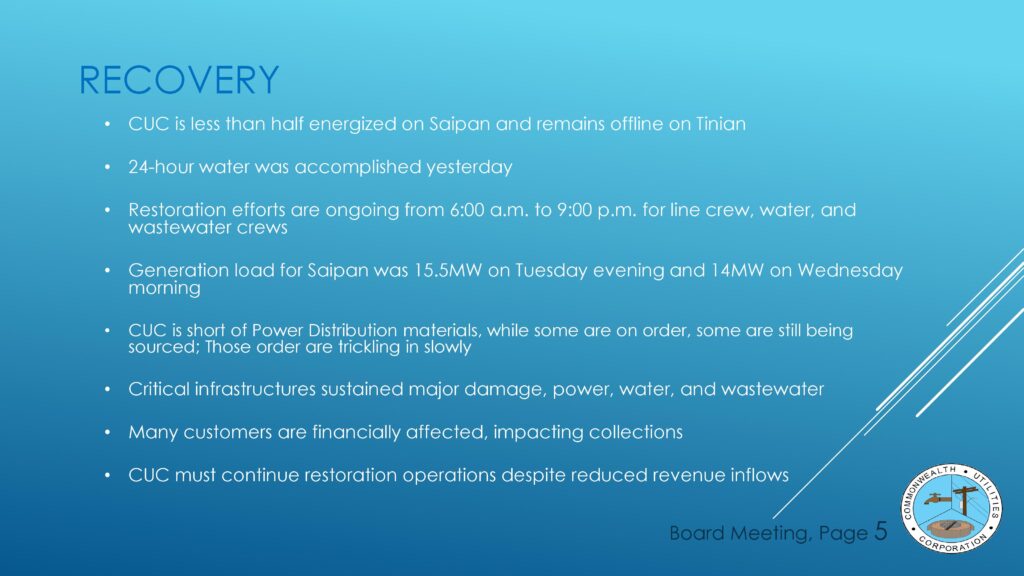
On recovery operations, the presentation reported CUC is less than half energized on Saipan and remains offline on Tinian. 24-hour water service was restored Wednesday. Restoration crews for line, water, and wastewater are working from 6 a.m. to 9 p.m. Generation load for Saipan was 15.5 megawatts Tuesday evening and 14 megawatts Wednesday morning. CUC remains short of power distribution materials, with some orders in transit and others still being sourced, the presentation said. Critical infrastructure sustained major damage to power, water, and wastewater systems.
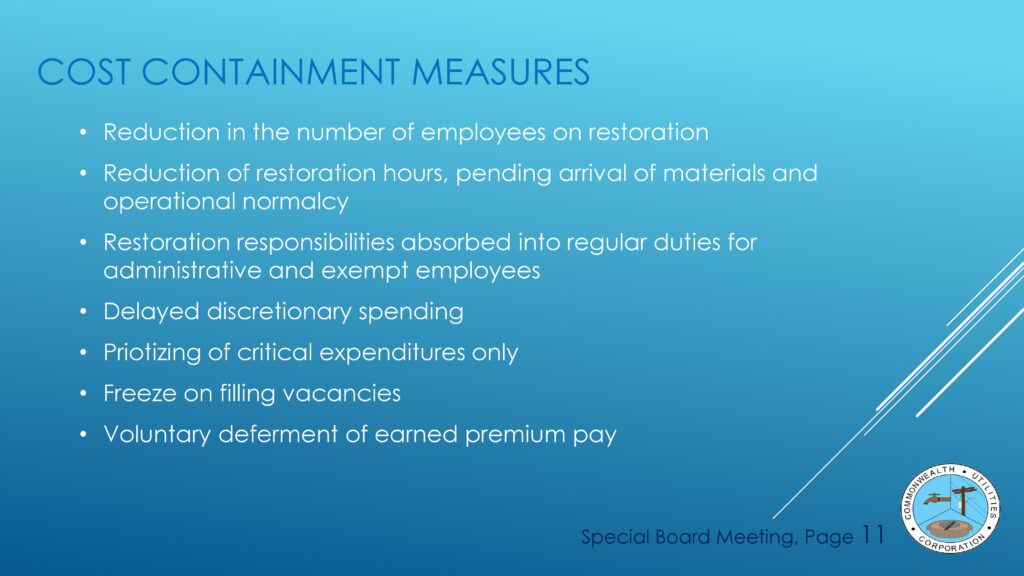
The presentation said CUC has already implemented cost containment measures including a reduction in the number of employees on restoration, a reduction of restoration hours pending the arrival of materials, restoration responsibilities absorbed into regular duties for administrative and exempt employees, delayed discretionary spending, prioritization of critical expenditures, a freeze on filling vacancies, and voluntary deferment of earned premium pay.
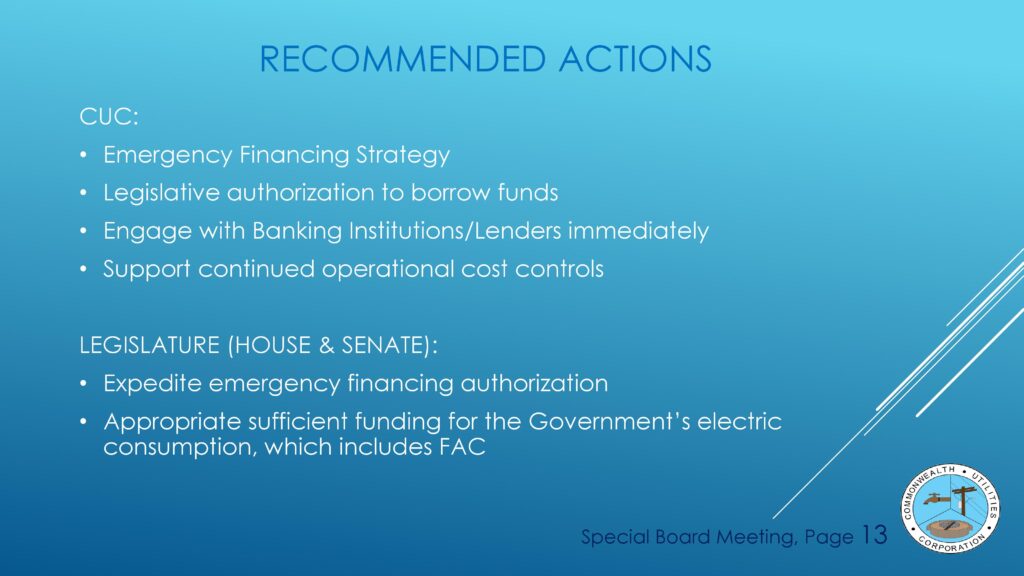
The presentation recommends CUC pursue an emergency financing strategy that includes legislative authorization to borrow funds, immediate engagement with banking institutions and lenders, and continued operational cost controls. From the Legislature, the presentation asks the House and Senate to expedite emergency financing authorization and to appropriate sufficient funding for the government’s electric consumption, which includes the FAC.
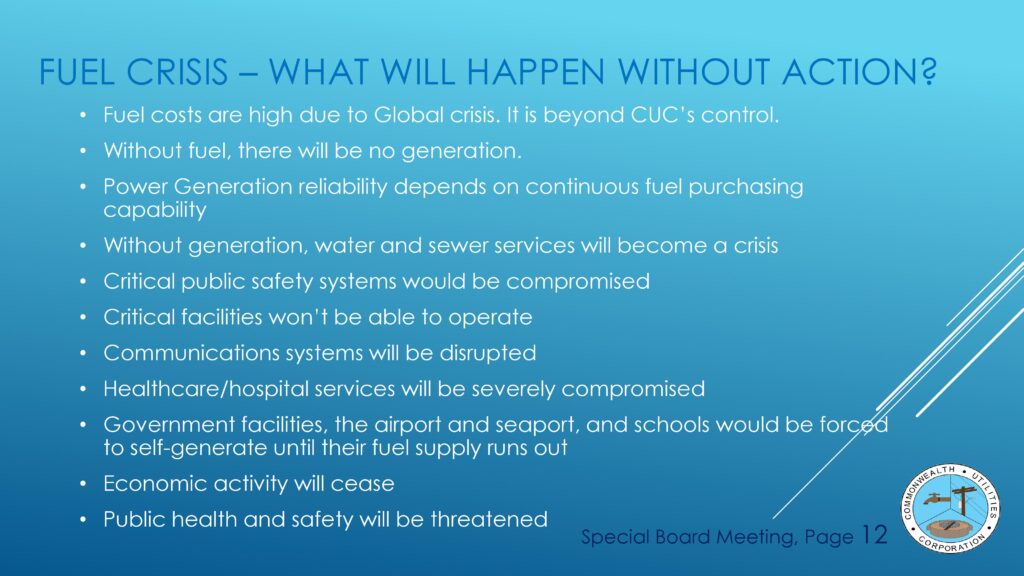
The presentation warned that without action, the consequences of a fuel shortage would cascade across the CNMI. “Without fuel, there will be no generation,” the presentation said. “Without generation, water and sewer services will become a crisis.” Critical public safety systems would be compromised, critical facilities would not be able to operate, communications systems would be disrupted, and healthcare and hospital services would be severely compromised, the presentation said. Government facilities, the airport, the seaport, and schools would be forced to self-generate until their fuel supply ran out, the presentation said. Economic activity would cease, and public health and safety would be threatened.
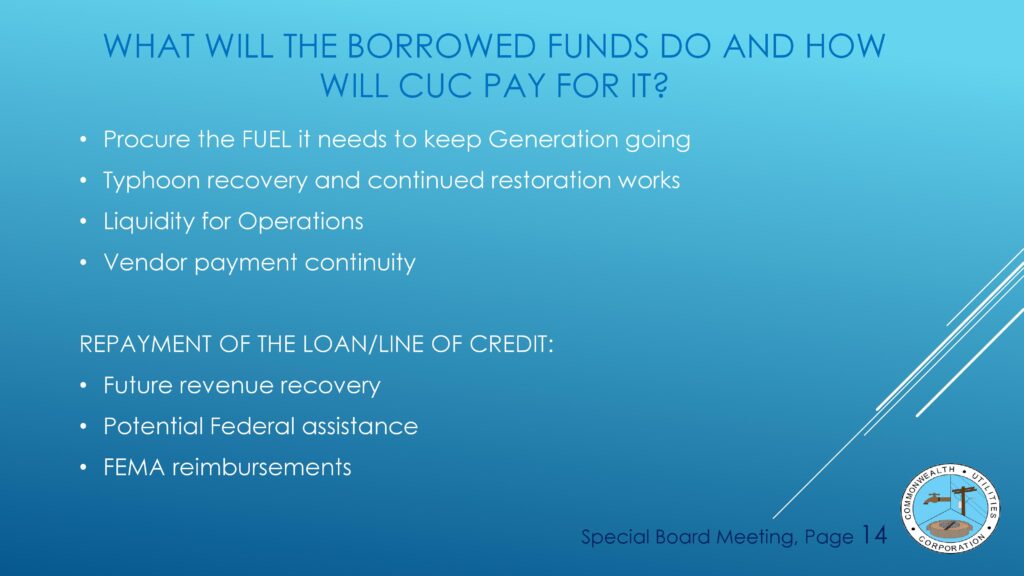
Borrowed funds would procure fuel to keep generation going, fund typhoon recovery and continued restoration, provide liquidity for operations, and maintain vendor payment continuity, the presentation said. Repayment would come from future revenue recovery, potential federal assistance, and FEMA reimbursements.
“The proposed financing is intended as bridge stabilization funding during the disaster recovery period and the lag in billing,” the presentation said. “Eventually the FAC collections will flow in.”
“CUC remains committed to restoring and maintaining reliable utility services despite extraordinary post-disaster financial challenges,” the presentation said.