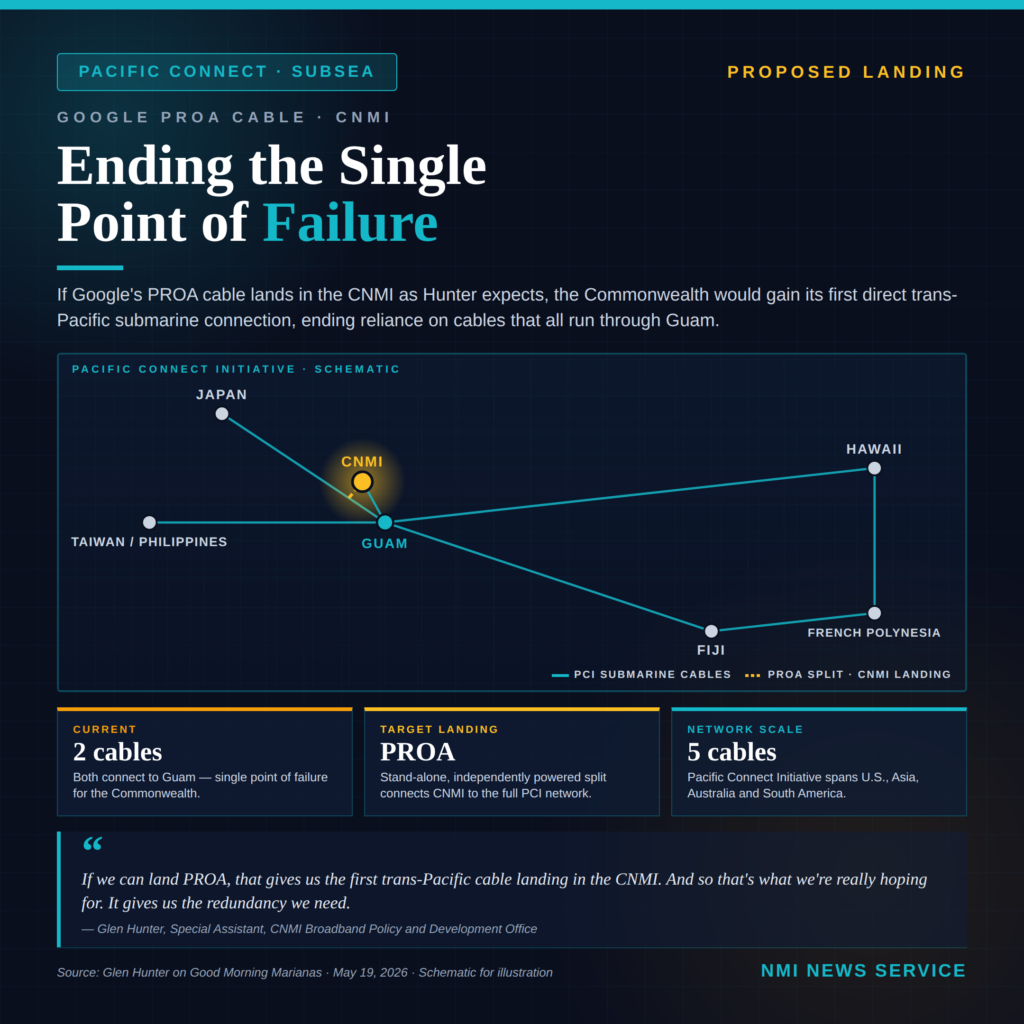
SAIPAN – The Commonwealth is working to land a Google trans-Pacific submarine cable in the CNMI by late 2026 or early 2027, a connection that would end the islands’ reliance on cables that all run through Guam, Broadband Policy and Development Office Special Assistant Glen Hunter said Tuesday on Good Morning Marianas.
Hunter said the Commonwealth has signed a memorandum of understanding with Google to advance the landing of the PROA cable, part of the company’s Pacific Connect Initiative, in the CNMI. The cable runs from Japan and currently lands in Guam. Under the arrangement Hunter described, Google would split the landing so that the PROA also touches down in the CNMI, giving the Commonwealth its first trans-Pacific submarine cable connection.
The CNMI currently connects to the rest of the world through two submarine cables that both terminate in Guam, the Marianas-Guam cable and the Atisa cable. Hunter said that arrangement creates a single point of failure for the Commonwealth, as demonstrated in 2014 and 2015 when a severed cable cut off connectivity, disrupting credit card transactions, landline service and other communications.
Late Governor Arnold I. Palacios wrote to the U.S. Secretary of State early in his administration about the connectivity vulnerability, Hunter said. That outreach helped catalyze federal interest in Pacific submarine cable redundancy, including a feasibility study for what was then called Connect Pacific.
Google’s Pacific Connect Initiative now includes five major cable systems that interconnect the United States, South America, Australia, Singapore, Taiwan, Japan and the Philippines in what Hunter described as a “box and cross” pattern designed for resilience. If one cable is severed, traffic can be rerouted through the network. Other cables in the initiative, including TPU and Bulikula, are also being explored for possible split landings in the CNMI, Hunter said.
The PROA landing remains a work in progress, Hunter said. He acknowledged that costs across the broader Pacific Connect network have escalated and that the global system as a whole may now run into the tens of billions of dollars, creating pressure points across the project. Super Typhoon Sinlaku has also been a factor, he said.
Hunter said the project’s strategic value goes beyond redundancy. With end-to-end fiber under construction across Saipan, Tinian and Rota through the federal Broadband Equity, Access and Deployment program, and a trans-Pacific cable landing in place, he said the CNMI would be positioned to compete for data center development and digital economy investment.
“We built the ballpark, now come and play ball,” Hunter said.
He pointed to Singapore and Hong Kong as historical examples of small jurisdictions that became regional digital hubs by investing early in connectivity infrastructure.
Guam currently has roughly 14 to 16 submarine cables landing on the island and has developed into a regional data center hub, Hunter said. The CNMI’s pitch would be redundancy.
“Should they encounter some catastrophic storm or something of that nature, the Marianas, the CNMI, is also part of the U.S. and we also will have the similar connectivity options,” he said. “And we’re just a stone’s throw from Asia, which is a big market to a lot of the people that are storing data.”
Hunter said he is hopeful for a PROA landing toward the end of 2026 or early 2027. He plans to provide further updates as the project progresses.